“Practically perfect in every way.” – It’s an exaggeration, but not much of one. Sherman Brothers finest moment seals the deal on a classic.
Spoiler-free Movie Review of Mary Poppins:
To save time, I’m going to list all the problems with this movie first – because there really aren’t many:
The actors are wearing more makeup than seems possible. It looks like they wandered in from a black & white silent film and the makeup artists didn’t know it was 1964.
The whole “I Love To Laugh” sequence with the gifted character actor Ed Wynn, while very good, is wholly unnecessary and adds to the run time of an already long film. It’s an extra adventure that doesn’t fit in with the rest of the storyline. It should have been excised and the story would have been much more streamlined.
When Jack Warner passed over Julie Andrews for the film version of My Fair Lady (which she had been starring on Broadway) in favor of Audrey Hepburn it freed her up for Walt Disney to cast her in her first film performance. That’s not the problem. The problem is that Andrews got the Best Actress Oscar over Hepburn, for which I call shenanigans. Andrews is masterful in this picture, but I don’t believe her performance was better than Hepburn’s. I wonder if Andrews got the edge because she did her own singing (Audrey was looped) or out of sympathy for not landing the Eliza Doolittle role she had made famous. Or maybe someone wanted to show up Jack Warner. In any event, it’s sort of like arguing between best Beatles albums, since they are both magnificent…
Of course, that I’m classifying the beating out Audrey for an award a problem shows just how deep I have to dig for any real criticism of the picture. (Note: I didn’t include Dick Van Dyke’s truly dreadful cockney accent because it’s one of those things that’s so bad it’s almost good. Not only that, it surely convinced filmmakers Albert Broccoli & Ken Hughes that he should just skip the English accent for Chitty Chitty Bang Bang entirely, so there’s that.) The story of bringing author P.L. Travers’s character to movie screens is famously if rather inaccurately chronicled in the feature film Saving Mr. Banks, but even before that picture it was interesting stuff, with Disney’s struggles with Travers being legendary. In the end, they both were probably right in their instincts; Travers was rightfully protective of her work if possibly too attached to recognize how much Disney’s influence could do for her character – Disney and company made a few major missteps with the characters while simultaneously adding immeasurable benefits in the adaptation. It really is a tremendous picture. The plot doesn’t need repeating, as probably everyone has seen the film at some point in the past 50 years, suffice it to say that it’s a classic story, based loosely on the first Mary Poppins novel with some of the second in there. You can’t call any 139 minute film streamlined and it certainly isn’t – it could probably do with a haircut, but at that time many pictures were longer. (Although there’s no official intermission in the movie, there probably should have been and many theaters took it upon themselves to add one anyway.) The acting is over the top as only 1960’s movies can be, but that doesn’t mean it isn’t wonderful. I find the whole picture lacking in subtlety and at times it’s hard to shake the impression that everyone is yelling at you. Your enjoyment of the film likely depends on your feelings on Julie Andrews’ performance. It’s a bit much for me personally, but unquestionably excellent and star-making. Van Dyke is simply wonderful in the picture – one of the all-time great physical actors. David Tomlinson turns in a great performance that works much better the older you are. The film as a whole possesses that quality of being layered and like many great films you take away different things at different times of your life. The music is a complete triumph, the high point in the career of the Sherman Brothers. No wonder they were asked to essentially make it twice with Chitty Chitty Bang Bang. Mary Poppins would prove to be one of the biggest hits of Walt Disney’s filmmaking career and is regarded by many as his greatest film. It is marvelous.
Poster:
Trailer:
Bechdel Test:
Pass
The Representation Test Score: B (9 pts)
(http://therepresentationproject.org/grading-hollywood-the-representation-test/) [schema type=”movie” url=”http://movies.disney.com/mary-poppins” name=”Mary Poppins” description=”A magic nanny comes to work for a cold banker’s unhappy family.” director=”Robert Stevenson” actor_1=”Julie Andrews” actor_2=”Dick Van Dyke”]
Despite this site being comprised primarily of movie reviews, it initially was to feature music reviews and appreciation. The name of this website, Now Very Bad, is actually taken from a musician joke*.
I hope to expand on the musical focus of this site, and I’m starting right now with the first in a series on bass players: Now Very Bass. (Bass is my chosen instrument…)
To kick off the series, I’m going to spotlight a bassist who is currently on his Final Tour with the band that made him famous and is one of my first influences: Nikki Sixx.
Now Very Bass: NVB#01 Nikki Sixx (Mötley Crüe, Sixx:A.M.)
From their start in the early 1980’s, Motley Crue was one of the loudest, hardest rock bands around. A large part of the driving rhythm of the band was provided by bassist Nikki Sixx. Of course, in the early days, Sixx attracted attention more for his on-stage antics, such as lighting himself on fire, than for his fretwork. And while the showmanship continues to be a huge part of the stage show over thirty years later, the same solid rhythm section that holds the band together today was already evident on the early records.
Sixx’s playing style is similar to many hard rock bassists of the time, known for being more sturdy than flashy. Mostly lives in the groove with a fairly typical hard rock / metal focus on pumping the root. It helps that his partner is one of the finest rock drummers out there, Tommy Lee. Like AC/DC before them, the simplicity of the music on paper can lead to the impression that anyone can play it. Sure, you can hit all the notes, but that driving beat is a deceptively difficult thing to do well. Anyone who has been in a new band can attest to that.
The self-produced debut album, Too Fast For Love, released in November 1981, may be more notable for Sixx’s writing than his bass playing. Sixx has always been a songwriter first, probably part of the selfless commitment to the songs over any showy playing. The record is rough around the edges, even after being remixed by Roy Thomas Baker, but the raw energy of the songs makes it a classic. Check out Live Wire, Public Enemy #1 or the title track.
For the band’s second album, Shout At The Devil, the songwriting is improved and the overall sound is far more polished. Shout is one of the best metal albums of all time, as Sixx really came into his own as a songwriter. The bass playing is typically solid if not particularly noteworthy. During these early records he generally used B.C. Rich Warlock & Mockingbird basses.
The time changes of the Theatre of Pain opener City Boy Blues are maybe a signal of some new styles creeping in with the band’s sound and complexity. Sadly, the bands extracurricular activities likely held them back from exploring any further, but the band tries out some interestingly classic rock/country tones on Raise Your Hands To Rock.
For the cover of Brownsville Station’s Smokin’ in the Boys Room, Sixx employs some distinctive sliding octaves on the verses. This is also the first time he uses an 8-string bass to fill out the sound. It is very effective, and I have always been surprised he didn’t use 8 & 12 strings more live, particularly as he switched to Hamer basses at this time, and Hamer has a long history with those instruments.
The album’s highlight, of course, is Home Sweet Home. The sonic field is altered significantly with the piano introduction, and there is some smooth movement of the bass line against the guitar solo.
Due to lifestyle decisions and priorities at the time, the 4th record, Girls, Girls, Girls, finds the band treading water a bit. There are some great tracks, but there’s more than a little bit of filler. The title track and the opener, Wild Side, are classics, finding Sixx keeping up with Mick Mars at his sleaziest. The record is a bit uneven but the high points are among the band’s best. The lyrical high point has to be Dancing on Glass, with Sixx getting his junkie poetry on.
The most interesting contribution by Sixx to the album, however, features no bass at all. The mostly instrumental piece Nona was written by Sixx for his grandmother and clocks in at less than 90 seconds, but it’s a beautiful piece with strings and offers a never to be repeated taste of a more mature direction for the Crue.
Crue went with a totally new approach on the follow-up, their first sober album, Dr. Feelgood. They severed ties with Tom Werner, producer of their past three albums and went with the bombastic Bob Rock. Rock would produce Feelgood and the follow-up album in addition to all of the new material for the various compilations the band would put out for the next 15 years. The record sounds huge and the bass is more upfront than in any previous recording.
The title track explodes with what I believe to be their first use of the Drop D tuning, and the chugging rhythm of the intro shows some very precise picking and great low-end. The guitars and basses are generally tuned down a half-step on all of the Motley albums, but the low D really sets the tone for what many consider their best album.
Contrast this with the bluesy approach to Don’t Go Away Mad (Just Go Away), which sees Sixx filling in the verses with a very complementary approach.
Sixx used Spector basses on both Girls & Feelgood, particularly Gibson Thunderbird-inspired Spectorbirds, but started to utilize some classic P-basses and would soon switch to Gibson Thunderbirds or Thunderbird variations by Ernie Ball & Schecter for the remainder of his career.
The band added three new tracks for the semi-greatest hits album Decade of Decadence, most notable of these being the single Primal Scream, with a very riff-heavy bass line.
But the record also collected some songs recorded for compilation albums, beginning a trend of releasing some of their finest and most challenging pieces on non-album releases. (Decade of Decadence has since gone out of print, with most of the “extra” tunes included on Supersonic And Demonic Relics.) Rock N’ Roll Junkie may have been a fairly straightforward song for a truly terrible movie (The Adventures of Ford Fairlane), but the bass is fantastic with a great groove.
Most outstanding is the cover of Tommy Bolin’s Teaser. The song is absolutely perfect for the band and for Sixx’s playing. It was recorded for the Stairway to Heaven / Highway to Hell compilation for the 1989 Moscow Music Peace Festival (It’s a very interesting record, with then current artists performing at the festival – strong-armed by manager Doc McGhee – covering songs by artists who had died from substance abuse.) Sixx had been very vocal about his admiration for Bolin in the rock mags of the day, which was certainly influential in Geffen releasing a 2-cd box set, The Ultimate… in 1989. (I know Sixx’s endorsement was the reason I checked out Tommy Bolin, for which I am eternally grateful.)
After the monster success of Feelgood, the band separated with singer Vince Neil and enlisted singer/guitarist John Corabi for the hugely underrated self-titled 1994 album, Mötley Crüe. While the album was a commercial failure, I consider it an artistic success. The band really challenged themselves with this one and I believe it is the first album in their career that is actually well-rounded. Even their greatest efforts before this had contained some amount of filler, and picking the greatest hits from the early albums is easy. And that may have been part of the real problem with the album – there’s no real single. Hooligan’s Holiday may have been a poor choice of single – it’s far from the best song on the album – but I’m not really sure what they’d have used instead.
The record has a great bass sound, with lots of moving parts and some experimentation with distortion and other bass effects. The two guitar approach also leads to some interesting things. It is unfortunate that the times had changed and the landscape didn’t favor this music.
In their tell-all book, The Dirt, everyone involved with the project has bitter and unpleasant memories about the follow-up album, Generation Swine, which I think is unfortunate, as I love the album. In some ways it’s one of my favorites. I get why they don’t like it – it’s schizophrenic, having started off as a Corabi album and ending up with Vince Neil back. There are too many cooks and everyone is doing what they want, but it makes for an interesting album – there are some great songs on here. I would have loved to have heard this with Corabi’s vocals – maybe his tenure with the band would be more fondly recalled.
From a bass standpoint, it’s easily Sixx’s most experimental and exciting record. In addition to handling some of the lead vocals, there’s a lot of use of distortion and effects and different recording styles. The single Afraid starts with strummed bass chords as the main riff and it’s a great sound. On the tour Sixx brought out both Epiphone 5 strings and 12-strings from Hiroshigi Kids Guitar Company.
He would also use 5 string basses on Enslaved & Bitter Pill, two new songs for 1998’s Greatest Hits.
After touring in support of the Greatest Hits record, Lee would leave the band and be replaced for 2000’s New Tattoo. There is a real difference in that groove on the Mike Clink-produced album without Lee. Replacement drummer Randy Castillo (RIP) was a very fine drummer, but there is an ingredient x missing. He and Sixx hold down the rhythm, but there is very little groove and none of Lee’s creative embellishments. I never realized how good Lee was until I heard Crue without him. I’m no drummer, so I can’t even point to exactly what it is that he adds. He’s a seriously hard hitter, and tends to use the bass drum a lot and/or tune his drums a bit deeper to add to the “bass” of the band.
This period is significant largely as the time in which Sixx was collaborating with other artists, including a significant songwriting partnership with James Michael. Michael has co-writing credit on 6 of the 10 originals on New Tattoo, as well as 2 of the 3 new original tunes on the 2005 compilation Red, White and Crüe. [Sick Love Song & the Japanese-only release I’m a Liar (and That’s the Truth)]. Note: The 3rd was also a Sixx collaboration – with band Simple Plan.
James Michael would soon collaborate with Sixx on a more permanent basis in their new band Sixx:A.M. in 2006. They have released two studio albums to date with a third to be released in October 2014.
The final Crue album, Saints of Los Angeles, was released in 2008 and featured the original lineup. The title track is classic Crue and the album is very solid. James Michael took on the producer role for the project and the bass never sounded better. Every song on the album was written by the Sixx:A.M. members and Marti Frederiksen with a few co-writing credits from Mick Mars and one from Tommy Lee.
The latest (and last?) Crue song, All Bad Things Must Come To An End is currently being played on their Final Tour and is featured in the promo video below:
Nikki Sixx has provided the pulse of one of the biggest rock bands in history and redefined the role of the bass player in the band. His songwriting has made him a central figure in the rock landscape and inspired countless musicians.
*Joke has been told many times over the years, but goes (roughly) as follows:
A party of explorers are travelling through the jungle when they hear a steady, rhythmic drumming. Curious, they ask their guide what the drumming is about. The guide replies, “When drums stop, very bad.”
They continue their trek but the drums keep pounding away; again they inquire about the sound and are again told, “When drums stop, very bad.”
They press on, nearly driven mad by the incessant drumming, when suddenly the pounding stops. The explorers are surprised and look expectantly to the guide who says, “Now very bad…now bass solo.”
Not at all bad, but could have been great. All the elements are here for fantastic sci-fi movie, but they went more for low-quality horror.
Spoiler-free Movie Review of Dreamscape:
What a missed opportunity this movie is. It’s so close to being great – it just doesn’t quite get there and may have missed out on good in the attempt.
Dennis Quaid plays Alex Gardner, who was a psychic wiz-kid in studies with Dr. Paul Novotny (Max von Sydow) before he tired of being a test subject and went out into the world to use his gifts to become a petty gambler. Just as he’s pushed his luck too far he is recruited/kidnapped to pick up where he left off with his former mentor who is now working in the area of shared dreams. Novotny, along with Jane DeVries (Kate Capshaw) is trying to combat nightmares and sleep disorders by linking a psychic to a dreamer where the psychic can diagnose and/or cure the disorder. Of course the mind control possibilities are endless, which is why the research is government funded and shadowy power broker Bob Blair (Christopher Plummer) is maneuvering to get the President of the United States (Eddie Albert) under control.
The potential is all there – it’s a great setup. It sounds better than it is, though and there are a few reasons why:
The marketing is misleading. All of the descriptions I’ve read from the press materials make it seem as though the President is trapped inside the dreamworld and needs to be rescued. That’s just factually untrue, but would have made a more interesting story.
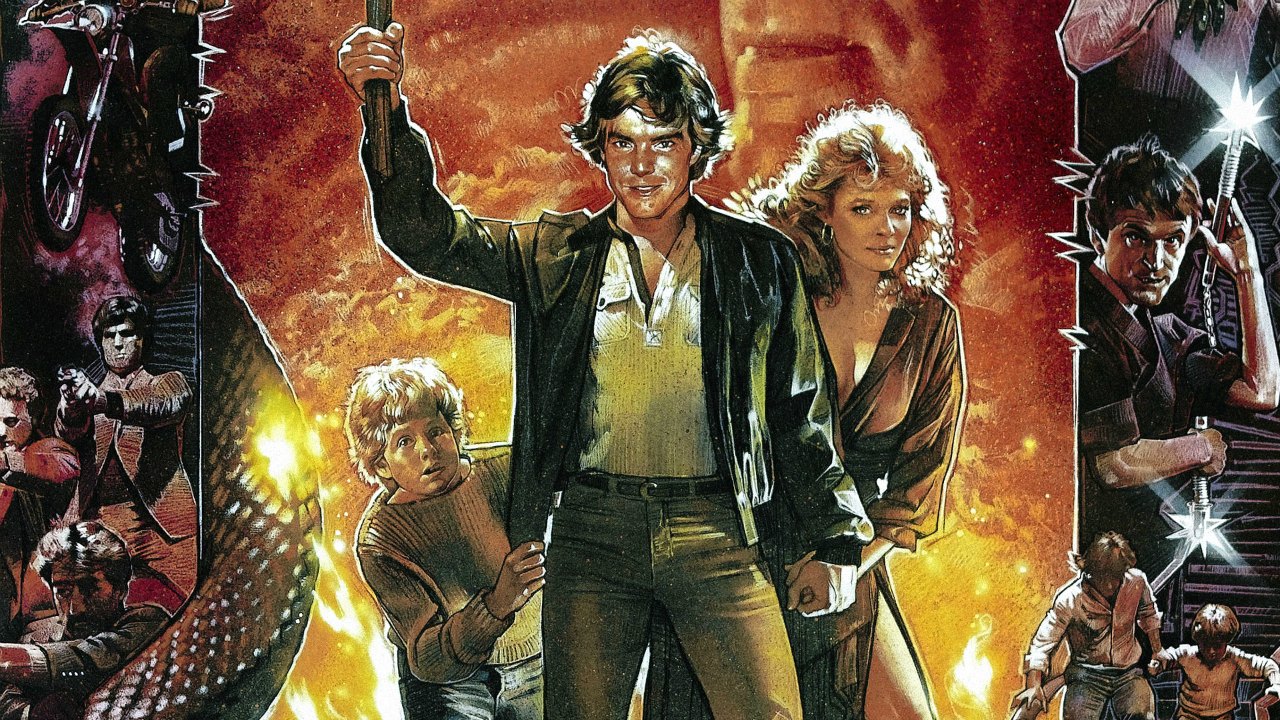
This impression is supported by the gorgeous poster by master artist Drew Struzan, which may be the best thing about the movie. Look at this thing; tell me this doesn’t look exactly like the sequel to Indiana Jones and the Temple of Doom – which came out only a few months earlier and also featured Struzan’s artwork.
The effects are simply dreadful. I really try hard not to pick on older films for outdated effects, but these are fairly poor even for 1984.
The tone is all wrong. The filmmakers seem unsure if they are making a sci-fi thriller, a political thriller or a horror picture. The mix of all three cheapens all.
This last reason is the main problem with the film. It’s less than 100 minutes and that’s not a lot of time to make a good mind-bending movie. So they don’t. There’s hints of some deep psychological/philosophical stuff, but they don’t run with it and that’s a fatal mistake. Instead it lives more in the horror genre where it does ok, but it’s not as effective as other genre films. This was the second film released with the new PG-13 rating and I suspect they were a little unclear on who the audience was going to be and therefore how far to go.
As sci-fi it’s pretty good; as a thriller it stinks. There’s actually a chase scene on a horse racetrack. There’s no real intrigue – you know who the bad guy is and what his game is almost instantly. The pseudo-gangsters aren’t threatening and the whole world seems underpopulated. I don’t know if the low budget is the reason, but the whole affair feels quite small-scale – lots of mostly empty rooms and barren sets with few actors.
There are some other frustrating things about the picture. They got maestro Maurice Jarre to do the score; but he insisted on doing an electronic score. So close to greatness…
Dreamscape is a terribly frustrating picture because it coulda/shoulda been so good. It is still an entertaining movie and I enjoyed it, but the story just doesn’t live up to its premise. There’s a great movie in here, they just couldn’t quite coax it out, and by focusing on the horror elements they cheapened the story. I’d say it’s desperately in need of a remake, but the ground was later covered so much better by The Matrix, Dark City and particularly Inception that there may not be enough legroom. I haven’t read The Dream Master, the novel by Roger Zelazny on which this picture was partly based, but it sounds like it may have enough meat on the bone to justify a re-imaging for another film.
[schema type=”movie” name=”Dreamscape” description=”A young psychic on the run from himself is recruited by the government to save the US president whose mind is trapped inside the dreamworld.” director=”Joseph Ruben” actor_1=”Dennis Quaid” actor_2=”Max von Sydow” actor_3=”Christopher Plummer” actor_4=”Kate Capshaw”]
Much more serious than I remember this being. Decades of people yelling “Wolverines” made me remember the movie as campy & it really isn’t.
Spoiler-free Movie Review of Red Dawn:
Wow, they don’t waste a lot of time on this one – there’s a blitz of exposition blasted on screen too fast to read, then about two minutes of seeing a couple of teenagers, without even bothering to name them before the shooting starts. The action starts in about minute four. Within 6 minutes it’s a full war. I wonder if director John Milius was double-parked or something.
Red Dawn is possibly most noteworthy for being the first film released with the new PG-13 rating. (The Flamingo Kid earned the rating first, but was delayed in coming to market.) What’s interesting about this distinction is that in no way should this have been rated anything but R, whether PG-13 existed at the time or not. I’m a firm believer that any movie containing kids killing kids should earn an immediate R. (I’m looking at you, Hunger Games…) And this is an exceptionally violent movie by any measure (including the tasteless on-screen “Carnage Counter” feature on the DVD), considered at the time to be the most violent movie ever released with a rate of 2.23 acts of violence per minute.
It’s a serious movie. Having not seen this since the 80’s I had vague recollections of this being a slightly more violent The Outsiders. But the age of the protagonists is the only thing that separates Red Dawn from a full-on war film, and a rough one at that. Sure, it has a Outsiders-styled cast, but since the movie spends a minuscule amount of time learning anything about these characters, they could just as easily be 22 year old soldiers. It’s a good thing so many of the cast members went on to be famous, because if I didn’t recognize the actors I’d have no way of telling the characters apart.
It’s fascinating to see a war breaking out in North America, which is really the big draw with this picture. Ever since the introduction of nuclear weapons, it’s been hard to imagine a World War III fought with conventional weaponry and so Red Dawn plays out like an interesting “what if ” scenario. Admittedly, we learn over the course of the picture that limited nuclear strikes have taken place, wiping out major strategic cities, but this bit of exposition is delivered halfway through the picture during a rare non-violent moment and so you might miss it.
And that’s really where a strength becomes a weakness. One of the interesting stylistic choices of the film is leaving these kids so completely in the dark, cut off from all information. It is a very effective bit of storytelling for the first act of the film, but it isn’t really sustainable, so the solution to this problem literally falls out of the sky in the form of downed fighter pilot Lt. Col. Andrew Tanner (Powers Boothe). Tanner is able to interject some perspective and info about what is happening in the outside world. It’s a necessary character to introduce, since the audience has surely been wondering why the Russians and Cubans are bothering with this little town in Colorado of seemingly no strategic importance. But it’s too little too late. We want to see more of what is happening elsewhere. It has been really interesting to see what goes on in one small town in an event such as this and it gives the story weight. But the tantalizing taste of the larger struggle that Tanner’s info suggests made me impatient with the limited story of one group of insurgents. The efforts of these kids are fascinating but credulity starts to wane as the story progresses.
I’m a sucker for a Cold War story and Red Dawn produces images and a scenario not previously explored. It partially slakes my desire for a Cold War land war film. (I’d love it if someone would produce a film version of Tom Clancy’s Red Storm Rising.) It’s far from a perfect film (I’m not even sure it’s a good film) – it has huge pacing problems, little to no characterization, no real introduction and a non-ending. It also feels a bit like right-wing propaganda with a touch of Lord of the Flies brutality. But it is a unique picture that is better than I remembered it, and I love the Basil Poledouris score.
[schema type=”movie” name=”Red Dawn” description=”It is the dawn of World War III. In mid-western America, a group of teenagers bands together to defend their town, and their country, from invading Soviet forces.” director=”John Milius” actor_1=”Patrick Swayze” actor_2=”C. Thomas Howell” actor_3=”Lea Thompson” actor_4=”Charlie Sheen” actor_5=”Darren Dalton” actor_6=”Jennifer Grey” actor_7=”Brad Savage” actor_8=”Doug Toby”]
It is the dawn of World War III. In mid-western America, a group of teenagers bands together to defend their town, and their country, from invading Soviet forces.
Poster
Runtime
114
Tagline
A full scale military invasion by foreign troops begins. Total surprise. Almost total success . . . .
More than a little unclear, it is nonetheless a fascinating & thrilling underwater sci-fi adventure. Great story & even better execution…
Spoiler-free Movie Review of The Abyss:
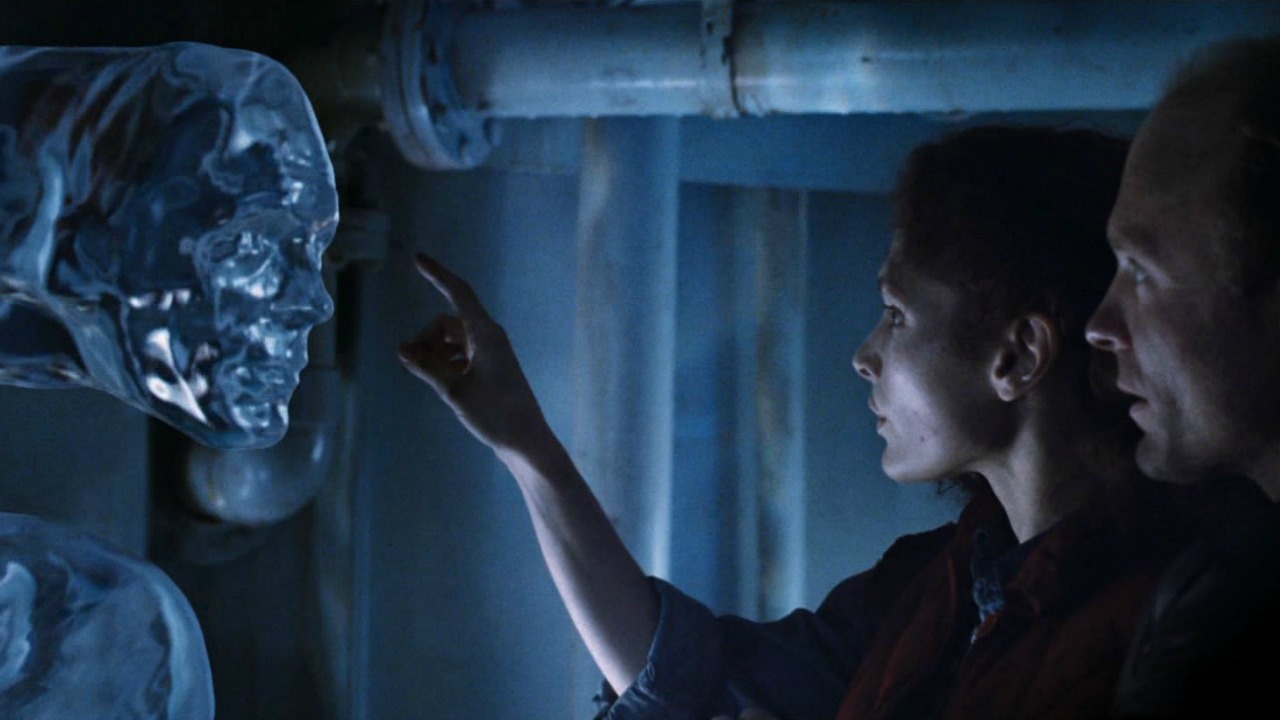
The Abyss is one of those films that may be remembered solely for their special effects. Indeed, when I was putting together this post, after much consideration I realized I had to use the water tentacle “face” as the featured image as it is so indelibly linked with the film. Until now I never actually sat through the whole picture, and that scene is more or less the only bit of the film I was familiar with as a result.
Having now watched it properly (I caught bits and pieces over the years) I think it is a real shame that the legacy of the film has been reduced to its effects. The movie is a whole lot more than a test kitchen for Terminator 2.
In some ways, James Cameron’s film isn’t terribly original. It could certainly be argued that the movie is a typical sci-fi actioner, but underwater. It certainly does follow many action film conventions, and I think the plot of the picture is significantly weakened when you reflect on just how much it relies on the action taking place on the edge of a cliff. It quite literally is a cliffhanger picture, with the only variation being the location of the cliff as part of an underwater trench. But it is an unique story, even if it does follow some well-traveled paths to get there.
An American nuclear submarine crashes following a run-in with an unidentified floating object and for reasons that are explained quickly and not entirely satisfactorily, the rescue is entrusted to an underwater oil drilling team. They’ll be supervised by a crack team of Navy SEALS (who can somehow get to the area when the regular military rescue team cannot), led by Lieutenant Hiram Coffey (Cameron regular Michael Biehn), who have their own (not entirely explained) agenda.
The drilling operation works something like this: the Benthic Explorer, on the surface is attached via some type of umbilical tether to the underwater drilling platform the Deep Core, over 500 meters beneath the surface. This was a little confusing to me, not being even moderately familiar with this technology. Generally that wouldn’t be a problem, but the interaction between the two vessels is a fairly major plot point and its one area where I felt the movie really failed. I’m not a huge fan of scenes of obvious exposition, but sometimes they are really necessary. A two minute scene showing a diagram of the connection or a map would have been hugely helpful. There’s a huge storm coming that affects everything, not to mention a potential military incident between the US & Russia over the recovery of the sunken ship due to its location, yet I never really had a clear idea where this all was taking place. A year after The Abyss, one of the greatest cold-war naval films of all time, The Hunt for Red October, did a fantastic job of illustrating its concepts with excellent exposition. I wonder if the filmmakers took any lessons from this film.
The human element of the story is ably handled by Virgil “Bud” Brigman (Ed Harris) and Dr. Lindsey Brigman (Mary Elizabeth Mastrantonio), estranged spouses in charge of different areas of the drilling and rescue operation. The two actors have a nice chemistry, but the show is pretty much stolen by Michael Biehn. The studio unsuccessfully lobbied to get him a Best Supporting Actor nomination, which he absolutely deserved. His Lt. Coffey is suffering from high pressure nervous syndrome, and had a more marquee actor turned in this paranoid performance they certainly would have been recognized.
I haven’t even really gotten into what happens in the story, including the sci-fi elements, because they really are better experienced firsthand. If you’ve somehow avoided knowing what happens for 25 years (I did) I’m not going to be the one to spoil it. The story and the film are very good. It’s an exciting adventure story and the underwater setting makes for a great picture.
Unfortunately, the ending bites. This is almost certainly explained by the severe trimming the picture underwent to get to a more reasonable runtime of 140 minutes. The Special Edition cut of the film that made it to video restores another half an hour of footage that apparently makes a huge difference in rounding out the ending. I’ll try to screen it and update this review soon.
Cameron and DP Mikael Salomon do a great job of creating the claustrophobic feel of the underwater setting, with an early sequence as the rescue crew boards the stricken submarine particularly noteworthy. Salomon shoots a scene from the first person perspective of crewman Jammer Willis, with his labored breathing intensifying, and it is one of the most tense and suspenseful sequences I’ve ever seen.
Apparently it was a nightmare shoot, with actors breaking down and nearly drowning on occasion, and the film is probably single-handedly responsible for Cameron’s reputation as a very difficult director to work with. The final product is wonderful, though.
The Abyss is a unique film and another great example of James Cameron’s singular vision. The film stops short of being the greatest underwater picture of all time – I don’t think anything will ever top Das Boot – but it’s right up there. Had the filmmakers been allowed to make the longer picture they intended, the theatrical cut would likely be a much more complete film. As it stands, it is a very good if somewhat confused film with an unsatisfying and simplistic ending. Gorgeous visuals in a unique setting make this easily recommended.
[schema type=”movie” name=”The Abyss” description=”A civilian diving team are enlisted to search for a lost nuclear submarine and face danger while encountering an alien aquatic species.” director=”James Cameron” actor_1=”Ed Harris” actor_2=”Mary Elizabeth Mastrantonio” actor_3=”Michael Biehn” ]

 Of course, that I’m classifying the beating out Audrey for an award a problem shows just how deep I have to dig for any real criticism of the picture. (Note: I didn’t include Dick Van Dyke’s truly dreadful cockney accent because it’s one of those things that’s so bad it’s almost good. Not only that, it surely convinced filmmakers Albert Broccoli & Ken Hughes that he should just skip the English accent for Chitty Chitty Bang Bang entirely, so there’s that.)
  The story of bringing author P.L. Travers’s character to movie screens is famously if rather inaccurately chronicled in the feature film Saving Mr. Banks, but even before that picture it was interesting stuff, with Disney’s struggles with Travers being legendary. In the end, they both were probably right in their instincts; Travers was rightfully protective of her work if possibly too attached to recognize how much Disney’s influence could do for her character – Disney and company made a few major missteps with the characters while simultaneously adding immeasurable benefits in the adaptation.
  It really is a tremendous picture. The plot doesn’t need repeating, as probably everyone has seen the film at some point in the past 50 years, suffice it to say that it’s a classic story, based loosely on the first Mary Poppins novel with some of the second in there. You can’t call any 139 minute film streamlined and it certainly isn’t – it could probably do with a haircut, but at that time many pictures were longer. (Although there’s no official intermission in the movie, there probably should have been and many theaters took it upon themselves to add one anyway.)
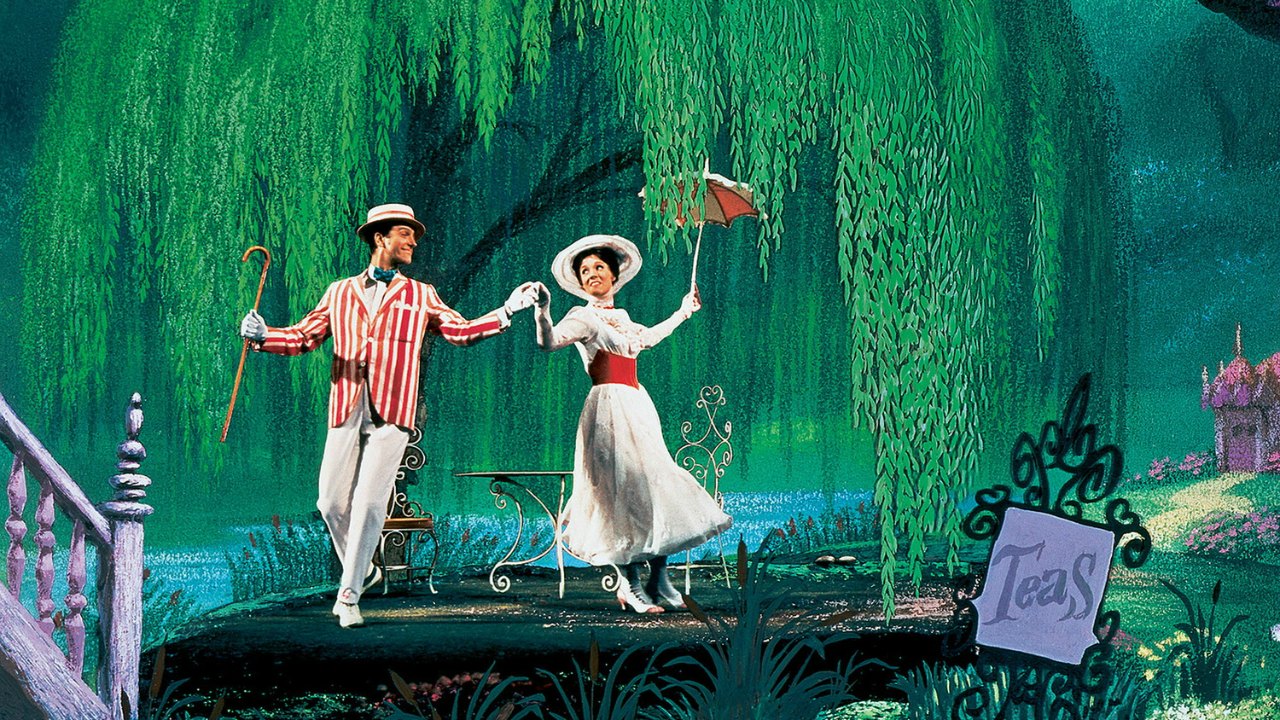
  The acting is over the top as only 1960’s movies can be, but that doesn’t mean it isn’t wonderful. I find the whole picture lacking in subtlety and at times it’s hard to shake the impression that everyone is yelling at you. Your enjoyment of the film likely depends on your feelings on Julie Andrews’ performance. It’s a bit much for me personally, but unquestionably excellent and star-making. Van Dyke is simply wonderful in the picture – one of the all-time great physical actors. David Tomlinson turns in a great performance that works much better the older you are. The film as a whole possesses that quality of being layered and like many great films you take away different things at different times of your life.
  The music is a complete triumph, the high point in the career of the Sherman Brothers. No wonder they were asked to essentially make it twice with Chitty Chitty Bang Bang.
  Mary Poppins would prove to be one of the biggest hits of Walt Disney’s filmmaking career and is regarded by many as his greatest film. It is marvelous.
 [schema type=”movie” url=”http://movies.disney.com/mary-poppins” name=”Mary Poppins” description=”A magic nanny comes to work for a cold banker’s unhappy family.” director=”Robert Stevenson” actor_1=”Julie Andrews” actor_2=”Dick Van Dyke”]