Author: mfordfeeney

  • Starman (1984)

    Starman (1984)

    140 Character Movie Review – #140RVW

    Carpenter tries on new style to great effect with this slow burn alien love story. Straight from the age of acting over action. #DefineBozo

    Starman

    Spoiler-free Movie Review of Starman:

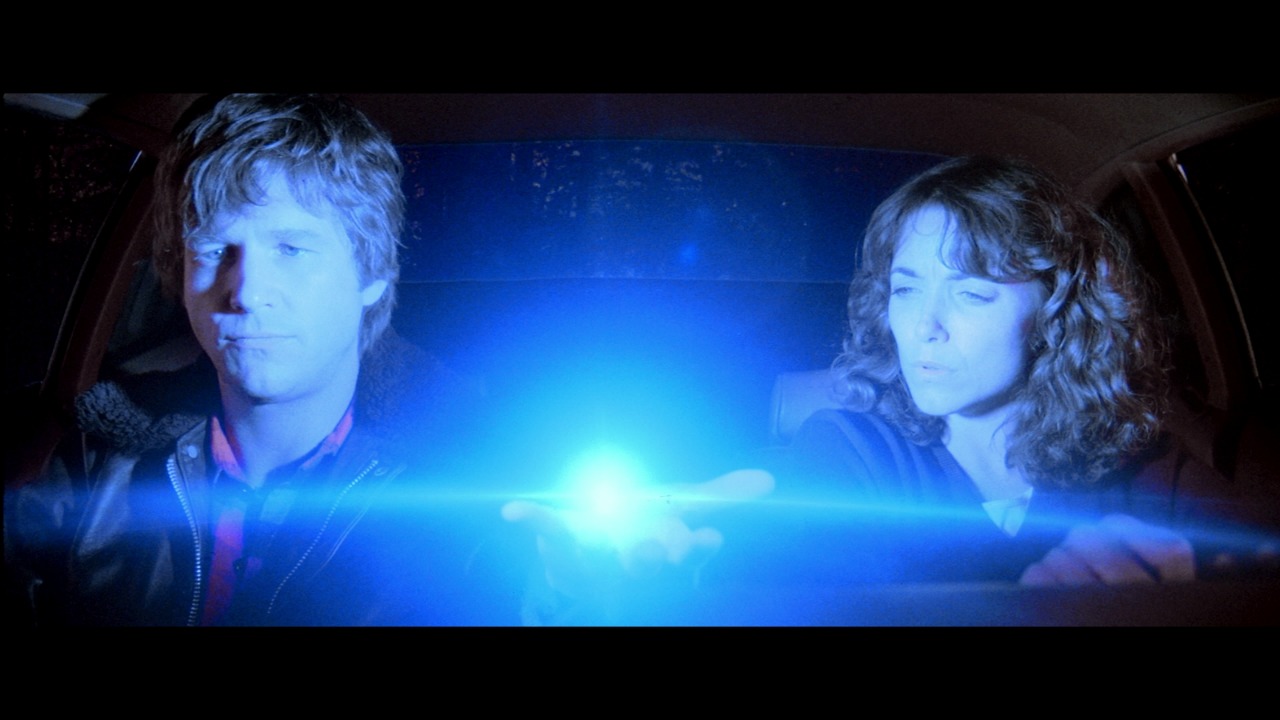
    I only vaguely remember seeing Starman on cable at some point. I probably wasn’t interested in the love-heavy story at the time, even if it was courtesy of John Carpenter and starring Jeff Bridges and the love of my early life, Karen Allen.

    Starman

    Executive produced by Michael Douglas? Must be a story there. (There is, although it doesn’t have much to do with Douglas – he brought the project to Columbia. The bigger story is that Columbia optioned two aliens come to Earth projects – this one and another called Night Skies. They had to pick one to run with, so they went with the more adult-themed Starman. Night Skies went over to Univeral Pictures, where it was released under the name E.T. the Extra-Terrestrial. Whoops…)

    Starman

    So Starman had a difficult birth. Despite being started much earlier than the other picture, E.T. came to market much faster and became a juggernaut that sent Starman into a development tailspin. It would take several years for the film to see release as lots of people attached to the project split, seeing the similarities between the films and presumably not wanting to follow such a tough act. Script doctor Dean Riesner was brought in to more or less rewrite Bruce A. Evans & Raynold Gideon’s screenplay (though Riesner would never receive screen credit for bizarre Writers Guild reasons).

    Starman

    Such a different style for Carpenter. He’s definitely to be commended for stretching himself. Carpenter has stated that he took on Starman after his (amazing) 1982 remake of The Thing bombed and he was concerned he was about to get bounced out of Hollywood. This is the only one of his films that received an Academy Award nomination (Best Actor for Bridges).

    Bridges is such a fine actor. He plays alien so well. He has this comfort and command of his body that allow him to convey so much personality.

    Starman

    Karen Allen sings! New favorite movie! So good to see such a meaty role for Allen. Her scene in the restaurant, explaining love and death is fantastic.

    (Side note: The 1980’s seems to be the decade of actresses wandering around with shirts but not pants. The whole lounging around in nightshirt and underpants thing. It’s not even about being sexy, it’s just about portraying people realistically. And that is sexy in its own way…)

    Starman

    Charles Martin Smith is one of those great character actors that I’m always happy to see. He’s had a good career, but I always think actors like this could use more work.

    It’s not an effects picture, of course, but it punches its weight – the practical stuff is well done and in keeping with the tone of the picture. The scene of the morphing/transformation is awfully strange. Effects were done by Stan Winston & Rick Baker, so while there isn’t a ton of FX work, it’s all pretty good…

    You know, sometimes the constraints of the time really work in favor of the filmmaker. That’s not to say that not having great tech turns average directors into Hitchcock, but there is a natural suspense that builds when you have to take things slowly and avoid spending too much time focusing on details.

    You can always count on Carpenter for an interesting 80’s synth score.

    Love the vintage black & orange 1977 Mustang Cobra.

    Starman

    This SETI investigation where they have actual evidence of a flying saucer must be the most low-key, relaxed secret government project of all time. People are just wandering around, transporting the thing in plain sight. No one is filming or documenting anything. They crack the thing open and the first guy to pop through is wearing street clothes and has a cigar…

    There’s this older, seemingly more innocent time on display here that must be just as alien to modern kids as it is to the Starman. The picture was made in 1984, but it could just as easily be 1974. It’s hard to imagine this story playing out the same today. People hopping boxcars, sneaking past roadblocks, plus there’s a Woolworth on the Vegas strip…

    Starman

    “Well, I guess the question is who’s the missionary, and who are the cannibals?”

    One possible quibble might be that there’s a predictability to the script that probably was there even 30 years ago. But that’s ok; it’s the journey that’s important.

    Starman is a great film. More a character-driven road picture than the sci-fi film it started life as, the performances are wonderful and the whole picture has its own pace and feel that may not be groundbreaking, but are completely welcome. Highly recommended…

    Poster:

    Trailer:

    Bechdel Test:

    Fail

    The Representation Test Score: C (5 pts)

    (http://therepresentationproject.org/grading-hollywood-the-representation-test/)

    Starman Representation Test

    [schema type=”movie” name=”Starman” description=”He has traveled from a galaxy far beyond our own. He is 100,000 years ahead of us. He has powers we cannot comprehend. And he is about to face the one force in the universe he has yet to conquer. Love.” director=”John Carpenter” actor_1=”Jeff Bridges” actor_2=”Karen Allen” ]

    Main Cast Jeff Bridges Starman, Karen Allen Jenny Hayden, Charles Martin Smith Mark Shermin, Richard Jaeckel George Fox
    Rating PG
    Release Date Fri 14 Dec 1984 UTC
    Director John Carpenter
    Genres Adventure, Drama, Romance, Sci-Fi
    Plot An alien takes the form of a young widow’s husband and asks her to drive him from Wisconsin to Arizona. The government tries to stop them.
    Poster Starman
    Runtime 115
    Tagline In 1977 Voyager II was launched into space, inviting all lifeforms in the universe to visit our planet. Get ready. Company’s coming.
    Writers Bruce A. Evans (written by) &, Raynold Gideon (written by)
    Year 1984
  • Nineteen Eighty-Four (1984)

    Nineteen Eighty-Four (1984)

    140 Character Movie Review – #140RVW

    Nearly perfect adaptation, by which I mean it’s just as eye-opening, visceral and difficult to enjoy as the source novel. #ISoldYouYouSoldMe

    Nineteen Eighty-Four (1984)

    Spoiler-free Movie Review of Nineteen Eighty-Four (1984):

    “It’s a beautiful thing, the destruction of words.”

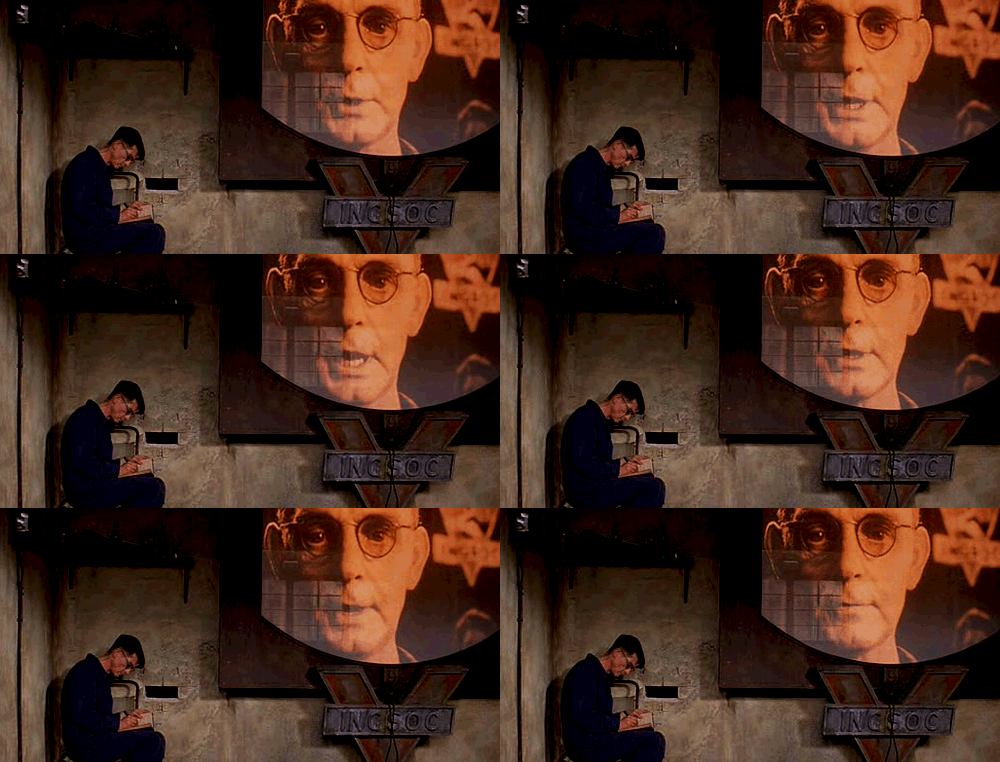
    What with one thing and another, I missed the 30th anniversary of Nineteen Eighty-Four this past December. Not that it really matters – the film is timeless. Actually, I only missed finishing my review on time – I most certainly watched the film. Several times, actually. It says a lot about how amazing this film is that I have willingly put it on many times, because it is anything but enjoyable to watch.

    Nineteen Eighty-Four (1984)

    “Under the spreading chestnut tree. I sold you, you sold me.”

    Nineteen Eighty-Four is a truly disturbing film. A perfectly realized vision of the absolute terror of the source novel. With a surplus of dystopian tales out there now, nothing touches this one. It’s not the obvious stuff, the big displays, it’s the complete acceptance of the horrible state of affairs by the people – explosions happen and no one even looks up.

    Nineteen Eighty-Four (1984)

    “Who controls the past controls the future. Who controls the present controls the past.”

    The Two Minutes’ Hate at the beginning of the film is savagely heartbreaking. One of the ugliest scenes ever put to film.

    Nineteen Eighty-Four (1984)

    It’s hard to imagine how this adaptation could possibly be any better. Writer/director Michael Radford constructed an absolute masterpiece. The picture has such a slow pace, but it’s just the thing for this story.

    The acting is plusskillful, and needed to be for this material to work so well. John Hurt is absolutely perfect in the role of Winston Smith.

    Nineteen Eighty-Four (1984)

    Suzanna Hamilton is the actress who plays Julia. Why did she never become a huge star? She had a good career, but based off of this film, should have been given more work. Hers is a masterful performance, even in a film teeming with them. Richard Burton is predictably great in his last film role.

    Nineteen Eighty-Four (1984)

    The film rights to the novel were given by George Orwell’s widow (Sonia) only upon assurance that the picture wouldn’t be a big special effects display. That prohibition works wonders for the enduring quality of the film – it looks like it could have been made any time in the past 50 years or the next 20. The visual look of the film is courtesy of legendary cinematographer Roger Deakins, bleaching out the negatives during processing. Masterful.

    Nineteen Eighty-Four (1984)

    About the only misstep in the picture may be the music by Eurythmics (well, it was 1984…), which replaced the original score by Dominic Muldowney, although with the various versions released on home video and in different regions, I’m not really even sure which version I’ve seen. So I’d have to say that the modern music is not as distracting as expected – since I don’t even know if I’ve ever noticed it…

    Nineteen Eighty-Four is an exquisite interpretation of Orwell’s defining work. Unusually for such a bleak tale, it has a rewatchability that is at odds with it’s unpleasant portrait of a potential future/present. It’s a brutal book, of course, and the source material has that same counter-intuitive attraction. I don’t know that you could reasonably say that the film is more effective in telling the story, but I wouldn’t hesitate to count this among the more EFFECTIVE adaptations of a classic novel ever to see release…

    Nineteen Eighty-Four (1984)

    “If you want a vision of the future, Winston, imagine a boot stamping on a human face forever.”

    Poster:

    Trailer:

    Bechdel Test:

    Fail

    The Representation Test Score: D (3 pts)

    (http://therepresentationproject.org/grading-hollywood-the-representation-test/)

    Nineteen Eighty-Four (1984)

    [schema type=”movie” name=”Nineteen Eighty-Four (1984)” description=”George Orwell’s novel of a totalitarian future society in which a man whose daily work is rewriting history tries to rebel by falling in love.” director=”Michael Radford” actor_1=”John Hurt” ]

    Main Cast John Hurt Winston Smith, Richard Burton O’Brien, Suzanna Hamilton Julia, Cyril Cusack Charrington
    Rating R
    Release Date Fri 14 Dec 1984 UTC
    Director Michael Radford
    Genres Drama, Romance, Sci-Fi, Thriller
    Plot George Orwell’s novel of a totalitarian future society in which a man whose daily work is rewriting history tries to rebel by falling in love.
    Poster 1984
    Runtime 113
    Tagline 2+2=5
    Writers George Orwell (novel), Michael Radford (written by)
    Year 1984
  • White Christmas (1954)

    White Christmas (1954)

    140 Character Movie Review – #140RVW

    Beautiful Irving Berlin music (except the minstrel number), excellent screwball dialogue & fine performances, especially by Clooney & Kaye.

    White Christmas

    Spoiler-free Movie Review of White Christmas:

    Yes, this review certainly is out of season. So what? After a period of low output, I’m getting back into somewhat of a good groove with the reviews and want to finalize many of these half-written pieces from the back end of 2014, including this one, written for the 60th anniversary of White Christmas in December. (Besides, the holiday setting is really the only thing that makes it a holiday movie, per se.)

    White Christmas

    White Christmas is sort of a greatest hits album of a film. Like Singin’ In The Rain, it’s largely a collection of music from other, less popular or unproduced plays and films. It’s interesting that this picture is revered and loved, while Holiday Inn, the original home of the classic song White Christmas, is more often thought of as the answer to a trivia question than for its own merits (which are considerable).

    But if that introduction seems to indicate that White Christmas is a retread or a lesser work, that is in no way the reality. White Christmas is a wonderful film, a holiday classic without qualification.

    White Christmas

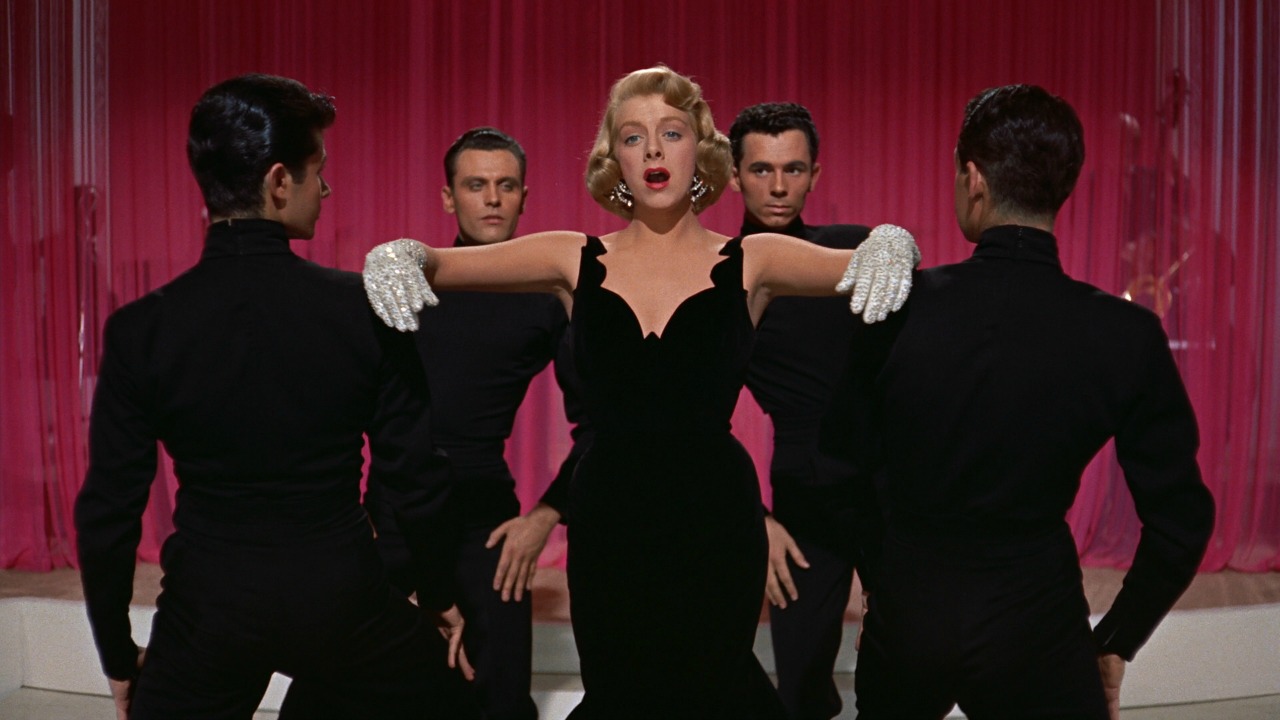
    Filmed in Technicolor, the colors are rich and sumptuous, popping off the screen. More importantly, it was the first movie released in VistaVision, and remains a gorgeous spectacle to show off that storied format. The expanded scope of the format makes for great, sweeping dance numbers. I always found it interesting that Gene Kelly disliked scope films, feeling that the 1.33:1 “full” format made for better blocking and film choreography of dance scenes. I have no intention of disagreeing with such an amazing filmmaker, but I quite like the widescreen 2.35:1 or even 2.40:1 frame for musical numbers – provided, of course, that they use it in the planning. If you’re just trying to track a couple, 4:3 or 16:9 does work better.

    The film was helmed by Michael Curtiz – so many great movies on that resume. It has always amazed me that when people discuss the legendary & prolific directors like Ford, Welles, or their modern contemporaries like Spielberg, Curtiz’s name seldom comes up. He was attached to so many landmark films.

    White Christmas

    The music, of course, is the big draw, with so many great Irving Berlin tunes. Upon watching the film for the first time with my daughter this holiday season, I was astonished that the song she sang the most in the days following was the Army song “The Old Man”. Guess you can never tell…

    The highlight may be the title song, but not the traditional performance at the end of the picture. In the first scene, set in wartime Europe, Crosby understates it wonderfully accompanied only by Kay grinding the melody out on a music box. The song has never sounded better.

    White Christmas

    (The lowlight, of course, is the Minstrel number – I completely forgot about this thing. Blocked it out, more likely. While I’m not one for fiddling with films after the fact, I think you could make a pretty good case for cutting this number completely out.)

    The song that has in some ways become the centerpiece of the picture, “Sisters”, is accompanied by Crosby & Kaye sending it up; a late add, included when the stars were seen goofing around on set.

    White Christmas

    What a knockout cast. Rosemary Clooney is nearly as entertaining as an actress has she is a singer. Her chemistry with the somewhat flat Vera-Allen, who is here for her phenomenal dancing, makes the girls portions of the story at least as interesting as the Crosby/Kaye scenes. (There is some truly wonderful dancing by Kaye & Vera-Ellen.)

    Danny Kaye may be the most overlooked talent in Hollywood history. No, Donald O’Connor, probably… (who actually was attached to the project before leaving due to illness). Can you imagine this film with Fred Astaire, whom the part was written for? No knock on Astaire, but this thing would have been too stuffy without Kaye.

    White Christmas

    It’s a good story, being something slightly more than just a vehicle for the songs. The Army buddies dynamic of the two male leads is an inspired premise and keeps the motivation for all of the characters actions believable. “Let’s just say we’re doing it for a pal in the Army, huh?”

    The dialogue is snappy and fun and helps the pace, which would otherwise suffer a bit. As great as this picture is, I have no idea why they felt the need to drag it out for two full hours. But the screwball comedy wit from veterans Norman Krasna, Norman Panama and Melvin Frank is textbook stuff and should be taught in classes as such…

    White Christmas

    White Christmas really is a great film to watch at any time of year. There’s nothing about Clooney’s performance of “Love, You Didn’t Do Right By Me” that will have you thinking about anything cool. Highly recommended…

    Poster:

    white christmas_poster

    Trailer:

    Bechdel Test:

    Pass

    The Representation Test Score: C (6 pts)

    (http://therepresentationproject.org/grading-hollywood-the-representation-test/)

    White Christmas Representation Test


    [schema type=”movie” name=”White Christmas” description=”A successful song-and-dance team become romantically involved with a sister act and team up to save the failing Vermont inn of their former commanding general.” director=”Michael Curtiz” actor_1=”Bing Crosby” ]

    Main Cast Bing Crosby Bob Wallace, Danny Kaye Phil Davis, Rosemary Clooney Betty Haynes, Vera-Ellen (as Vera Ellen) Judy Haynes
    Rating Approved
    Release Date Thu 14 Oct 1954 UTC
    Director Michael Curtiz
    Genres Comedy, Musical, Romance
    Plot A successful song-and-dance team become romantically involved with a sister act and team up to save the failing Vermont inn of their former commanding general.
    Poster White Christmas
    Runtime 120
    Tagline First and unforgettable picture in VISTAVISION
    Writers Norman Krasna (written for the screen by) &, Norman Panama (written for the screen by) …
    Year 1954
  • My Fair Lady (1964)

    My Fair Lady (1964)

    140 Character Movie Review – #140RVW

    Winner of 8 Oscars and unbelievably charming even after 170 minutes (and 50 years). A timeless masterpiece no matter how you cut it. #Audrey

    My Fair Lady

    Spoiler-free Movie Review of My Fair Lady:

    People love to recount the story of how Julie Andrews wasn’t allowed to reprise her Broadway role of Eliza Doolittle for the film adaptation of My Fair Lady and how she got the last laugh when she won the Best Actress Oscar for her performance in Mary Poppins, while Audrey Hepburn wasn’t even nominated. They like to gloat about how Hepburn was dubbed for most of her singing performances when producer Jack Warner, refusing to transpose her songs to a lower register more suited to her voice, decided that Marni Nixon’s looped voice would be better for the part. Everyone wanted Andrews to play the role in the film, including Hepburn. Walt Disney even offered to delay the filming of Mary Poppins to allow Andrews to do both pictures.

    My Fair Lady

    Alright, I’ll say it; Audrey Hepburn is better for this picture than Julie Andrews would have been and Warner was right to make the casting decision he did. Would Andrews have been great in the role? Of course she would have. Julie Andrews is a wonderful, world-class actress and the film would have been excellent. But it’s sublime with Hepburn…

    My Fair Lady

    The Academy, in sympathy for Andrews and snobbery over the looped singing, left Hepburn out of the running for Best Actress, despite being the lead in a film they would select as the Best Picture of 1964. Ridiculous. Hepburn not only deserved to be nominated, she deserved to win.

    My Fair Lady

    (You may be realizing by now that this review is going to be a bit of an Audrey-obsessed affair. I don’t apologize for that at all. I’m in very good company – everyone loves Audrey. But if you like, skim this one – I promise to get around to other aspects of the film at some point…)

    My Fair Lady

    One reason that Hepburn is so effective in this role is that she is believable consorting with both flower sellers and the gentry. I never saw Andrews perform the role, but have a hard time accepting that she’d ever seem like anything but a lady, even in the gutter. Both actresses can exude an air of royalty, but Hepburn’s rail-thin physique and experiences of malnourishment in the Second World War help to make the early scenes more plausible and Eliza’s journey more satisfying.

    My Fair Lady

    The movie is nearly perfect. It’s a great story – that’s why they’ve told it so many times in so many ways. The Greek myth itself is interesting and led to a host of interpretations on the stage, from operas to dramas. George Bernard Shaw’s original play Pygmalion, upon which the Lerner & Loewe musical is based, is excellent. It was adapted into a film long before this musical was even conceived of. And of course there have been a ton of updates in the years since.

    My Fair Lady

    But this may be the most satisfying telling of all. Shaw introducing an element of satire and social commentary about the English class system was an inspired touch and lifts the subject material to a new level, and the addition of music and then filmed spectacle makes the statement stand out most illustratively.

    My Fair Lady

    I won’t apologize for enjoying My Fair Lady best. Partly it’s the music, largely it’s the acting, mostly it’s the libretto/book – great dialogue. I found reading Pygmalion a little unsatisfying after seeing My Fair Lady first. That’s not really fair, but it is what it is.

    My Fair Lady

    One of the great joys, of course, is the spectacle on display. They quite simply don’t make them like this anymore. In truth, that’s not necessarily a bad thing, as the evolution of cinematic storytelling has for the most part been entirely improved with the passage of time, but there is no way to watch a picture of this magnitude without being impressed and a bit sad that you won’t see it’s like again.

    My Fair Lady

    Rex Harrison is his splendid peacock self, leading the mostly British cast through the English anachronisms and picking up a Best Actor Oscar for it. Stanley Holloway is delightful as dustman turned moralist Alfred P. Doolittle, stealing the show with two of the best numbers.

    My Fair Lady

    The music, for its part is top shelf. Lerner & Loewe would never do anything else quite as inspired as My Fair Lady (Paint Your Wagon somewhat cancels out Camelot and Gigi), but considering the quality of this work, it’s enough…

    My Fair Lady

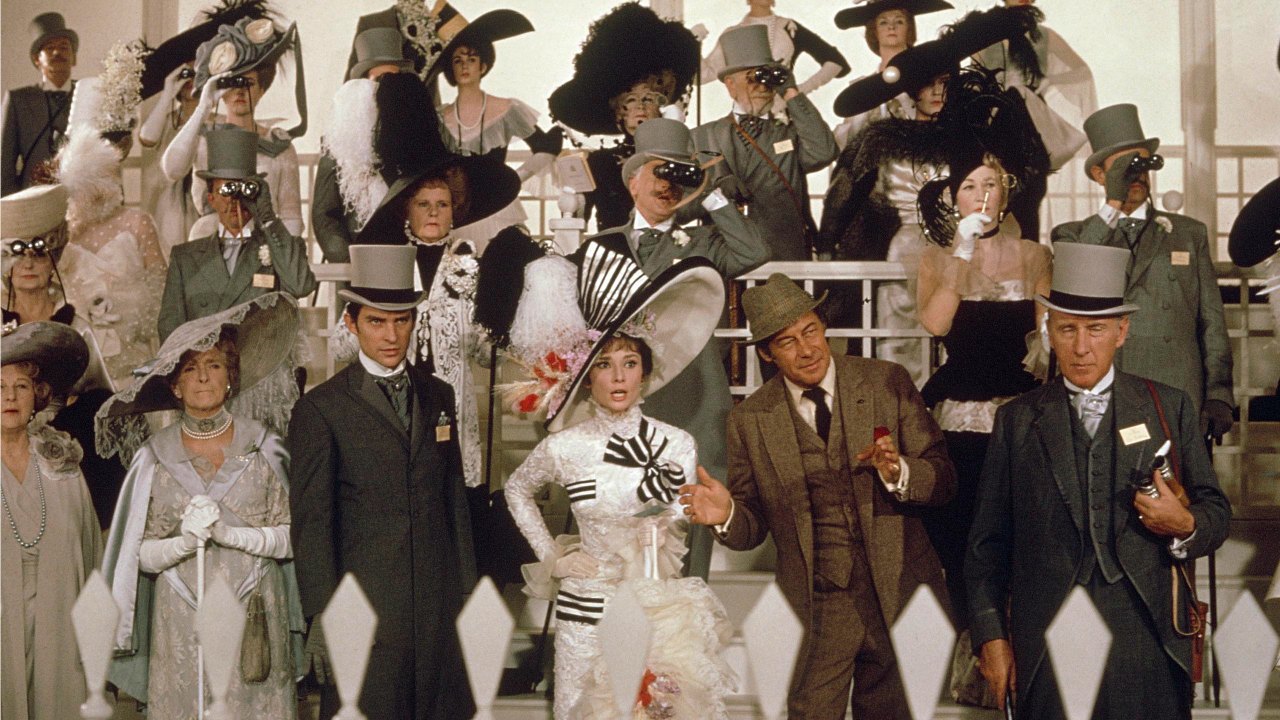
    For all of the great dialogue, music and acting, however, My Fair Lady remains a visual extravaganza. The sets are expansive and ornate, expanding the horizons beyond those possible on stage, without ever really losing that theater ambiance. Gene Allen, Cecil Beaton and George James Hopkins won an Oscar for Art Direction, while Beaton picked up another for Costume Design. Actually, Beaton had nothing to do with the sets at all, doing only costumes, but had a very good agent & contract. (In point of fact, Beaton was such a distraction that he was actually barred from the filming set and the art department.)

    My Fair Lady

    The costumes are indeed great; most of them are pretty straightforward period pieces. But Hepburn’s outfits…

    My Fair Lady

    Shot in glorious 65mm by Harry Stradling (who also got an Oscar…), the picture is beautifully lit and the colors are warm and inviting, even if there seems to be an intentional softening over the whole thing.

    My Fair Lady

    All of this comes together to make a true classic, one of the all-time great film musicals. Loverly…

    Poster:

    Trailer:

    Bechdel Test:

    Pass

    The Representation Test Score: C (6 pts)

    (http://therepresentationproject.org/grading-hollywood-the-representation-test/)

    My Fair Lady Representation Test

    [schema type=”movie” url=”https://www.facebook.com/MyFairLadyMovie” name=”My Fair Lady” description=”A misogynistic and snobbish phonetics professor agrees to a wager that he can take a flower girl and make her presentable in high society.” director=”George Cukor” producer=”Jack Warner” actor_1=”Audrey Hepburn” actor_2=”Rex Harrison”]

    Main Cast Audrey Hepburn Eliza Doolittle, Rex Harrison Professor Henry Higgins, Stanley Holloway Alfred P. Doolittle, Wilfrid Hyde-White Colonel Hugh Pickering
    Rating G
    Release Date Fri 25 Dec 1964 UTC
    Director George Cukor
    Genres Drama, Family, Musical, Romance
    Plot A misogynistic and snobbish phonetics professor agrees to a wager that he can take a flower girl and make her presentable in high society.
    Poster My Fair Lady
    Runtime 170
    Tagline The loverliest motion picture of them all!
    Writers Alan Jay Lerner (book), George Bernard Shaw (as Bernard Shaw) (from a play by)
    Year 1964
  • Cinderella (2015)

    Cinderella (2015)

    140 Character Movie Review – #140RVW

    Typically well-made live-action update of classic fairy tale is aggressively ok. Far too long for little ones to sit still – parents, too…

    Cinderella

    Spoiler-free Movie Review of Cinderella:

    Disney has my admiration when it comes to milking a cow. They really do not miss a single trick. Not only did they strike pure gold with their strategy of mining old fairy tales for most of their early film classics, they’re now getting a second bite at the apple by remaking all of their old hits in live action. They could frankly make movies forever without ever having to write a single story. As I’ve noted before in my review of Maleficent, I quite expect that they plan just that…

    So if the idea here is to update all of the old kids animated movies for the kids of today, why is this so long? With attention spans getting shorter, why are films going in the opposite direction when it comes to run-times?

    Cinderella

    It only took 74 minutes for Walt Disney’s animation team to spirit us through the Cinderella story, and it had 6 songs – not one of which is repeated here (although I did hear one in the end credits). I don’t understand what on earth made the filmmakers responsible for the update feel that this version merited another 40 minutes. 112 minutes is far too long for kids to sit still, so who are you making this film for?

    The intended audience of the film is the puzzle that stuck with me through the whole picture. Despite the serious matter inherent in the death of the titular character’s parents, it’s not a particularly dark tale. To the credit of the filmmakers, they didn’t ramp up the action or danger or anything like that. That suggests a younger target market – fair enough. But why then is it so talky and epic and repetitive?

    Cinderella

    The screenplay by Chris Weitz plays it extremely safe, but that’s not really a bad thing. There are missed opportunities and maddening decisions, sure. (Including the tale about asking the father to bring home the first branch he sees is great, but not if you don’t show the tree planted for her mother. Also, if you insist on making this picture so long, why excise the business of the ball lasting three nights and having three dresses?) But at least he didn’t try to hit the LOTR-y with unnecessary villains and battle scenes, or placing the heroes in great danger.

    Similarly, although the acting is quite good, the actors are seldom given any real room to create something new. Most noteworthy, as you might expect, is Cate Blanchett. She turns in a predictably great performance as the wicked stepmother Lady Tremaine, and in adding a hint of subtle suggestion that the woman’s actions are driven by a sad backstory gets just enough opportunity to let you see how much better of a character you’re not going to be getting. This is a real missed opportunity to make this character slightly less one-dimensional.

    Cinderella

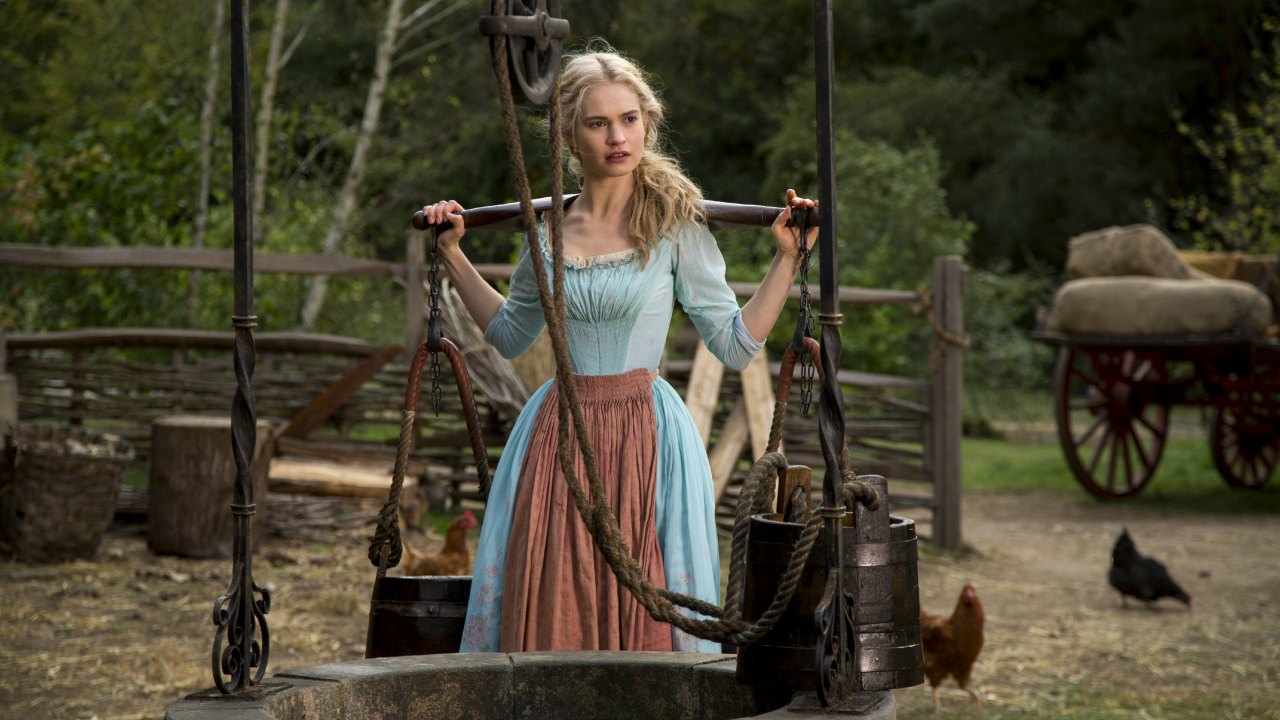
    Most of the characters are fairly milquetoast, so any added embellishments do little to distinguish them, but they are fine performances nonetheless. Lily James is perfectly suited to the role of Cinderella, and her interactions with her dead mother & father walking (Hayley Atwell & Ben Chaplin, respectively) are lovely and earnest if a touch heavy on the treacle.

    Helena Bonham Carter kind of phones in her turn as the Fairy Godmother. Her casting was actually probably a good call, but the whole sequence seems extraordinarily rote and hurried. The picture has a lot of pacing problems, with certain scenes overstaying their welcome, but you wouldn’t have expected the only magical portion of the story to have been directed as though the pumpkin coach was double-parked. This is the best part of the story for kids! 

    Cinderella

    I noted with interest that they actually added some significant interaction between the King (Derek Jacobi) and Prince Charming (Richard Madden), allowing them to express familial love. It’s fine, but the cynic in me was accutely aware that this may be Disney’s attempt at a Frozen / Maleficent moment for males.

    Cinderella

    That leads me to the conundrum that Disney has created with these films. As an audience member, you have now been trained to expect a “hook” or a surprising twist. Watching these Disney updates has become an exercise not unlike going to a Christopher Nolan or M. Night Shaymalan film – no matter how much you may be enjoying the picture, you are distracted the whole time wondering what third act surprise they’re going to drop on you. I find I can only really enjoy these films upon a second viewing, when I’m no longer focused on what they’re planning next. Similarly, I spent the entirety of Cinderella wondering if they were going to pull some metaphorical play like having the slipper not fit but the prince realizes that Cinderella fits in his heart or some similar drivel.

    Another aside; I couldn’t shake the feeling that there were a lot of meetings at the studio about how the depiction of Cinderella in Into the Woods was going to differ from this picture. I strongly suspect that Branagh was instructed to play it straight and not go for the darker parts of the original tale since that ground would be covered by the studio’s other picture. Oh, and by the way Branagh? You’re slumming, pal…

    Cinderella

    The picture is absolutely gorgeous. The set design, the costumes, the photography – it’s all superb. In some ways it’s like the Oscar-bait films that are always nominated but never seriously considered. You only get partial credit for succeeding with these films; they’re supposed to be gorgeous…

    So, after that overlong review – was it any good? I suppose so. Despite my stated ambivalence about the overlong runtime and surfeit of humor, the kids in the theater seemed to go for it. Most of the adults looked bored – I sure was – but my daughter loved it. So, mission accomplished, I guess…


    Oh, and the cynical decision to throw a Frozen short at the beginning of the film to increase ticket sales paid off big time. The picture had a smash opening weekend, and I’m certain half of the ticket sales are due to the inclusion of Frozen Fever (which was cute, if slight). It certainly ensured our attendance at a picture that looked a little underwhelming. Well played, mouse…

    Frozen Fever

    Poster:

    Trailer:

    Bechdel Test:

    Pass

    The Representation Test Score: B (8 pts)

    (http://therepresentationproject.org/grading-hollywood-the-representation-test/)

    Cinderella [schema type=”movie” url=”http://movies.disney.com/cinderella/” name=”Cinderella” description=”The story of “Cinderella” follows the fortunes of young Ella whose merchant father remarries following the tragic death of her mother. Keen to support her loving father, Ella welcomes her new stepmother Lady Tremaine and her daughters Anastasia and Drizella into the family home. But when Ella’s father suddenly and unexpectedly passes away, she finds herself at the mercy of a jealous and cruel new family. Finally relegated to nothing more than a servant girl covered in ashes, and spitefully renamed Cinderella since she used to work in the cinders, Ella could easily begin to lose hope. Yet, despite the cruelty inflicted upon her, Ella is determined to honor her mother’s dying words and to “have courage and be kind.” She will not give in to despair nor despise those who abuse her. And then there is the dashing stranger she meets in the woods. Unaware that he is really a prince, not merely an employee at the palace, Ella finally feels she has met a kindred soul. ” director=”Kenneth Branagh” actor_1=”Lily James” ]

    Main Cast Lily James Cinderella, Cate Blanchett Stepmother, Richard Madden Prince, Helena Bonham Carter Fairy Godmother
    Rating PG
    Release Date Fri 13 Mar 2015 UTC
    Director Kenneth Branagh
    Genres Adventure, Drama, Family, Fantasy, Romance
    Plot When her father unexpectedly passes away, young Ella finds herself at the mercy of her cruel stepmother and her daughters. Never one to give up hope, Ella’s fortunes begin to change after meeting a dashing stranger.
    Poster Cinderella
    Runtime 112
    Tagline Midnight is just the beginning.
    Writers Chris Weitz (screenplay)
    Year 2015