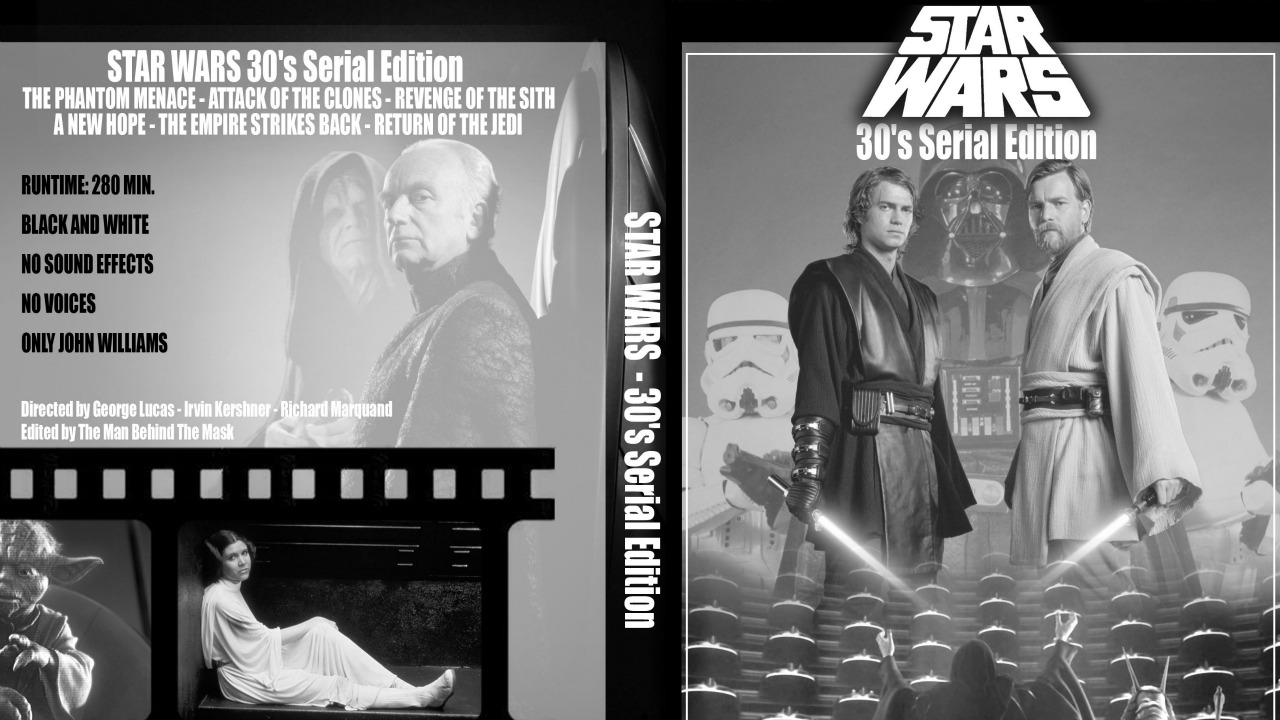
Would Star Wars really work as a silent film? Many always thought so. Now that The Man Behind The Mask has done it, fares pretty well…
Spoiler-free Movie Review of Star Wars: 30’s Serial Edition:
It’s long been maintained that the Star Wars films are so timeless, visual and universal that they don’t even need language. I know that my sister used to say that the movies would work just as well as silent films. Well, let’s see if she’s right…
Because faneditor The Man Behind the Mask created silent, black and white versions of Episodes I-VI. Stripped of color, dialogue and sound effects, this is a very different way to experience the films.
Not only has the presentation of the films been significantly altered, the movies themselves have been severely edited. Partly this is a function of the removal of spoken dialogue; with old-fashioned titled cards simply recapping the action, most scenes don’t need to run anywhere near as long. But the editor has really run with this approach, taking the opportunity to strip most scenes to their basic essentials.
Those title cards really strip the dialogue, for good and bad. Short statements replacing the audible mangling of the English language that the films (particularly the prequels) are often guilty of is mostly an improvement. The minimalist approach largely helps the story and removes the fluff. However, the wording on these cards is so sparse and clearly translated from another language that at times they read as too simplistic. Not a big issue, though, as the whole point is that you barely need to understand the language at all to follow these great stories.
Removing the color from the films produces mixed results. Black and white masks some of the “fake” quality of the CG. But since the films were quite obviously meant to be in vivid color, the effect looks similarly unreal. It’s also very clean, which sort of breaks the metaphor of these being like old films…
(Actually, I just found out that the editor created “dusty” versions of his edits, 4:3 cropped and looking beat up. It works much better.)
So, does this approach work? Results may vary. Condensing the prequel films so much is probably extremely welcome for those who don’t really like those episodes. It’s effective even if you are a fan of all the pictures, just not quite as satisfying. They play as Reader’s Digest condensed versions of the stories.
The biggest thing missing in these versions of the films is the sound. While the John Williams score is wonderful to hear in isolation, the 30’s Serial Edition certainly serves as a reminder of the importance of the Saga’s sound design. Not only are the award-winning sound effects sorely missed, their absence lessens some of the weight of the visual effects.
Personally, while I really enjoyed Star Wars: 30’s Serial Edition, it comes off as more of a cool experiment than anything.
Needs to be judged for what it is: one of the first fan edits, based off of a VHS copy. Decent edit for the time that kicked off a movement.
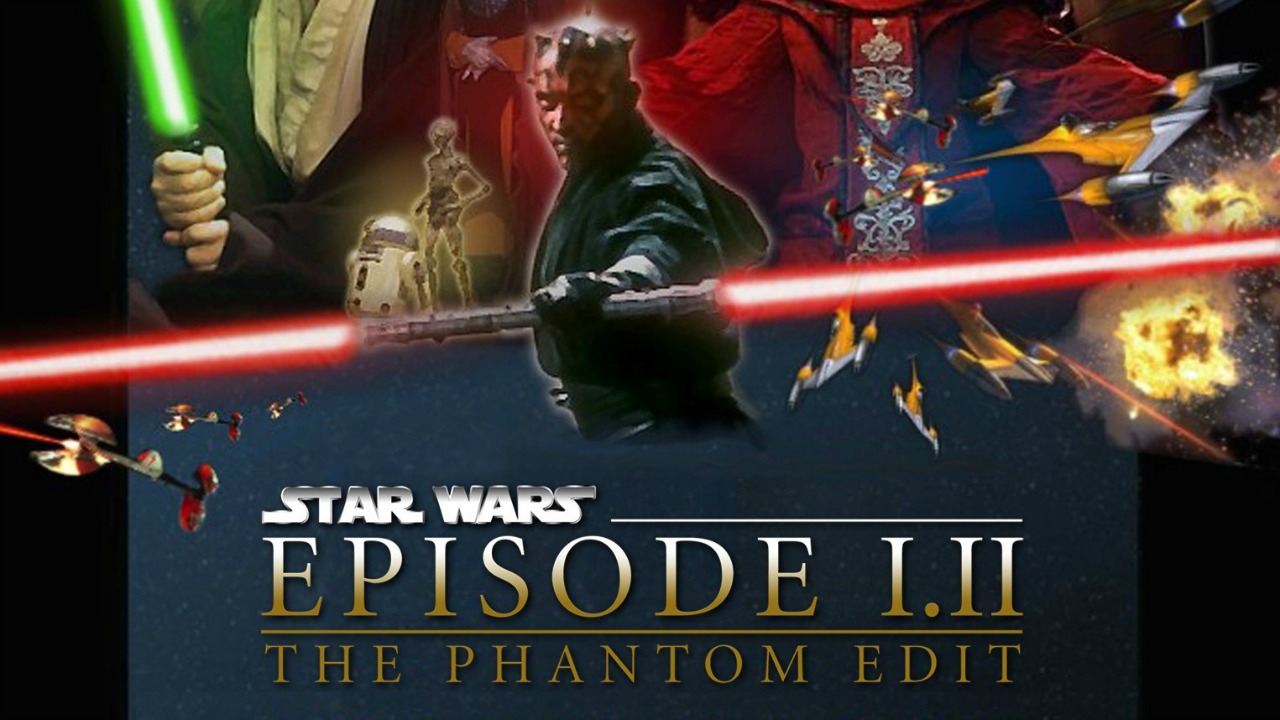
Spoiler-free Movie Review of Star Wars: Episode I.II – The Phantom Edit:
Fanedits are great fun. While I truly venerate original works, I have always been fascinated by the classical music conept of “variations on a theme”. I love remixes, reimaginings, alternate versions – anything that takes an original idea and creatively adds something to it. The original work should always be kept intact – the idea isn’t to replace, merely to enhance. I may be a snob, but I’m not a purist; cover versions of songs are great.
The Phantom Edit wasn’t the first fanedit, but it was probably the first to achieve a high degree of visibility. The story of a film professional re-editing the most hyped film in modern movie history spread around Web 1.0 at just the right time. It resonated with a lot of disappointed Star Wars fans who felt let down by Star Wars: Episode I – The Phantom Menace.
As I’ve stated before, I am a fan of the prequels. I have a ton of problems with them, yes, but I’m still happy that Lucas made them. I liked The Phantom Menace then and I like it now. But yes, I appreciate and approve of the 20 minute haircut that the film gets here.
Episode I definitely needed some work, and without access to the source materials, there is a limit to what can be corrected. The major addition is subtraction; while certain Jar Jar antics and the midichlorian nonsense get the axe, most of the work is done with a scalpel. It’s trim work, not wholesale excising, and the pace is improved as a result. The edits are largely minor, a bit here and there, slimming down the narrative. But film is an artform of timing and beats, frames and pacing, and these things make a huge difference.
I’ve seen edits of all of the films in the past 15 years that rival and surpass what The Phantom Editor (Mike J. Nichols) accomplished with only a VHS tape of the original film, but The Phantom Edit is still an impressive achievement.
Professional & obviously loving documentary about the film phenomenon. Nothing eye-opening here, but fun stuff well-crafted by caring hands.
Spoiler-free Movie Review of Back in Time:
Today is October 30, 2015; we are over one week into the future. If you don’t know what I’m talking about, you may as well stop reading now, because this one is strictly for Back to the Future geeks…
It was very easy to get caught up in the media saturation last week as we finally caught up with the date in the future into which the characters of Back to the Future Part II traveled. It was a great story that had something for everyone. It did get a bit much for some, I’m sure. Even as someone who was guiltier than most of spreading the #BTTF30 & #BackToTheFutureDay stories around, I became a bit weary at a certain point. It didn’t do to look too closely at the second film, after all. (This is a point of disagreement in my house; BTTF2 is my daughter’s favorite of the trilogy.)
So the Kickstarter-funded documentary Back in Time had to wait a little bit to be reviewed, even though I watched it on when it was released on #BackToTheFutureDay.
Back in Time is structured around two parts, focusing on the film and the fans, respectively. This approach not only makes for a logical structure, it also keeps the film fresh after the one hour mark. Because for all of the positive elements of the film, the first half of the picture really is pretty standard behind the scenes content. Back in Time would not be out of place on a box set bonus disc; in fact, that’s where it probably should exist. The filmmakers made a great feature on the film and have better than usual access to the talent involved. Pretty much everyone you would want to hear from was included. Universal should have hired them to create supplements for the 30th anniversary edition that just came out. (Not that I’m disparaging the content that is on the set – it’s great stuff.)
But Back to the Future is actually pretty well documented already. Possibly because it came after the big Spielberg/Lucas blockbusters that fueled so much public interest, it was understood that the public would be interested in knowing more about the film. So there’s a ton of behind the scenes footage, EPKs, books, articles, you name it. So while I enjoyed the first half of Back in Time, there was a certain familiarity to much of the stories and information.
No, it is in the second half where Back in Time really shines. This is where they introduce you to super-fans with unique stories to tell, like:
Joe Walser, who led the efforts to restore the “hero A” car
Massachusetts resident Bill Shea, who owns several screen used vehicles
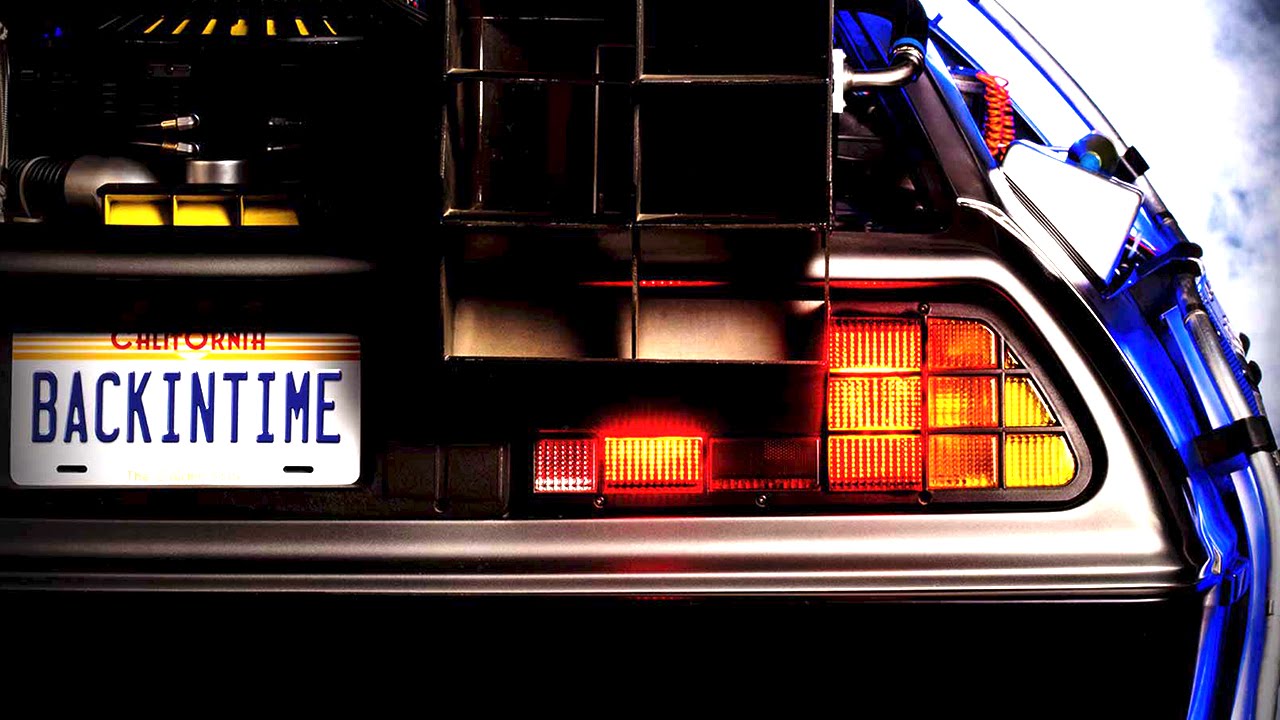
Terry & Oliver Holler, who travel the world in their homemade DeLorean time machine to raise funds for the Michael J. Fox Foundation
This is where the film becomes something more than a simple retrospective. The focus on individual stories ironically is more effective at reminding you why you care about this franchise than the more traditional clips and talking head approach.
Back in Time is an easy recommendation for fans of the Back to the Future series. While you likely won’t learn anything new, the access to the cast and filmmakers alone make it worth your time, and the focus on the fans provide the most compelling reason to watch both the doc and the film series.
Poster:
Trailer:
https://vimeo.com/ondemand/backintime
Bechdel Test:
n/a
The Representation Test Score: n/a
[schema type=”movie” url=”http://www.backintimefilm.com” name=”Back in Time” description=”The documentary film Back in Time is, at its heart, a look at the very real impact the Back to the Future movies have had on our culture. Funnily enough, the film’s genesis is a testament to how large that impact truly is. The project’s origins are humble: what started as an amusing addition to a Bar Mitzvah video, just happened to resonate and get stuck in director Jason Aron’s head. The Back to the Future trilogy had been a childhood inspiration which led to his career in film, and the idea of the De Lorean time machine wouldn’t leave his thoughts alone.
Those thoughts blossomed into idea for a film which would delve into the impact of the iconic machine. A plan was drawn up, and a Kickstarter campaign was launched. Over 600 backers helped the team supplement the feature’s budget, and for the past couple of years that money has gone to help Back in Time become something so much more than anyone involved ever imagined that it could be.
What was once a little idea that spawned a tightly-focused documentary has grown into something truly amazing over two years of filming. Instead of just a look at the eye-catching De Lorean, Back in Time is a cinematic monument to the vastness of the trilogy’s fandom. In addition to the footage and interviews revolving around the time machine itself, the crew found that simply by delving into the impact of the trilogy an epic journey began to unfold before them.
Shooting in London, England during a Back to the Future event, hundreds of attendees in 1950’s attire were captured for the documentary as they reveled in their shared love of the films; the crew got to set feet upon one of the prophesied hoverboards during a shoot at Hendo Hoverboards; and trips all across America took them from brightly-lit time machine-filled garages to the sun-kissed homes of some truly unforgettable faces.
The crew captured countless hours of footage during filming. From Robert Zemeckis and Bob Gale, to the Sheas and Hollers, and from James Tolkan and Lea Thompson to Christopher Lloyd and Michael J. Fox, Back in Time features interview after interview that simply must be seen.
The scope of the impact of the Back to the Future trilogy is truly something to behold. Back in Time will premier in the fall of 2015 thanks in great part due to the support of a legion of fans. Digital and physical copies of the documentary will be made available after the premier, with precedence going to all those who backed the film’s Kickstarter campaigns.” director=”Jason Aron” ]
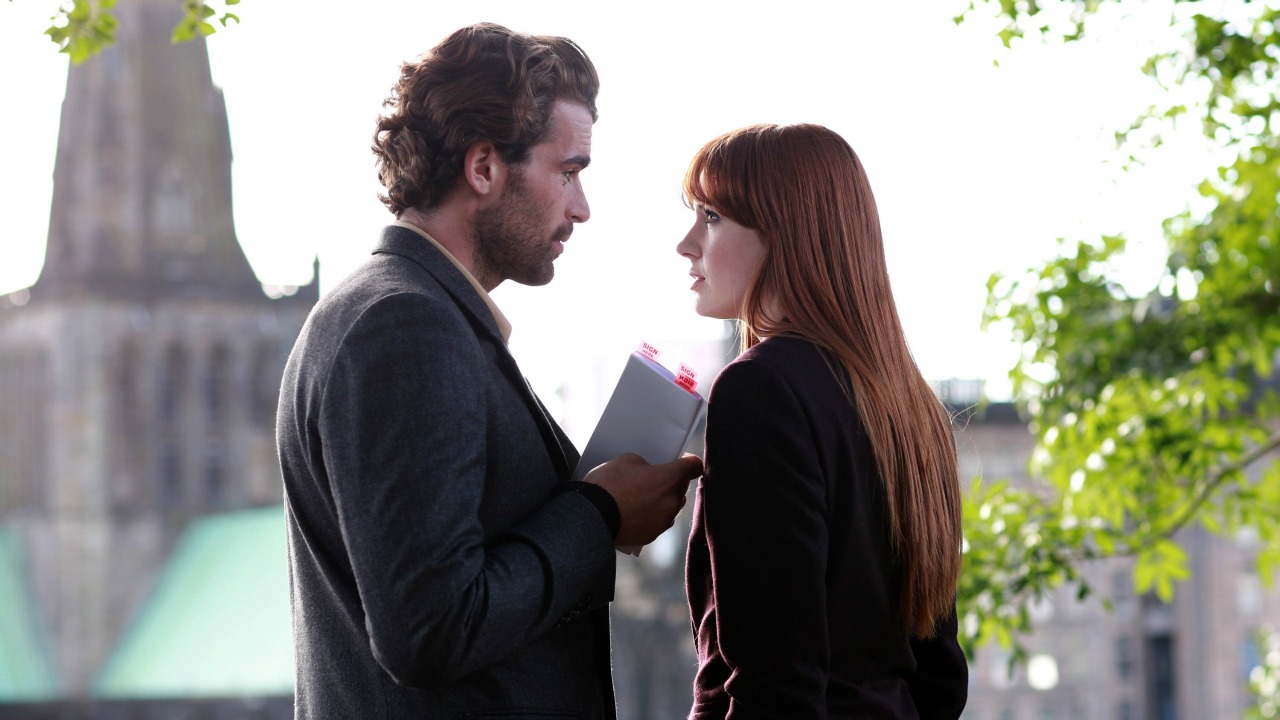
In some ways, a meet-cute rom-com of the sort you’ve seen many times. But it’s Karen Gillan…and chemistry with Stanley Weber wonderful…
Spoiler-free Movie Review of Not Another Happy Ending:
Since the Chicago Cubs failed to fulfill the Back to the Future, Part II promise of winning the 2015 World Series two nights ago (I couldn’t even talk about it yesterday), I need some cheering up. So why not take a look at an under the radar romantic comedy starring my favorite Doctor Who companion, Karen Gillan.
(Aside: how like the Cubs is it to get eliminated from the playoffs on the very day they were predicted to win it all? It was their “density”! That’s so Cubs…)
Not Another Happy Ending is a partially crowdfunded 2013 indie comedy filmed in Glasgow. The Scottish setting is lovely and refreshing. DP George Geddes films a collection of beautiful scenes. And the costume design by Louise Allen is amazing – Gillan’s outfits are Annie Hall style trend-setting. Or at least they should be…
Gillan is a wonderful actress and this is one of the few times she’s really been allowed enough time to show it. I’m not going to be watching her horror film (Oculus), and they cancelled her ABC comedy Selfie, so this is a film I’m going to be returning to in order to watch her work.
(Aside: Selfie was not a good TV show, but it had potential. It was DOA, earning a spot on most critics “first to be cancelled” prediction lists, and not without reason. But I would have liked to see it get more of a chance. The whole thing was a little too obvious and self-aware, trying too hard, but John Cho and Gillan were wonderful together and both really deserve a great show.)
The synopsis of the film is correct but a little incomplete, which took me out of the film-watching experience a bit. I was thinking back to the story I expected instead of just watching the story that was actually on screen. In an effort to prevent others from this same experience, my quick recap is going to be a little longer than usual. I don’t think I’m spoiling anything, just clarifying. The summary, that an editor finds that his best author can’t write when happy so he tries to make her sad, is fantastic; it’s a perfectly good blurb on the film. However, that storyline doesn’t really start until halfway through the picture.
Written by David Solomons, Not Another Happy Ending tells the tale of Jane Lockhart (Gillan), an author struggling to get her first novel published. Tom Duvall (Weber), editor of a small publishing company, spots a diamond in the rough and the two fight and flirt through the process of editing her highly personal, almost memoir. The gruff, impersonal Frenchman and the quirky, earnest Scot have great chemistry, sparks obvious to everyone but themselves. They fall out regarding the title of the novel, vowing never to work together again; then the book is a hit.
So the excellent pitch that he needs to unblock the author takes place over a much more rich and interesting backdrop than may be expected from the premise. There’s lots of great stuff about Lockhart’s new-found success and the separate struggles of Lockhart and Duvall.
The cast is fantastic; I’ll stop gushing about Karen Gillan, lest I lose any remaining credibility as an impartial critic. Stanley Weber is a wonderful foil – dreamy and full of Gallic intensity, he handles scenes of quiet and bombast equally well.
Iain deCaestecker (Fitz from Marvel’s Agents of Shield) steals every scene he is in as Roddy, Tom’s best mate. Similarly, Amy Manson impresses as Darsie, Jane’s come to life protagonist. Gary Lewis as the senior Lockhart is nicely subdued, expressing the range of a father’s emotions with a performance rather unlike anything I think I’ve seen before. It’s quietly impressive.
Not Another Happy Ending is an easy recommendation. It’s a rom-com, so if that isn’t your cuppa, you know to steer clear. But it is a very good one that sparkles because of the leads and a refreshingly unique storyline.
As is becoming an annoying trend, the 2013 film didn’t hit the states until appearing late 2014 online and on DVD in January of this year. I don’t think it ever saw theatrical release in the US. But it is readily available online from a number of services; I encourage you to give it a try…
[schema type=”movie” url=”http://www.filmmovement.com/filmcatalog/index.asp?MerchandiseID=426″ name=”Not Another Happy Ending” description=”Jane Lockhart (Doctor Who’s Karen Gillan) has pulled off a rare feat with her debut novel â?” critical acclaim and mainstream success. But now, with just the last chapter of the follow-up to write, she encounters crippling writer’s block. It’s bad news for her, and the worst possible circumstance for her publisher, Tom, his company nearly bankrupt. Like all good authors, Jane writes best when miserable, and her newfound literary success, a handsome playwright boyfriend (Henry Ian Cusick, Lost) and a renewed relationship with her father has her happier than ever. With her writer’s block spiraling out of control, even Jane’s fictional characters intrude in her real life, terrified they won’t get the ending they deserve. So Tom, depending on her next book to save his business, takes it upon himself to singlehandedly dismantle every happiness in Jane’s life. As Jane all but gives up on writing the end of the story, Tom’s misguided tampering may just backfire into one very unexpected happily ever after.” director=”John McKay” actor_1=”Karen Gillan” ]
Never read the books and I’m not the target audience, but I thought it was a great scarefest for kids and funny enough for their parents…
Spoiler-free Movie Review of Goosebumps:
I don’t like being scared. I really don’t. I’m a great big coward about scary movies & books, and if I ever go missing, don’t waste time looking for me at a haunted house because I’d die on the front step before ever entering. But I thought I could probably handle a kids scary movie. At least if my daughter went with me and we could hold hands…
The relationship of kids and fear is fascinating. I remember when the whole Goosebumps phenomenon hit in the 90’s (when I was well outside of the target demographic); I was mystified that kids would willingly read books meant to scare them. I had always assumed that everyone was as much of a wuss as me, despite a childhood full of evidence that I was a grade A wimp.
I’m certain much better read scholars can explain all of the sociological and developmental factors at work better than I. All I know is kids need to learn to face their fears and scary stories are an entirely healthy way to do so. Probably. I’m still not watching The Exorcist to find out if that’s true, though…
I like Jack Black and the trailers looked good, so we headed into the local theater to be scared. (Not in 3D, though. No way…)
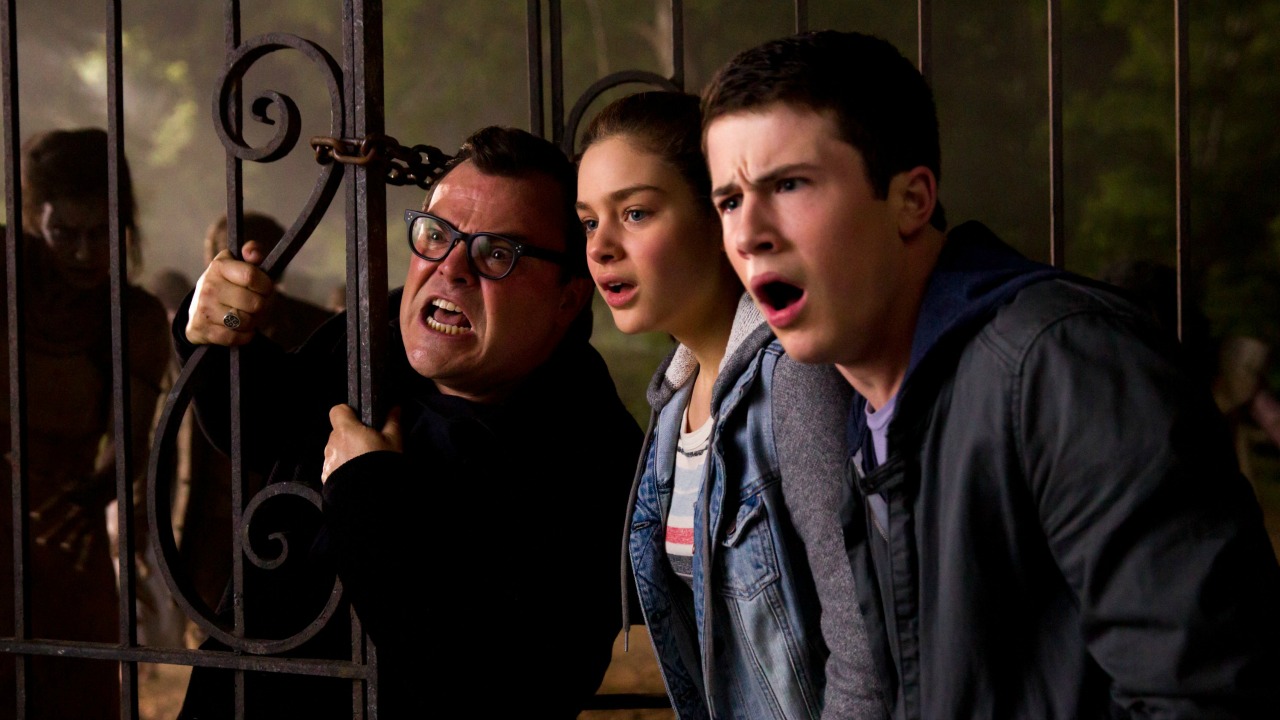
The premise for the Goosebumps film is really quite clever; author R.L. Stine came up with all these monsters as a coping mechanism as an unhappy kid. He put so much of himself into it they became real to him, then actually became real. Since then, he’s been keeping the monsters literally locked in the manuscripts of the stories he wrote. Of course they escape, raise heck (it is a kids movie, after all) and people learn valuable life lessons.
Screenwriters Scott Alexander & Larry Karaszewski came up with the great story concept that provides a vehicle for introducing as many characters from the book/tv series as they want and have time for. Makes for a rich movie, if a bit overcrowded. Darren Lemke would write the script that pulled it all together. Not sure who had the idea about providing a backstory for Stine, but while it may sound hokey, it really works very well and provides a great structure for the tale.
The CG effects are ok, but no better than they need to be. One of the five (?!) production companies behind the film is actually Sony Pictures Animation, which should give you some indication of just how heavily they’d be relying on CG.
Some of the Goosebumps monsters are creepy, some are funny; none seem to be terrifying. I can certainly imagine some kids having nightmares. I don’t really need to speculate too much – I saw one parent leading her crying kids out of the picture after the first big bad hit the town. To be fair, I think they were a bit young to be there – most of the kids in the audience seemed to be having a great time. Be advised, though, while as usual your mileage may vary, know your kid – on the big screen some of the characters were definite nightmare fuel, particularly the main baddie, a ventriloquist dummy.
The acting is fun, with Black hamming it up in several roles and affecting an odd but effective accent for his turn as the children’s author. The teens mostly look like believable teenagers, and the lead trio of Dylan Minnette (Zach), Odeya Rush (Hannah) and Ryan Lee (Champ) work very well. The usually enjoyable Ken Marino is in the film for no reason I can detect.
Danny Elfman provided the score, reflecting the film’s obvious aim for a perfect balance of funny and scary. In my opinion they got the balance right, but I’m sure there are those who find Black’s overacting irritating; probably the long-time book fans.
Goosebumps is exactly what it tries to be – a Halloween styled funny movie, scary enough to provide genuine thrills, but not enough to make older kids actually terrified. Their younger siblings may not see much of the film hiding behind the seats, though…Recommended.
Odd facts:
Tim Burton tried to produce a Goosebumps film way back in 1998.
R.L. Stine created the magazine Bananas? I totally forgot about Bananas; we used to order that through school book fairs! He also wrote for Dynamite, another lunchroom fave…
[schema type=”movie” url=”http://www.goosebumps-movie.com/” name=”Goosebumps” description=”Upset about moving from a big city to a small town, teenager Zach Cooper (Dylan Minnette) finds a silver lining when he meets the beautiful girl, Hannah (Odeya Rush), living right next door. But every silver lining has a cloud, and Zach’s comes when he learns that Hannah has a mysterious dad who is revealed to be R. L. Stine (Jack Black), the author of the bestselling Goosebumps series. It turns out that there is a reason why Stine is so strange… he is a prisoner of his own imagination – the monsters that his books made famous are real, and Stine protects his readers by keeping them locked up in their books. When Zach unintentionally unleashes the monsters from their manuscripts and they begin to terrorize the town, it’s suddenly up to Stine, Zach, Hannah, and Zach’s friend Champ (Ryan Lee) to get all of them back in the books where they belong.” director=”Rob Letterman” actor_1=”Jack Black” ]
A teenager teams up with the daughter of young adult horror author R.L. Stine after the writer’s imaginary demons are set free on the town of Greendale, Maryland.