Category: Books

  • Armada (2015)

    Armada (2015)

    Armada
    Armada by Ernest Cline

    My rating: 4 of 5 stars

    Your summer read has just arrived.

    Ernie Cline, patron saint of 1980’s geeks and author of the wildly successful Ready Player One is back with a new novel, Armada.

    In Armada, Cline invokes the spirit of 80’s sci-fi adventure books and films like The Last Starfighter, Ender’s Game, Flight of the Navigator and WarGames in a classic tech-based coming of age tale. Indeed, it is very hard to summarize the plot of Armada without either giving away too much or making it sound like a rip-off of the previously mentioned works.

    It is a wholly original story, though, despite a plethora of influences, which, to his credit, Cline name-checks early and often. If you thought Ready Player One contained a lot of references, Armada is absolutely bursting at the seams with them. Too many? Maybe.

    The big concern with Ready Player One when first announced was whether this 1980’s-centric premise would be gimmicky. In the end, the excellent storytelling overcame those fears. In the case of Armada, I was more worried about the 80’s obsession overrunning the book, as it was now the author’s sophomore effort and wouldn’t get a free pass for originality. I needn’t have worried. In Ready Player One, the geeky references are elevated above nostalgia as they are integral to the plot. Armada doesn’t rely so heavily on the pop culture stuff for the story itself – it’s there more for color. Whether this makes the 3000 references to old videogames and movies more or less enjoyable to you is somewhat a personal opinion. I found all that stuff great, but I can easily see that it may not play for everyone.

    Armada

    Thematically, Armada repeats many of the first books beats; young male outsider as protagonist, parental loss, geeky love interest. This doesn’t make the work seem overly familiar, thankfully, but it will be interesting to see if Cline branches out a bit more with future novels.

    In all of the reviews you read or hear about Armada, you will likely encounter mostly comments about the geeky pop culture subjects and references. I certainly fell into that trap here. What’s lost in this focus, however, is the success of Armada as a science-fiction novel. Even more than in his first novel, Cline really shows an impressive command of battle descriptions. The aerial combat is depicted visually right into your mind, as though you were reading a novelization of a film you’d seen many times. No wonder the novel was optioned for film long before publication…

    One thing about Armada that I find interesting; despite the focus on the 1980’s, Ready Player One was set in 2044. Armada is set in our very near future, but the advances in virtual reality (VR) between the writing of Cline’s first novel and second (many of which he has inspired) inform the developments in his literary world. Put simply, this means that his predictions for the exciting future of VR are forecasted far ahead of the earlier schedule. I find this exciting…

    Armada is a very easy recommendation. It’s an enjoyable tale with some clever ideas and a sense of fun to match its many influences. The characters are interesting and well-written and Cline displays a real gift for writing the action scenes.

    The audiobook version narrated by Wil Wheaton is excellent, too!

    Oh, and after you’ve read the book, go here: http://www.earthdefensealliance.com/

    Armada

    [schema type=”book” url=”http://www.armadabook.com” name=”Armada” description=”THE NEW NOVEL FROM THE BESTSELLING AUTHOR OF READY PLAYER ONE It’s just another day of high school for Zack Lightman. He’s daydreaming through another boring math class, with just one more month to go until graduation and freedom—if he can make it that long without getting suspended again. Then he glances out his classroom window and spots the flying saucer. At first, Zack thinks he’s going crazy. A minute later, he’s sure of it. Because the UFO he’s staring at is straight out of the videogame he plays every night, a hugely popular online flight simulator called Armada—in which gamers just happen to be protecting the earth from alien invaders. But what Zack’s seeing is all too real. And his skills—as well as those of millions of gamers across the world—are going to be needed to save the earth from what’s about to befall it. Yet even as he and his new comrades scramble to prepare for the alien onslaught, Zack can’t help thinking of all the science-fiction books, TV shows, and movies he grew up reading and watching, and wonder: Doesn’t something about this scenario seem a little too… familiar? Armada is at once a rollicking, surprising thriller, a classic coming of age adventure, and an alien-invasion tale like nothing you’ve ever read before—one whose every page is infused with author Ernest Cline’s trademark pop-culture savvy.” author=”Ernest Cline” publisher=”Crown Publishing” pubdate=”2015-07-14″ isbn=”0804137250″ ebook=”yes” hardcover=”yes” ]

  • Dark Disciple: Star Wars (2015)

    Dark Disciple: Star Wars (2015)

    Dark Disciple: Star Wars
    Dark Disciple: Star Wars by Christie Golden

    My rating: 4 of 5 stars

    Note: this review was written based on a Digital Review Copy (DRC) uncorrected galley proof provided by NetGalley (https://s2.netgalley.com/catalog/book/65783)

    When Disney abruptly and unwisely canceled The Clone Wars animated TV series following their purchase of Lucasfilm, it was inevitable that there would be a number of unfinished stories in various stages of development. Animation has one of the longest lead cycles of any creative endeavor, and things that are seeing release today are the product of years of development.

    The Clone Wars was wildly popular, with a dedicated creative team with no expectation that the series was coming to an end, so the unceremonious pulling of the plug meant not only that many things didn’t get wrapped up, but that some storylines that had already been completed had not seen the light of day and now had no venue to see release.

    A few of the nearly completed episodes were haphazardly sewn together into an inaccurately named set called The Lost Missions, that wasn’t really lost nor a series of missions, and this was kinda, sorta, Season Six. It was a Netflix exclusive until it was put on disc a little while later, and while the circumstances surrounding the whole affair give the impression of a slapdash scraping of the bottom of the barrel, the episodes are nothing of the sort. The Lost Missions are a bittersweet ending for the series, since they aren’t an ending at all, but display all the quality of the rest of the series and make you even more dismayed that it was shuttered.

    A few other episodes have been portioned out as animatics and such, but we’ve likely seen the last of the animated series itself. Fortunately, there is still the less expensive to produce medium of novels in which these stories may still escape.

    At least there was until the equally ill-advised decision to scrap the entirety of the long-running Expanded Universe (EU), designating nearly forty years of novels, comics and other stories as “Legends”, and keeping only the past couple of things in play.

    Ok, I told myself I wasn’t going to do this here but I need to spend a minute on this EU Legends thing. The choice to throw out all of the material that was created before you arrived is so unbelievably disrespectful to the authors and fans of said work that it could only come from a massive multi-national company like Disney. Or could it? After all, George Lucas himself was completely indifferent to the things he didn’t personally create. Sure, he’d dip into it once in a while, when he saw something interesting he wanted to grab and use for his own purposes, but that is your right with licensed properties.

    Years ago I wrote an unpublished piece to TheForceCast (the podcast of theforce.net) railing against Lucasfilm’s cavalier attitude concerning the works they had licensed. (Sidebar: the near continuous dumping on the EU is why I finally stopped listening to the show.) If you’re really interested, here’s the bit: https://www.nowverybad.com/odds-and-ends/

    I found it insulting that they considered these stories good enough for me to spend my money on, but not good enough for them to actually take seriously or feel any obligation to acknowledge when coming up with new stories for The Clone Wars show. (Which spawned, wait for it, more licensed stories; none of which count anymore, either. Explain that one…) So this one can’t really be laid at Disney’s door. Lucas, after all, is the one who came up with new storylines for Episodes 7-9 as part of selling his company. (Want a bit of amusing irony? The creative team behind the new films isn’t following his stories…)

    I understand the dilemma the new creative team behind the next set of films faces. I really do. You want to forge a new future for the franchise, but oops, you already have the next several decades of the Star Wars timeline filled in by authorized tales. I’m not unsympathetic, but it was your decision to make 7, 8 and 9; not mine. It’s not as though they couldn’t have used the broad strokes of the Expanded Universe and created adaptations of fan-loved stories. In fact, it would have been heaps easier. Marvel Studios will NEVER run out of their own stories to adapt and they’re doing pretty well over there. They have yet to actually write a truly original screenplay for any of their pictures so far; they are all adaptations. By my estimation, Marvel may not even need to write an original comic story ever again and they will still have enough material to make movies for, oh, say, 50 years.

    Sorry for the long interlude on the EU thing. I really didn’t intend to go into it here, but it’s really difficult to discuss the new wave of Star Wars stories without dealing with this. In fact, what are they planning on calling these “new EU” stories? If the non-movie stuff before was called the Expanded Universe and now is classified “Legends”, what should we call non-movie “canon” stuff that’s being produced now? NU-EU?

    Dark Disciple: Star Wars
    “Get on with it!”

    So, back to the book itself…

    Dark Disciple is based on a story by Katie Lucas, Head Writer Matt Michnovetz, and Series Supervising Director Dave Filoni that would have been an extended arc of eight episodes on Season Seven of The Clone Wars. Lucas has memorably written previously for the show and particularly for the character of Asajj Ventress, notably with the Savage Oppress arc of Season Four.

    In Dark Disciple, the Jedi Council, appalled at the most recent atrocity of Count Dooku, this time the near complete genocide of a race of aliens, takes the uncharacteristic and unprecedented step of sanctioning the assassination of the Separatist leader. The instrument they choose to perform this most un-Jedi act is Master Quinlan Vos, who has previously flirted with the Dark Side and worked undercover for Dooku (or has he? I don’t think those stories count anymore…)

    Since Vos stands little chance of getting close to the public face of the Confederacy of Independent Systems (the Separatists), Master Obi-Wan Kenobi suggests enlisting the assistance of former Dooku apprentice Asajj Ventress. Of course, Ventress is hardly a friend of the Jedi, even if she did briefly ally with Kenobi against the sort-of Sith brothers Darth Maul and Savage Oppress – enemy of my enemy and all that – so Vos will have to be clever in tricking Ventress to help him, posing as a fellow bounty hunter. Oh yeah, Ventress is a bounty hunter now, finding it the best option for survival after her revenge attempt against Dooku for trying to kill her failed and he massacred her family, the Nightsisters.

    You know, as I try to summarize the plot of Dark Disciple, I’m kind of making the point of the EU-bashers for them – that the Expanded Universe got too convoluted and detailed to follow and created a huge barrier to entry. Which would all be fair, except that everything I just summed up happened on the TV show. That’s a TV show for kids that ran for only five seasons, with Ventress’s story making up only a fraction of those episodes. Sure, I intentionally wrote some of the previous history above with an eye to satire – making the whole thing sound sort of like a comic book / soap opera. Because make no mistake, any long-running franchise has to face and cop to the completely valid criticisms of being over-complicated and not noob-friendly.

    The fact is, I’m not sure you can completely avoid excluding new fans from any series any more than you can keep basketball discriminating against short people (stolen from 1980’s Doonesbury strip by Garry Trudeau). Let’s face it, these Expanded stories, whatever they want to call them, are aimed at existing fans – it’s like selling coffee mugs at a café – you are cultivating your audience from an existing group that has already shown an interest in your product. Sure, you want to increase your base, which is why that’s not the only place you sell your mugs, but you have to know where your main customer lives, so to speak.

    Asajj Ventress is one of the most interesting characters to come from the Expanded Universe and The Clone Wars (she was an EU character first, of course – created for stories that now don’t count…). A former Jedi Padawan who came to hate the Jedi for what she perceived to be their failing of her master; a former slave who transformed herself into a skilled warrior and dark-side adept, pledging her allegiance to a fallen Jedi turned Sith Lord who responded with no such allegiance; an orphan whose surrogate families have been repeatedly destroyed.

    Quinlan Vos, too, is a product of the EU and one of its most popular characters. A Jedi who has walked the narrow path between the dark and the light; particularly adept at undercover work but divided by his split roles; a Kiffar with an ability to gain information about objects by a mere touch who always been forced to remain untouched by attachment.

    The narrative works very well, pairing these two multi-faceted characters on a mission of dubious morality. One of the things the TV show struggled most with was the tonality and seriousness of the stories. Star Wars is theoretically supposed to be family-friendly entertainment, but, well, it does have the word “war” in the title. Sometimes these things get dark. Throughout all of the material, canon and otherwise, creators (even the notorious GL) have searched for the right amount of gravity and import, the whole dark/light balance. The Dark Horse Comics telling of the Clone Wars tended to deal more plainly with the adult-oriented war stories, but the TV show itself occasionally featured murder, terrorism, torture, suicide bombing and slavery. These episodes would sometimes follow a light-hearted escapade with Jar-Jar or the droids.

    Here in Dark Disciple, author Christie Golden is able to indulge in a story that fully explores the nature of the Dark Side, treachery, secrecy and the lengths to which you will go to achieve your goals.

    The story may be a touch on the long side, but not by much and not because it wasn’t interesting. Golden writes Star Wars very well and brings the tale to life with good beats and a strong story. I really enjoyed the consistent characterization and the integrity of the story along its predecessors. I can’t imagine that this would have been any better as a fully realized TV story. Highly recommended for fans of the Wars…

    Bonus:

    Check out some cool concept art from the proposed show: http://www.starwars.com/tv-shows/dark-disciple-concept-art-gallery

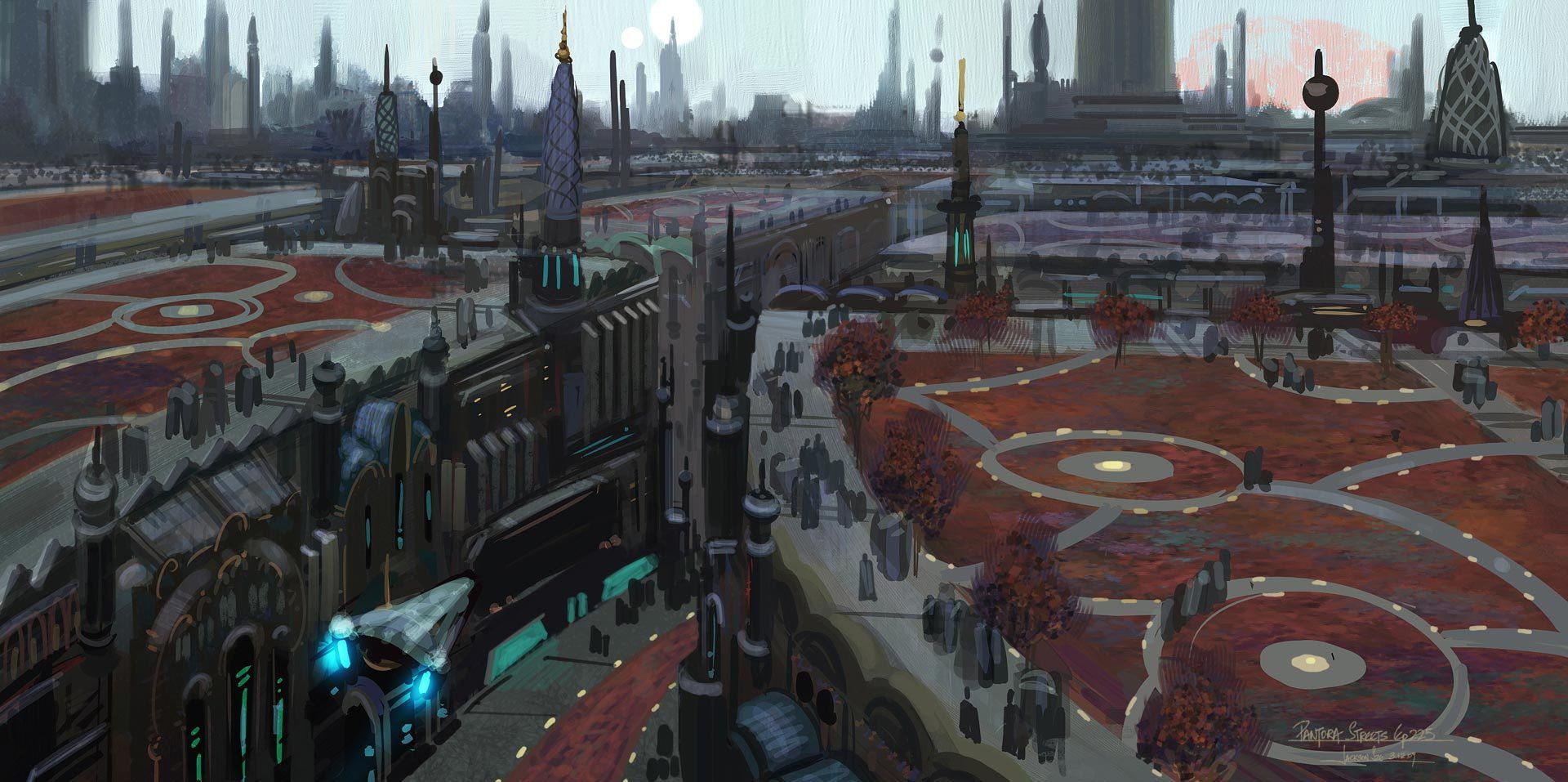
    Pantora
    Concept art of the streets of Pantora by Jackson Sze.

    [schema type=”book” url=”http://www.randomhousebooks.com/books/7868/” name=”Dark Disciple: Star Wars” description=”Based on unproduced scripts from the blockbuster TV show Star Wars: The Clone Wars! The only way to bring down the dark side’s most dangerous warrior may be for Jedi and Sith to join forces. In the war for control of the galaxy between the armies of the dark side and the Republic, former Jedi Master turned ruthless Sith Lord Count Dooku has grown ever more brutal in his tactics. Despite the powers of the Jedi and the military prowess of their clone army, the sheer number of fatalities is taking a terrible toll. And when Dooku orders the massacre of a flotilla of helpless refugees, the Jedi Council feels it has no choice but to take drastic action: targeting the man responsible for so many war atrocities, Count Dooku himself. But the ever-elusive Dooku is dangerous prey for even the most skilled hunter. So the Council makes the bold decision to bring both sides of the Force’s power to bear—pairing brash Jedi Knight Quinlan Vos with infamous one-time Sith acolyte Asajj Ventress. Though Jedi distrust for the cunning killer who once served at Dooku’s side still runs deep, Ventress’s hatred for her former master runs deeper. She’s more than willing to lend her copious talents as a bounty hunter—and assassin—to Vos’s quest. Together, Ventress and Vos are the best hope for eliminating Dooku—as long as the emerging feelings between them don’t compromise their mission. But Ventress is determined to have her retribution and at last let go of her dark Sith past. Balancing the complicated emotions she feels for Vos with the fury of her warrior’s spirit, she resolves to claim victory on all fronts—a vow that will be mercilessly tested by her deadly enemy . . . and her own doubt.” author=”Christie Golden” publisher=”Del Rey” pubdate=”2015-07-07″ isbn=”0345511530″ ebook=”yes” hardcover=”yes” ]

  • An Unwelcome Quest – Magic 2.0 #3 (2015)

    An Unwelcome Quest – Magic 2.0 #3 (2015)

    An Unwelcome Quest
    An Unwelcome Quest by Scott Meyer

    My rating: 4 of 5 stars

    I love being wrong nearly as much as I enjoy being surprised. With An Unwelcome Quest, I got both. I really expected this thing to run out of gas by now, but to my happy surprise, An Unwelcome Quest was my favorite of the three books in the Magic 2.0 series.

    Although I loved Spell or High Water, it was a rather involved story, with several arcs going at once. They all worked very well together, but I still welcomed the more direct and linear plot of An Unwelcome Quest.

    Almost of the characters have been established in at least one of the previous books, so the novel just jumps in and gets going.

    In a plot slightly foreshadowed in Spell or High Water, former wizard apprentice Todd, exiled for his obvious evil tendencies, obtains access to the program and seeks revenge against the other “wizards”. Instead of a simple murder attempt or direct violence, Todd transports those responsible for his banishment into a computer RPG of his own design, removing his targets powers for good measure.

    To be totally honest, that didn’t sound like a real promising story when I read the blurb. It was too simple, too pat. But that’s sort of the brilliant thing about it; with a simple mandate, the characters get to be themselves – maybe more than usual. There’s something wonderfully contrary about each of the wizards – it’s what led them to the program and the Middle Ages in the first place. So forced into a structured situation where their actions are mandated, they hilariously refuse to follow the narrative at all. It’s pretty great, actually; their would-be tormentor is increasingly frustrated by their unwillingness to play along with his involved vengeance scheme.

    Far from being let down by a needless attempt to continue a concept past its usefulness, I loved An Unwelcome Quest and now actually hope there are more installments in the series.

    Todd smiled. “I just thought I’d give you the opportunity to explain Foucault’s pendulum to your friends.” Tyler said, “Sure. There was this guy. His name was Foucault. He got himself a pendulum. They called it Foucault’s pendulum.” – this is my favorite joke in the whole book; don’t ask me why…

    [schema type=”book” url=”http://www.basicinstructions.net” name=”An Unwelcome Quest (Magic 2.0 #3)” description=”Ever since Martin Banks and his fellow computer geeks discovered that reality is just a computer program to be happily hacked, they’ve been jaunting back and forth through time, posing as medieval wizards and having the epic adventures that other nerds can only dream of having. But even in their wildest fantasies, they never expected to end up at the mercy of the former apprentice whom they sent to prison for gross misuse of magic and all-around evil behavior. Who knew that the vengeful Todd would escape, then conjure a computer game packed with wolves, wenches, wastelands, and assorted harrowing hazards—and trap his hapless former friends inside it? Stripped of their magic powers, the would-be wizards must brave terrifying dangers, technical glitches, and one another’s company if they want to see Medieval England—and their favorite sci-fi movies on VHS—ever again. Can our heroes survive this magical mystery torture? Or will it only lead them and their pointy hats into more peril?” author=”Scott Meyer” publisher=”47North” pubdate=”2015-02-10″ isbn=”1477821406″ ebook=”yes” paperback=”yes” ]

  • Spell or High Water – Magic 2.0 #2 (2014)

    Spell or High Water – Magic 2.0 #2 (2014)

    Spell or High Water
    Spell or High Water by Scott Meyer

    My rating: 4 of 5 stars

    I read the first book in this series, Off to be the Wizard (Magic 2.0 #1) last summer and enjoyed it for the fun read it was. I didn’t dive right into the sequel as I planned to, because reasons. This may partly explain why it didn’t grab me immediately as the first novel did.

    I think I was reading the Edgewood series by Karen McQuestion series at the same time, and while I quite enjoyed the first one, the sequels were really just more of the same. I think that’s why I haven’t reviewed those yet – I don’t really have anything positive or negative to add to the discussion and I’ve found that in the absence of anything positive that I want to discuss, my writing leans a little towards the critical side, and that’s not fair.

    So I suppose I was feeling a little jaded about sequels at that point. But then, on my second approach to Spell or High Water, it stuck. I’m not sure exactly where the changeover occurred; for some time I was unenthusiastically plowing through familiar territory and in the next minute I found myself really enjoying the story.

    In Spell or High Water, the characters of Off to be the Wizard take their act on the road, visiting Atlantis. Actually, it’s not really the lost city, rather a utopian construct created by new character Brit the Elder. See, her timeline split so that there are actually two versions of Brit occupying the same timeline – one who is proceeding through time semi-linearly and the other who has already experienced these events. I think it was around the introduction of this character that I put down the book for a while.

    But once past that odd storyline, Spell or High Water settles into a good rhythm with the split plotlines of Martin, Gwen & Philip trying to stop Brit from being killed, and that of the formerly banished Jimmy trying to make his way back to the program. Jimmy’s scenes are actually quite funny, making this character much more enjoyable to follow than in the first book.

    There’s a lot of great stuff with the man-servants of the female-run Atlantis and the seemingly pointless assassination attempts, but mainly author Scott Meyer focuses on what he does best: dialogue. This guy writes terribly funny stuff. The characters of Philip & Martin bicker like an old married couple and play well off of the third lead, Gwen, but really all of the characters get some fantastic lines. The entire complement of “wizards” are a riot, and there’s a whole lot more of them this time.

    Ultimately, that is why, against all expectation, I preferred Spell or High Water to Off to be the Wizard. Both are a good time, but it was faith restoring to find a sequel that builds off of all of the good ideas from the original work while pushing forward with new ones. Recommended.

    [schema type=”book” url=”http://basicinstructions.net/store/” name=”Spell or High Water – Magic 2.0 #2 (2014)” description=”The adventures of an American hacker in Medieval England continue as Martin Banks takes his next step on the journey toward mastering his reality-altering powers and fulfilling his destiny. A month has passed since Martin helped to defeat the evil programmer Jimmy, and things couldn’t be going better. Except for his love life, that is. Feeling distant and lost, Gwen has journeyed to Atlantis, a tolerant and benevolent kingdom governed by the Sorceresses, and a place known to be a safe haven to all female time-travelers. Thankfully, Martin and Philip are invited to a summit in Atlantis for all of the leaders of the time-traveler colonies, and now Martin thinks this will be a chance to try again with Gwen. Of course, this is Martin Banks we’re talking about, so murder, mystery, and high intrigue all get in the way of a guy who just wants one more shot to get the girl. The follow-up to the hilarious Off to Be the Wizard, Scott Meyer’s Spell or High Water proves that no matter what powers you have over time and space, you can’t control rotten luck.” author=”Scott Meyer” publisher=”47North” pubdate=”2014-06-17″ isbn=”1477823484″ ebook=”yes” paperback=”yes” ]

  • The Lost World (1995)

    The Lost World (1995)

    The Lost World
    The Lost World by Michael Crichton

    My rating: 3 of 5 stars

    Michael Crichton never wrote a sequel to any of his novels until Steven Spielberg talked him into doing so following Jurassic Park. He never wrote another sequel after The Lost World, either. Make of that what you will…

    That may sound like the buildup to a very negative review, but the truth is I mostly like The Lost World. The book, that is. The movie is crap, but we’ll get to that with the next review…

    Sure, the biggest problem with the novel is that there is no pressing need for it to exist; it’s a blatant cash-in and marks probably the only opportunistic move of Crichton’s career. But The Lost World is not at all a bad tale for all of that. The main reason is that Crichton actually comes up with a creative and interesting premise.

    Despite the ridiculous tagline of both the novel and the film, “Something has survived”, The Lost World is not simply a variation on a theme – a sequel being created out of the ashes of the first story that callously and simplistically tosses aside the logic of the original. Mostly…

    It certainly starts that way, not only retconning Ian Malcolm back to life but rehashing the “strange animals appearing in South America” opening of the first book. Other than the obvious logical leap that Malcolm wasn’t actually killed in Jurassic Park, the structure is fairly tight.

    Malcolm was an interesting character in the first book, but he has actually undergone obvious changes and growth as a result of his experience on Isla Nublar six years earlier. So Crichton introduces a new arrogant and irritating genius, Richard Levine, who possesses none of the likability or charm of Malcolm, making his parts of the novel joyless. That the character didn’t make the film adaptation is absolutely no surprise.

    The conceit is simple but clever: Jurassic Park was a tourist attraction, not a serious manufacturing plant. No enterprise of this scale could possibly have presented as well as the park on Isla Nublar did (you know, before people started getting eaten). Levine and Malcolm postulate that the actual cloning and growing of the animals must have taken place at a different location. It’s certainly a better concept than I would have expected; that’s a solid, reasonable assumption, and so the existence of another South American island full of dinosaurs isn’t (totally) as ludicrous as it sounds when I repeat it. In the film, the raison d’être is mentioned in passing ten minutes into the picture in possibly the all-time worst and most rushed exposition scene of all time. But in the novel, the explanation doesn’t take place until a quarter of the way through the book, and it’s the best scene in the whole thing.

    Other than that, it’s pretty straightforward. There are different wrinkles this time, newer characters and newer perils, but it’s more or less the same adventure from the first story. Malcolm even gets severely injured and delivers scholarly dissertations while doped up on morphine – again.

    Other than Levine, the new characters are pretty good. Characterization isn’t Crichton’s long suit, but it’s nice to see a strong female character in Dr. Sarah Harding. Actually, the dynamic isn’t radically different from Jurassic Park – a male & female scientist as the leads, two precocious kids, a sacrificial outdoorsman and a few other characters to pad the body count.

    The Lost World novel shares a somewhat unsatisfactory ending with the original Jurassic Park. There are some great set-pieces in the book, but the story doesn’t end much differently than it began, just with fewer people.

    I suppose the only reason I can’t wholeheartedly recommend The Lost World is the futility of the thing. Crichton does a good job making you understand why Malcolm would willingly go back into the T-Rex’s Den, so to speak, but he’s the only person with a respectable reason. The only other character who seems to have plausible motivation is the “villain”. #WeGotDodgson

    we got dodgson here

    Despite the above criticisms, I rather enjoy The Lost World. It has dinosaurs, for goodness sake…

    I probably sat down and read the novel once or twice, but I’ve listened to the abridged audiobook version read by Anthony Heald something on the order of 100 times. These stories are very revisitable…

    [schema type=”book” url=”http://www.crichton-official.com/books-lostworld-history.html” name=”The Lost World” description=”Six years after the death of John Hammond and the mysterious destruction of his Jurassic Park island of Isla Nubla, mathematician Ian Malcolm discovers a second island off Costa Rica, where Hammond created his genetically bred dinosaurs. He travels there with a scientific research team including paleobiologist Richard Levine, Sarah Harding, and two stowaway kids, Kelly and Arby, both 11 years old. Once on the island, they find themselves on the run for their lives from some of the killer dinosaurs with whom Ian has already crossed paths, along with some new killers. The group not only has to contend with the dinosaurs, but with murderous rival scientist Lewis Dodgson and his cronies, who are out to steal the dinosaur eggs for themselves, as well. ” author=”Michael Crichton” publisher=”Alfred A. Knopf” pubdate=”1995-09-17″ isbn=”“Something has survived.” Misleading tagline for the mixed bag that is Michael Crichton’s Jurassic Park sequel novel, The Lost World (1995). Review…” ebook=”yes” paperback=”yes” hardcover=”yes” ]