Category: Books

  • Jurassic Park (1990)

    Jurassic Park (1990)

    Jurassic Park
    Jurassic Park by Michael Crichton

    My rating: 4 of 5 stars

    Probably Michael Crichton’s most popular novel, Jurassic Park actually earns the praise, as it is a clever and entertaining read; among his best.

    The author really had a gift for examining complex issues and crafting captivating tales around them. A more cynical author would see these topical issues as simply fodder for a setting; an excuse to retell the same story with a new twist and count on people interested in the current topic area as a built-in audience. In Crichton’s stories, however, the big idea is not only absolutely crucial to the story, it’s frequently the raison d’être.

    So it is with Jurassic Park, in which the author examines ethical issues surrounding scientism, the impact of commercialization and profitability into the sciences, cloning, natural selection, corporate espionage and patronage. Plus it has dinosaurs!

    After all, while it’s a well-researched, whip-smart study, first and foremost it’s a great story – a classic adventure in the mold of Jules Verne, Arthur Conan Doyle or Robert Louis Stevenson.

    The novel actually had a long gestation period, having been started as early as 1983, while Crichton struggled to get the right story/feel. This is sort of amusing in retrospect, as he really shouldn’t have needed to look far for inspiration – he’d already written and directed a film about a high-tech amusement park turned deadly (Westworld).

    If you’ve only seen the film and not read the source novel, I can highly recommend Jurassic Park. You’ll absolutely gain appreciation for the story and get more out of the picture. The film is largely faithful to the book, at least in the ways that matter – tone, intent, conclusions. But the novel understandably has much more meat on the bone, and the scientific processes and the logic behind decisions and motivations is much clearer, making what may initially seem a far-fetched tale much more credible.

    The best reason to read the novel may be the following passage, which is condensed into possibly the best scene in the film, but really bears repeating in full:

    “Most kinds of power require a substantial sacrifice by whoever wants the power. There is an apprenticeship, a discipline lasting many years. Whatever kind of power you want. President of the company. Black belt in karate. Spiritual guru. Whatever it is you seek, you have to put in the time, the practice, the effort. You must give up a lot to get it. It has to be very important to you. And once you have attained it, it’s your power. It can’t be given away: it resides in you. It is literally the result of your discipline.

    Now what is interesting about this process is that, by the time someone has acquired the ability to kill with his bare hands, he has also matured to the point where he won’t use it unwisely. So that kind of power has a built-in control. The discipline of getting the power changes you so that you won’t abuse it.

    But scientific power is like inherited wealth: attained without discipline. You read what others have done, and you take the next step. You can do it very young. You can make progress very fast.
    There is no discipline lasting many decades. There is no mastery: old scientists are ignored. There is no humility before nature. There is only a get-rich-quick, make-a-name-for-yourself-fast philosophy.

    Cheat, lie, falsify–it doesn’t matter. Not to you, or to your colleagues. No one will criticize you. No one has any standards. They all trying to do the same thing: to do something big, and do it fast.

    And because you can stand on the shoulders of giants, you can accomplish something quickly. Yon don’t even-know exactly what you have done, but already you have reported it; patented it, and sold it. And the buyer will have even less discipline than you. The buyer simply purchases the power, like any commodity. The buyer doesn’t even conceive that any discipline might be necessary.

    I’ll make it simple. A karate master does not kill people with his bare hands. He does not lose his temper and kill his wife. The person who kills is the person who has no discipline no restraint, and who has purchased his power in the form of a Saturday night special. And that is the kind of power that science fosters, and permits. And that is why you think that to build a place like this is simple.”

    Jurassic Park

    For the 25th anniversary of the publication of the novel, and to tie into the release of the new film Jurassic World, Brilliance Audio has released a new unabridged audiobook narrated by Scott Brick. I’ve only just started it, but Brick is a great reader and I am enjoying it very much. I’m particularly enjoying just being able to listen to the story again. We bought my dad the Random House Audiobooks version from the early 1990’s and we all listened to it a million times. This version was only released in abridged version and on audio cassette and was ably read by John Heard. Despite the short run-time of only three hours, I quite enjoyed it. While I vastly prefer unabridged audiobooks, there’s often something nice about the abridged versions – they allow you to listen to a complete (if gutted) story during the time it takes to work on a project. Which is invariably what I was doing when listening. To this day, to hear this and a few other audiobooks is to mentally reach for a screwdriver or begin sorting files…

    Jurassic Park was a great read when it was published and remains a great read now. The topic was ahead of its time and inspired many to explore STEM, creating an uptick in people pursuing paleontology, chaos theory and genetics. Or at least we all found them fascinating and took a greater interest, and hey, that’s something…

    Jurassic Park

    [schema type=”book” name=”Jurassic Park” description=”A billionaire has created a technique to clone dinosaurs. From the DNA that his crack team of scientists extract, he is able to grow the dinosaurs in his laboratories and lock them away on an island behind electric fences, creating a sort of theme park. He asks a group of scientists from several different fields to come and view the park, but something goes terribly wrong when a worker on the island turns traitor and shuts down the power.
    __
    An astonishing technique for recovering and cloning dinosaur DNA has been discovered. Creatures once extinct now roam Jurassic Park, soon-to-be opened as a theme park. Until something goes wrong…and science proves a dangerous toy….” author=”Michael Crichton” publisher=”Knopf” pubdate=”1990-11-07″ isbn=”0394588169″ ebook=”yes” paperback=”yes” hardcover=”yes” ]

  • The Second Most Dangerous Job in America (2012)

    The Second Most Dangerous Job in America (2012)

    The Second Most Dangerous Job in America
    The Second Most Dangerous Job in America by Steve Himmer

    My rating: 4 of 5 stars

    This e-book short (57 pages) from author Steve Himmer reads like some hybrid of novel and memoir, so clear and realistic are the experiences related by the protagonist. Set up in 50 short chapters that each more or less detail an individual encounter, the book is like a bunch of anecdotes told by a friend.

    The Second Most Dangerous Job in America is what one assumes is a semi-autobiographical account of the odd and dispiriting experiences of an undergrad staffing the local 24-hour convenience store, working the counter in the middle of the night/morning. The unnamed main character is on summer break from college, and his chronicle of the depressing mundanity of the task will no doubt be uncomfortably familiar to anyone who’s spent time in a job they didn’t care to do or take seriously. Because, to the credit of the author, he isn’t being insulting to the work as a career choice; these are merely the way these experiences present themselves to someone punching the clock unengagingly. While he paints sometimes unflattering portraits of the night creatures that wander through this fluorescent oasis, there’s no mean-spiritedness at play here. The book is simply an account of the sort of things that can happen in the middle of the night in a small college town that has discharged all of the students for a few months.

    Confused drunks, manky hookers, indie rockers and other refugees from a Tom Waits album pass through the sliding doors, depositing wisdom, loose change and random expletive-filled proclamations before vacating the store, leaving the young man alone once more. It’s really story of solitude, very much in keeping with the author’s first novel, The Bee-Loud Glade: A Novel.

    The sheer banality of the repetitive interactions and quiet hours are implicit, made obvious from the weariness of the character rather than the reader having to experience first hand. The Second Most Dangerous Job in America is a marvel of efficiency; the author is able to utilize the reader’s familiarity of the the carbon copy convenience store setting and cut straight to quick musings interspersed with exchanges with the eccentric clientele.

    The book is a quick read – the first time I read it I tore through it on one train ride. It’s fun to revisit, as well. There’s a familiarity to the writing not unlike the moment you step through the doors and the bell dings and you realize that no matter where you are or how long it’s been, the convenience store is always the same, forever…

    The Second Most Dangerous Job In America

    [schema type=”book” url=”http://stevehimmer.com/” name=”The Second Most Dangerous Job In America” description=”The Second Most Dangerous Job In America chronicles a young man’s long, dark nights of the soul working graveyard shift in a convenience store, featuring minor celebrities, bargain brand cigarettes, and cup after cup of bad coffee. It’s a microcosmic meditation on work, self, and ambition set against a comic backdrop of mid-1990s fatalism. About the Author Steve Himmer is the author of the novels The Bee-Loud Glade, Fram, and Scratch (coming 2016). His short stories, essays, and reviews have appeared in The Millions, Ploughshares online, Post Road, Los Angeles Review, Hobart, and other anthologies and journals. He edits the webjournal Necessary Fiction teaches at Emerson College in Boston, Massachusetts.” author=”Steve Himmer” publisher=”Atticus Books” pubdate=”2012-01-13″ isbn=”984040528″ ebook=”yes” ]

  • Batman: The Long Halloween (1997)

    Batman: The Long Halloween (1997)

    Batman turned 75 years old earlier this year (2014). In recognition, we are rebranding our site for one week to Now Very Bat… and focusing on the blockbusters, the smaller films, the comics and the video games that feature the Dark Knight.

    Now Very Bat...


    Batman: The Long Halloween
    Batman: The Long Halloween by Jeph Loeb

    My rating: 5 of 5 stars

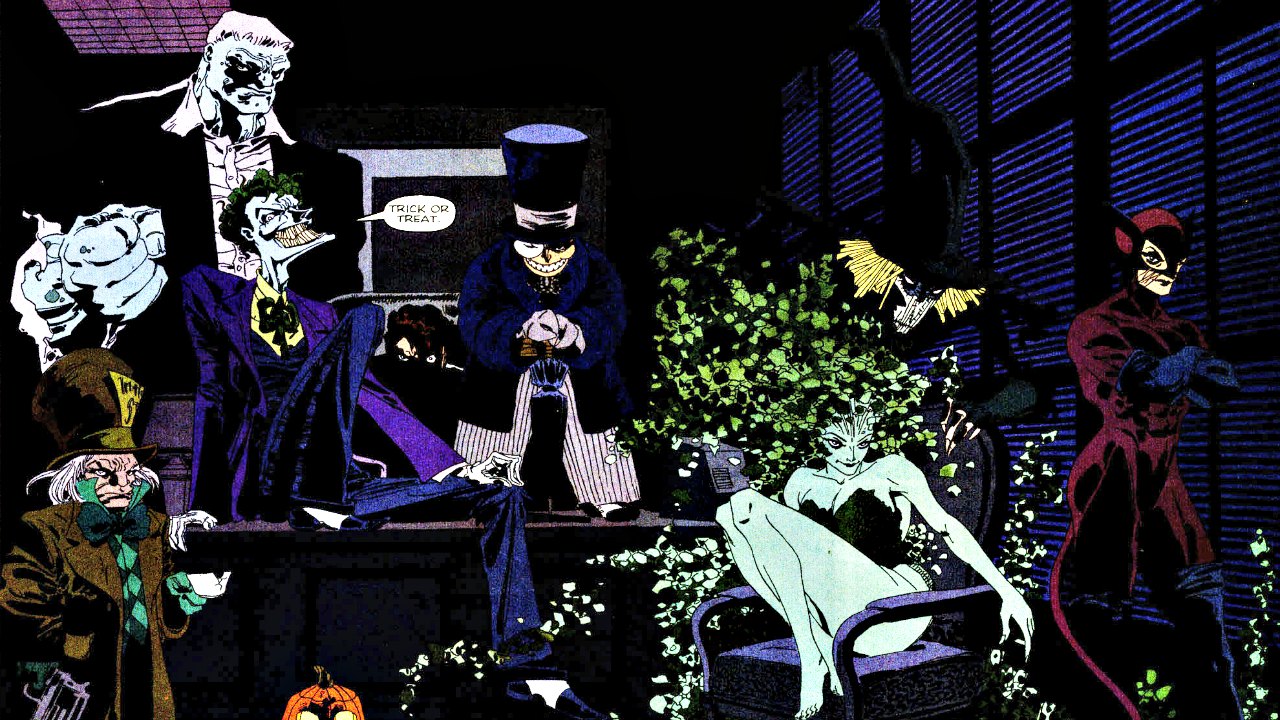
    This 13-issue series (collected in one graphic novel) by Jeph Loeb and Tim Sale is a nearly perfect comic in every way. In fact, maybe the only thing that keeps it from being truly perfect is a few too many Godfather references – they’re everywhere.

    The series was released from 1996 to 1997 chronologically comes after Batman: Year One, building off of the former’s focus on the early days of Batman’s career as he moves from battling gangsters to more colorful foes.

    Batman: The Long Halloween

    The influence of The Long Halloween on the greatest of all Batman movies, The Dark Knight, is undeniable. It is frequently cited as source material for Batman Begins, but TDK really channels it most. Three crusaders against crime meet on a rooftop to plan to take down the mob just as a new class of villain emerges and threatens organized crime from the opposite direction. It’s an absolutely impeccable story, breathing new life into the superhero genre by creating a conflict between the old world and the new and looking at what the emergence of all these caped and costumed opponents means to real people.

    Batman: The Long Halloween

    The plot of the story concerns the arrival of a serial killer in Gotham whose murders coincide with holidays. At first gangsters are the victims, but the targets begin to vary as the search narrows and soon no one feels safe. The lineup of characters features nearly everyone from Batman’s Rogues Gallery with each installment adding new players to the mix, and as these “freaks” move up in importance the mob struggles to survive.

    Batman: The Long Halloween

    The Long Halloween manages the neat trick of being a murder mystery while in the end the solution of whodunit isn’t really that important. It’s the chain of events set into motion by the killer that will upend Gotham. The mystery is very interesting, but the brilliant writing of Loeb ensures that it isn’t the only thing that is. Beyond highly recommended.

    [schema type=”book” url=”http://www.dccomics.com/” name=”The Long Halloween” description=”Taking place during Batman’s early days of crime fighting, this new edition of the classic mystery tells the story of a mysterious killer who murders his prey only on holidays. Working with District Attorney Harvey Dent and Lieutenant James Gordon, Batman races against the clock as he tries to discover who Holiday is before he claims his next victim each month. A mystery that has the reader continually guessing the identity of the killer, this story also ties into the events that transform Harvey Dent into Batman’s deadly enemy, Two-Face.” author=”Jeph Loeb, Tim Sale” publisher=”DC Comics” pubdate=”1998-12-31″ isbn=”1563894270″ ebook=”yes” paperback=”yes” hardcover=”yes” ]

  • Pines: Book One of the Wayward Pines trilogy (2012)

    Pines: Book One of the Wayward Pines trilogy (2012)

    Pines
    Pines by Blake Crouch

    My rating: 5 of 5 stars

    Wow. What an amazing book.

    I’m really enjoying my reading lately – I just keep bouncing from author to author. I’ve never been so open to suggestion. I read a thriller or sci-fi novel, love it, and see who the author rubs shoulders with. So many of these writers play in each others sandboxes. I always loved guys like William Gibson & Neal Stephenson, and Ernest Cline & Wil Wheaton turned me on to John Scalzi. Hugh Howey’s worlds led me to Jason Gurley, Michael Bunker and Marcus Sakey, from which I got to Brett Battles and now Blake Crouch.

    Most of the time these are authors I’m already aware of; Scalzi’s Redshirts was on my wish list for years before I finally read it. But it’s when I see the same names popping up it convinces me to take the plunge. (I should point out that I am quite a slow reader, so I put more thought into what I’m going to read than some might. My kindle is filled with books I haven’t gotten to yet…)

    In the case of Pines, I’d seen this popping up with increasing frequency based on my recent reads, which convinced me to give it a try even though it appeared to be a bit out of my usual areas of interest; by which I mean it looked like horror. I’m not a big horror fan, so the thriller aspects of a horror story have to be very compelling to keep me engaged past my squeamishness comfort level. Compelling is certainly a good word for Pines

    Pines tells the tale of Secret Service Agent and Gulf War veteran Ethan Burke, who finds himself in the rustic town of Wayward Pines, a slice of Rockwellian Americana nestled in the mountains of Idaho. He came there to investigate the disappearance of two agents, but a brutal car accident has killed his partner and left him a confused wreck with partial amnesia. He can’t locate his belongings, his identification or anyone who seems completely sane. The more he learns the less he knows, but he is certain of one thing: this place is dangerously strange…

    Intentionally filled with the atmospheric influence of Twin Peaks, Pines (the 1st book in the Wayward Pines trilogy) does indeed have an eerie quality, although I’m not sure I’d call the novel horror. There’s a “something is very wrong here” vibe to everything, and from that environment and the descriptions, your interest may not be totally piqued. I found the beginning of the novel to be interesting but a bit familiar. But things changed quickly.

    I may never have read a book to which the word momentum so readily comes to mind. The book starts off a little slowly, but I didn’t realize it was because a train takes a while to get to the top of the mountain. I was steadily more drawn in as the protagonist begins to get a grip on what’s happening, but when it hit the tipping point I was completely snagged and had to stay up far later than was wise because I needed to know where we were going.

    The author does a fine job taking the familiar, Twilight Zone type premise and giving it a great twirl. Pines is extremely engaging. It comes as absolutely no surprise that Fox has adapted the novel into a 10-part series to air in 2015. http://www.fox.com/wayward-pines/

    Highly recommended. Time to start book two…

    [schema type=”book” url=”http://www.blakecrouch.com/” name=”Pines” description=”Secret service agent Ethan Burke arrives in Wayward Pines, Idaho, with a clear mission: locate and recover two federal agents who went missing in the bucolic town one month earlier. But within minutes of his arrival, Ethan is involved in a violent accident. He comes to in a hospital, with no ID, no cell phone, and no briefcase. The medical staff seems friendly enough, but something feels…off. As the days pass, Ethan’s investigation into the disappearance of his colleagues turns up more questions than answers. Why can’t he get any phone calls through to his wife and son in the outside world? Why doesn’t anyone believe he is who he says he is? And what is the purpose of the electrified fences surrounding the town? Are they meant to keep the residents in? Or something else out? Each step closer to the truth takes Ethan further from the world he thought he knew, from the man he thought he was, until he must face a horrifying fact—he may never get out of Wayward Pines alive. Intense and gripping, Pines is another masterful thriller from the mind of bestselling novelist Blake Crouch.” author=”Blake Crouch” publisher=”Thomas & Mercer” pubdate=”2012-08-21″ isbn=”1612183956″ ebook=”yes” paperback=”yes” ]

  • Nothing O’Clock (2013)

    Nothing O’Clock (2013)

    Nothing O'Clock
    Nothing O’Clock by Neil Gaiman

    My rating: 5 of 5 stars

    Every tv or film series that is even moderately successful ends up having spin-off novels of varying quality. This is particularly true in the sci-fi genre. Doctor Who is somewhat more than moderately successful, so there are quite a lot of them. Because spin-off works in general have a reputation as being quickly produced extensions of the shows they represent, I’ve generally avoided them. But there are certainly stand out exceptions that make you sometimes rethink your preconception (and hopefully adjust your personal level of snobbery). Nothing O’Clock is most certainly one of these.

    As part of the celebrations for the 50th anniversary of Doctor Who last year, Puffin released 11 short stories in e-book format; one for each Doctor and written by different children’s authors. (A twelfth story for the new Doctor will be released in November 2014. No word on whether the War Doctor will get one…)

    For the eleventh story, they tapped Neil Gaiman, a phenomenal (and phenomenally successful) writer who has some experience both in the genre and in the series. Gaiman penned two episodes of the series in recent years during Matt Smith’s run as the Eleventh Doctor, and so he is very familiar with that iteration character and that of companion Amy Pond. In fact, it’s all too easy to imagine this story playing out on screen. In the audiobook version, which is how I partook of the story, this is aided in no small way by narrator Peter Kenny.

    The story is a nice combination of familiarity and freshness. It feels like just another in a long line of adventures for these well-known characters, but everything else about the tale is brand new and very typically Gaiman.

    The author introduces a new enemy, the Kin, an alien race determined to take over the Earth. (This is not a spoiler.) They are creepy as anything Gaiman has come up with before, and that’s not faint praise. The author has a real knack for spooky.

    The dialogue and characterization of the Doctor & Amy Pond is so good that I found myself googling a few lines to see if they had already been on the show – that’s how authentic Nothing O’Clock feels. This story would make an excellent episode, and so the length of the story feels exactly right.

    My only possible criticism of the story would be that it has probably unfairly raised my expectations for other Doctor Who stories. I’ll take that…

    [schema type=”book” url=”http://www.neilgaiman.com/” name=”Nothing O’Clock” description=”Thousands of years ago, Time Lords built a Prison for the Kin. They made it utterly impregnable and unreachable. As long as Time Lords existed, the Kin would be trapped forever and the universe would be safe. They had planned for everything… everything, that is, other than the Time War and the fall of Gallifrey. Now the Kin are free again and there’s only one Time Lord left in the universe who can stop them!” author=”Neil Gaiman” publisher=”Puffin” pubdate=”2013-11-21″ ebook=”yes” ]