Ernie Cline, patron saint of 1980’s geeks and author of the wildly successful Ready Player One is back with a new novel, Armada.
In Armada, Cline invokes the spirit of 80’s sci-fi adventure books and films like The Last Starfighter, Ender’s Game, Flight of the Navigator and WarGames in a classic tech-based coming of age tale. Indeed, it is very hard to summarize the plot of Armada without either giving away too much or making it sound like a rip-off of the previously mentioned works.
It is a wholly original story, though, despite a plethora of influences, which, to his credit, Cline name-checks early and often. If you thought Ready Player One contained a lot of references, Armada is absolutely bursting at the seams with them. Too many? Maybe.
The big concern with Ready Player One when first announced was whether this 1980’s-centric premise would be gimmicky. In the end, the excellent storytelling overcame those fears. In the case of Armada, I was more worried about the 80’s obsession overrunning the book, as it was now the author’s sophomore effort and wouldn’t get a free pass for originality. I needn’t have worried. In Ready Player One, the geeky references are elevated above nostalgia as they are integral to the plot. Armada doesn’t rely so heavily on the pop culture stuff for the story itself – it’s there more for color. Whether this makes the 3000 references to old videogames and movies more or less enjoyable to you is somewhat a personal opinion. I found all that stuff great, but I can easily see that it may not play for everyone.
Thematically, Armada repeats many of the first books beats; young male outsider as protagonist, parental loss, geeky love interest. This doesn’t make the work seem overly familiar, thankfully, but it will be interesting to see if Cline branches out a bit more with future novels.
In all of the reviews you read or hear about Armada, you will likely encounter mostly comments about the geeky pop culture subjects and references. I certainly fell into that trap here. What’s lost in this focus, however, is the success of Armada as a science-fiction novel. Even more than in his first novel, Cline really shows an impressive command of battle descriptions. The aerial combat is depicted visually right into your mind, as though you were reading a novelization of a film you’d seen many times. No wonder the novel was optioned for film long before publication…
One thing about Armada that I find interesting; despite the focus on the 1980’s, Ready Player One was set in 2044. Armada is set in our very near future, but the advances in virtual reality (VR) between the writing of Cline’s first novel and second (many of which he has inspired) inform the developments in his literary world. Put simply, this means that his predictions for the exciting future of VR are forecasted far ahead of the earlier schedule. I find this exciting…
Armada is a very easy recommendation. It’s an enjoyable tale with some clever ideas and a sense of fun to match its many influences. The characters are interesting and well-written and Cline displays a real gift for writing the action scenes.
The audiobook version narrated by Wil Wheaton is excellent, too!
[schema type=”book” url=”http://www.armadabook.com” name=”Armada” description=”THE NEW NOVEL FROM THE BESTSELLING AUTHOR OF READY PLAYER ONE It’s just another day of high school for Zack Lightman. He’s daydreaming through another boring math class, with just one more month to go until graduation and freedom—if he can make it that long without getting suspended again. Then he glances out his classroom window and spots the flying saucer. At first, Zack thinks he’s going crazy. A minute later, he’s sure of it. Because the UFO he’s staring at is straight out of the videogame he plays every night, a hugely popular online flight simulator called Armada—in which gamers just happen to be protecting the earth from alien invaders. But what Zack’s seeing is all too real. And his skills—as well as those of millions of gamers across the world—are going to be needed to save the earth from what’s about to befall it. Yet even as he and his new comrades scramble to prepare for the alien onslaught, Zack can’t help thinking of all the science-fiction books, TV shows, and movies he grew up reading and watching, and wonder: Doesn’t something about this scenario seem a little too… familiar? Armada is at once a rollicking, surprising thriller, a classic coming of age adventure, and an alien-invasion tale like nothing you’ve ever read before—one whose every page is infused with author Ernest Cline’s trademark pop-culture savvy.” author=”Ernest Cline” publisher=”Crown Publishing” pubdate=”2015-07-14″ isbn=”0804137250″ ebook=”yes” hardcover=”yes” ]
Typical Pixar magic from co-director Pete Docter w/ great emotional stuff leading to leaky eyes & lots of laughs. So why didn’t it grab me?
Spoiler-free Movie Review of Inside Out:
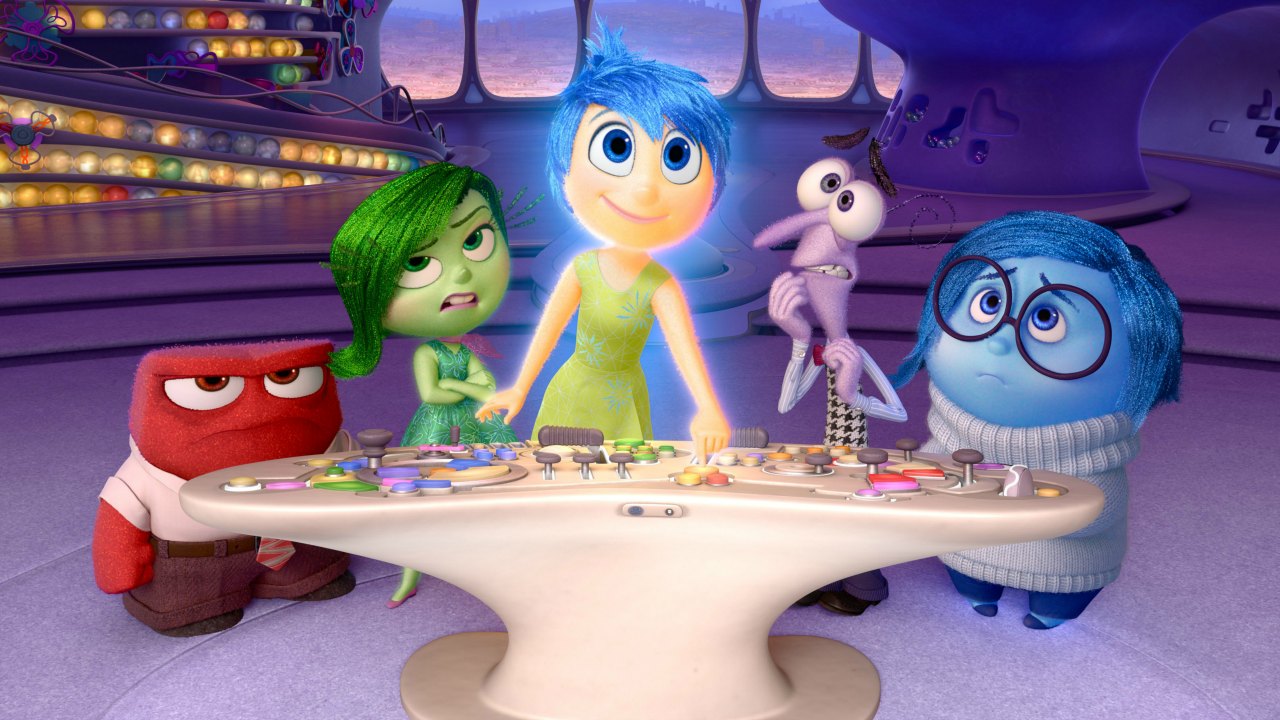
When the idea behind Disney/Pixar’s latest joint, Inside Out, was announced, there was a sort of déjà vu feeling to the whole affair. Yes, like most people, I instantly realized the story was not in fact original at all, but an echo of the 90’s FOX TV sitcom Herman’s Head, but that wasn’t the entirety of it.
(Although I have no idea how Pixar and the writers have avoided legal challenges thus far – it really is completely derivative. Maybe they can argue that the Mouse got there first with the 1943 Disney propaganda short Reason and Emotion? More probably because the TV show was produced by Disney-owned Touchstone.)
No, there’s more to it than that; an underlying sameness to the whole thing. There’s a familiarity that’s hard to shake, even as the picture handles issues and scenarios new to the screen. There’s a lot going on visually, and I’m sure I’ll get more out of it on repeated viewing, since there’s a lot of Easter eggs I caught even the first time.
I feel somewhat apologetic about criticizing Inside Out without a firm explanation of why it didn’t totally stay with me. Perhaps that’s exactly what I’m objecting to – it didn’t stick. I was intrigued by the idea, laughed a lot and genuinely was impressed with what the filmmakers had accomplished. And then I left the theater and I haven’t thought of it once since. I didn’t even have much enthusiasm for talking about it in the car on the ride home; I’d already moved on.
Now of course I am aware that I’m not the target audience for these pictures and the fact that so many of the Pixar films have resonated with me is a nice plus, not a designed feature. A younger audience, by definition, doesn’t bring the same history and experiences into every film and is almost certainly more enchanted with the idea of a control room in every person’s head, likely never having dealt with these abstract ideas previously. For the most part, I’m going to chalk my lack of infatuation with Inside Out to that; it’s a powerful movie, just not for me. That’s fine…
Pete Docter & Ronaldo Del Carmen came up with the story partly on Docter’s childhood and partly based on a dream of Docter’s regarding his young daughter. The pair also shared directorial duties and additionally utilized a co-ed pair of screenwriters to help flesh out the script (including Meg LeFauve & Josh Cooley). This duality of male & female voices throughout the production really provides rounded perspectives and a great depth of realistic feelings that play out vividly on screen. The team also consulted with psychologists to create accurate depictions of many concepts, and all the research pays off, as Inside Out is remarkably insightful.
One major criticism, though: Joy is white. All of the other emotions are colors, but the hero isn’t the yellow that her emotion signifies in the whole “emotions have colors” design – she’s Caucasian, i.e., “normal”. C’mon, Pixar, you’re better than that…
My biggest takeaway from Inside Out, actually, is how wonderful it is that this movie will be instrumental in giving children and those who work with children a language in which to communicate. Even before seeing the film, I was genuinely pleased that Pixar had made a popular picture that help so many people develop a vocabulary for talking about emotions and behaviors. As an educational tool, Inside Out is a masterful achievement.
And so perhaps it’s fine that as pure entertainment I found Inside Out to be a little underwhelming. It’s certainly a very good, solid picture which my family all enjoyed, and if it isn’t one of Pixar’s more impressive films, perhaps they’ve achieved something more important.
Oh, and Pete Docter, please stop making balloon animals out of my heart with these movies. While best in class movies like Finding Nemo (which is about a father and child and therefore perfectly engineered to tug on my heartstrings) and Wall-E are true masterpieces, they don’t make me tear up. But all of your pictures – Monsters, Inc., Up and Inside Out have coincided with a sudden unexpected occurrence of leaky eye syndrome. I suspect these films were experimenting with a Smell-O-Vision broadcast set to “Onion Cutting”. Which is also encoded onto the Blu-Rays. And plays every time…Yeah, that’s probably it…
[schema type=”movie” url=”https://www.facebook.com/PixarInsideOut” name=”Inside Out” description=”From an adventurous balloon ride above the clouds to a monster-filled metropolis, Academy Award®-winning director Pete Docter (“Monsters, Inc.,” “Up”) has taken audiences to unique and imaginative places. In Disney•Pixar’s original movie “ Inside Out,” he will take us to the most extraordinary location of all—inside the mind.
Growing up can be a bumpy road, and it’s no exception for Riley, who is uprooted from her Midwest life when her father starts a new job in San Francisco. Like all of us, Riley is guided by her emotions – Joy (Amy Poehler), Fear (Bill Hader), Anger (Lewis Black), Disgust (Mindy Kaling) and Sadness (Phyllis Smith). The emotions live in Headquarters, the control center inside Riley’s mind, where they help advise her through everyday life. As Riley and her emotions struggle to adjust to a new life in San Francisco, turmoil ensues in Headquarters. Although Joy, Riley’s main and most important emotion, tries to keep things positive, the emotions conflict on how best to navigate a new city, house and school.” director=”Pete Docter” actor_1=”Amy Poehler” ]
Animation, Adventure, Comedy, Drama, Family, Fantasy
Plot
After young Riley is uprooted from her Midwest life and moved to San Francisco, her emotions – Joy, Fear, Anger, Disgust and Sadness – conflict on how best to navigate a new city, house, and school.
If you come in with the right expectations, you can have a good time with this summer popcorn movie. If not, you may truly hate this thing.
Spoiler-free Movie Review of Jurassic World:
Serious conflicting feelings about this one. Jurassic World is perfectly fine as the good-time summer movie that it unmistakably is, but that’s really all it is. Far from the excitement I’m supposed to feel at the kicking off of a new group of dinosaur movies, I’m sort of indifferent.
Maybe one of the reasons that I haven’t written this review before now for a movie that opened several weeks ago is that I’m struggling to elaborate on my stock answer to the question “how was it?”. “Eh, pretty good” just really isn’t a satisfactory response. Let’s see if I can do better…
The movie is completely absurd. It’s fun enough that you might not care, but it really is bonkers.
Jurassic World is directed by Colin Trevorrow, whose fitness for the job was determined by exactly one feature-length screen credit – co-writing and directing the cute little indie, Safety Not Guaranteed. That’s it. One indie film and he’s in charge of one of the biggest franchises in film history (and was reportedly in the running for another; incorrectly believed to be on the shortlist for Star Wars: Episode VII). Now if you read my review of Safety Not Guaranteed, you’ll know that I could scarcely have given it higher praise, but I don’t remember saying that this guy’s next picture should be a big budget blockbuster with its own line of toys.
Is this the end of the auteur director? Have we found an amazing new talent or have we reached the point with big franchise pictures where the director is not only no longer the most important voice on a film but increasingly just another technical position there to do the hands-on work of the producers? Can both be true?
Trevorrow, along with his writing partner Derek Connolly, does seem to be a talented young filmmaker, and the duo wrote the screenplay for Jurassic World. This is his project. So why does it feel like it was made by a group of producer and focus group-obsessed suits?
The whole thing takes exactly zero risks. Nothing is left to chance. I don’t know if it’s fair to say, seeing how Trevorrow co-wrote the thing, but it really does feel like anyone could have filmed Jurassic World.
What’s so surprising about Jurassic World is that it took so long to be brought to life. This series went through twists and turns on its way to de-extinction, and they ended up more or less where you would guess they started. The premise is so jarringly obvious that you wonder how they didn’t get here long before now.
Perhaps one of the things that makes the picture feel so “authored by committee” to me is the knowledge that they seriously planned a Jurassic Park IV film in which the dinosaurs would have been cross-cloned with humans, ostensibly to make dino-soldiers. After you’ve heard it, it’s sort of hard to un-know that, and you will always be wary of the possibility of complete absurdity around every corner.
So when the otherwise cool looking Jurassic World trailers showed superstar of the moment Chris Pratt seemingly leading a pack of Velociraptors on his motorcycle, you can understand why I was more than a little nervous.
I went into the theater with cautious optimism, though; I really love this franchise and hope for it to do well with each installment. And for the most part, Jurassic World succeeds. I definitely enjoyed it, and I believe anyone who goes into the picture looking to have fun, not pick things apart, will have a good time as well.
The premise is simplicity itself, and that’s no criticism. Ever since the high-concept idea of an amusement park with live dinosaurs was dreamed up, we’ve wanted to see this thing in full swing. Sure, the story of Jurassic Park and the succeeding iterations has always been man’s hubris and lack of respect of nature, and the inevitable problems karma has in store for such people. But that doesn’t mean we don’t want to see how that plays out.
One of the reasons The Lost World was so disappointing was because we got a glimpse of another world where the InGen Corporation tried the impossible task of controlling chaos, and then we quickly left. I want to see these controls – I love the bits in the first Jurassic Park novel where Arnold and Muldoon and Wu and Harding discuss all the problems they are having with these unknowable prehistoric animals and their attempts to control it all anyway. I want to see maps of how the whole place is laid out – I just love this stuff.
So Jurassic World was destined to at least partially please me by delivering on the promise of a fully functioning park. I can’t get enough of it – the intro could have been twenty minutes longer. I want to go on a complete tour. This is great stuff and I’m a sucker for it. When you see those reference books written in a fictional universe like Star Wars and wonder what kind of geek would find more information about a space monster interesting – me. I’m that guy. I’d love a book about how they finally got Jurassic World off the ground and what’s going on with Isla Sorna.
<soapbox-alert>
Unfortunately, this sort of detail is unlikely to come. Not because they filmmakers cut corners or didn’t bother to think about it – I’m sure they did. But Jurassic World is one more in a growing trend that I find terribly alarming: sequels that try to give fans EXACTLY what they want. The principle goes like this: everyone loved the first X, not so much Y & Z. So lets pretend Y & Z didn’t exist, and just pick up as if this is the true sequel. The most blatant example has to be The Terminator series, but that’s more or less what the Disney Star Wars series is doing, as well as Jurassic Park. I believe the Ghostbusters now filming in Boston is ignoring Ghostbusters 2, though I can’t confirm that yet.
I give my absolute guarantee that this approach will be employed for Indiana Jones. Not that I’m psychic – I know it because I can see how these producers think.
While I won’t personally guarantee them, I think there’s a better than good chance that these amnesiac sequels will be employed for the following franchises (in order of most to least likely):
Alien (80-85% chance they will find a way to get the space Marines back for another beautiful day in the Corps…)
Star Trek (80% or better; series approaching Kobayashi Maru without J.J. Abrams; may be a reboot, though)
Predator (75% chance of getting to da choppa without acknowledging the Gary Busey-led Predator 2)
Blade Runner (50-75%; it’s definitely happening, but they may keep a lot of the first film, hence the split score)
The Matrix (even money; depends on the desire of the Wachowskis)
Jaws (40%; nothing on the horizon, but I’m sure someone will do it)
Buffy the Vampire Slayer (25%; very unlikely for Whedon to backtrack, but you never know)
The Godfather (10%; almost no chance, but PLEASE! Don’t leave me with Don Connie…)
Not really counting comic book movies, which revinvent themselves every time out anyway, but Superman Returns may have been the best example of the approach – Singer truly pretended he was making Superman II. The X-Men films have done it a few times already, too…
And I’m not talking about reboots – that’s something totally else. Amnesiac sequels don’t want to reboot – they just want to pick and choose like a salad bar. (By the way – the only good examples of amnesiac sequels? Highlander and maybe one or two of the Michael Myers movies after Halloween III. Even though the movies after Highlander 2 were still crappy, no good can come of acknowledging Highlander 2…)
</soapbox-alert>
Jurassic World totally ignores the past two films, unless I missed something. And one of the characteristics of these sequels is that while they totally eschew the movies they don’t care for, they completely venerate whatever film they are trying to pick up from. It’s not even veneration, really, more like a slavish adherence to tone and cynical attempt to recreate the feel of the original. So Jurassic World succeeds at giving off the feel of Jurassic Park, and that’s the main takeaway.
I could go through every spot that is done right and every little thing that is done wrong, but what’s the point? This review has already gone on far too long. I’ll give you the highlights:
Seeing the park in full operational mode is worth the price of admission by itself.
Chris Pratt is so easy to root for that he’s fun to watch, even while he is participating in the world’s stupidest and most ludicrous subplot involving training dinosaurs.
As soon as Vincent D’Onofrio showed up on screen the whole film got dumber. I think even the people in the theater dropped a few IQ points.
Training dinosaurs as soldiers is Highlander 2 dumb. I simply cannot believe that this film spent over ten years in development hell and STILL couldn’t come up with a better storyline. Maybe they should have kept it simmering for another decade…
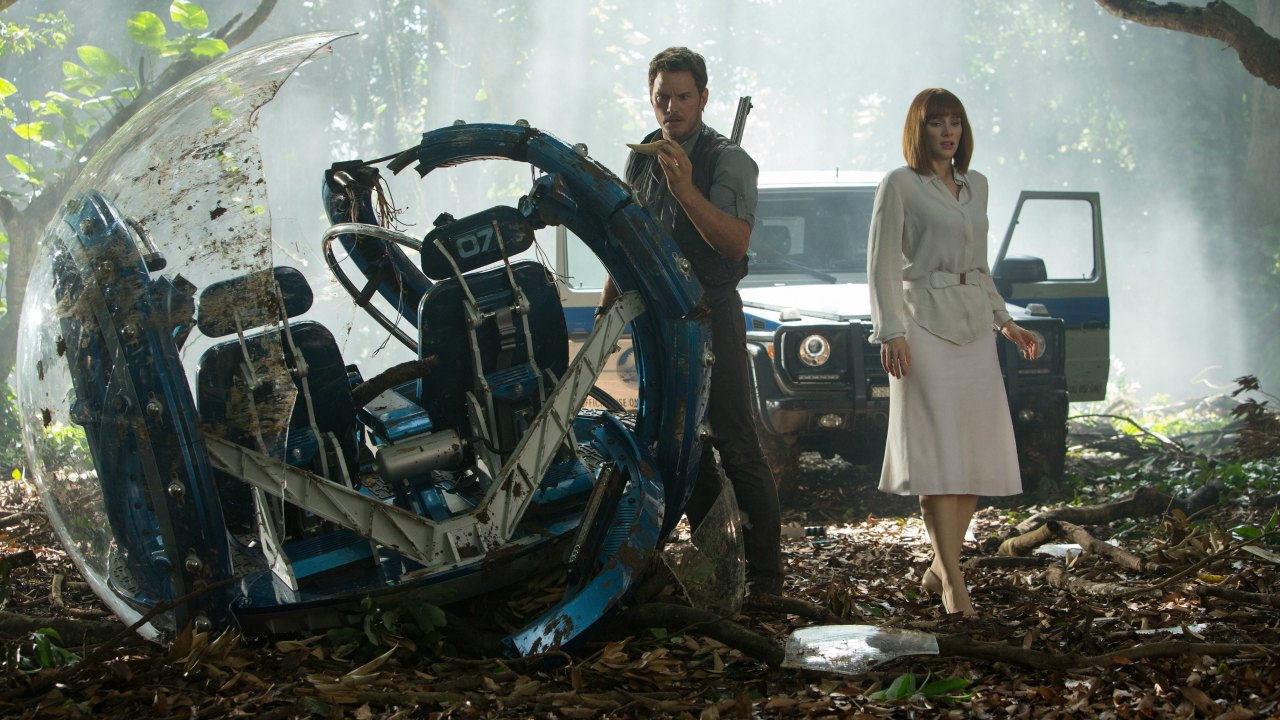
The gyrosphere scene is totally implausible but it’s so great looking I hardly cared.
I find it completely unbelievable that InGen is still in business after a T-Rex ate people in San Diego. They already had to introduce a new CEO in Simon Masrani (the excellent Irrfan Khan), so why not simply have a new company that bought InGen’s assets?
I think it’s time to stop expecting great things from Bryce Dallas Howard. She’s excessively OK. If there was going to be anything more interesting happening here we would have seen it by now.
I do like Jake Johnson in this – sort of. He gets far too much screen time for someone who really has no purpose to the story. He’s sort of the Ian Malcolm voice of skepticism, but that doesn’t really work when you are a willing employee.
B.D. Wong is back as the only survivor of the first film that you wish had been eaten. I really like Wong, though and was honestly glad to see him back. Except they didn’t do anything to explain why, after all that had happened in the past 22 years, he still has a job.
How many people were killed in this movie? The first film saw the deaths of four people. More isn’t more, guys…
Which brings me to my final point: you’re supposed to believe that this story is an indictment of our “more is more” culture, always wanting more, bigger, more dangerous stuff. But nowhere is this mindset more evident than IN THIS FILM’S VERY EXISTENCE. You can’t have it both ways…
For anyone still reading at this point (thanks for sticking around), I’m sure you’ve seen the film by now. Most people have, going by box office receipts. I’m not hoping to change any minds here. I’m just trying to process how I felt about a movie that so completely epitomizes my mixed feelings about moviegoing in 2015. To sum up; “eh, pretty good”…
[schema type=”movie” url=”http://www.jurassicworldmovie.com/” name=”Jurassic World” description=”Twenty-two years after the events of Jurassic Park, Isla Nublar now features a fully functioning dinosaur theme park, Jurassic World, as originally envisioned by John Hammond. After 10 years of operation and visitor rates declining, in order to fulfill a corporate mandate, a new attraction is created to re-spark visitors’ interest, which backfires horribly.” director=”Colin Trevorrow” actor_1=”Chris Pratt” ]
Twenty-two years after the events of Jurassic Park, Isla Nublar now features a fully functioning dinosaur theme park, Jurassic World, as originally envisioned by John Hammond. After 10 years of operation and visitor rates declining, in order to fulfill a corporate mandate, a new attraction is created to re-spark visitors’ interest, which backfires horribly.
When Disney abruptly and unwisely canceled The Clone Wars animated TV series following their purchase of Lucasfilm, it was inevitable that there would be a number of unfinished stories in various stages of development. Animation has one of the longest lead cycles of any creative endeavor, and things that are seeing release today are the product of years of development.
The Clone Wars was wildly popular, with a dedicated creative team with no expectation that the series was coming to an end, so the unceremonious pulling of the plug meant not only that many things didn’t get wrapped up, but that some storylines that had already been completed had not seen the light of day and now had no venue to see release.
A few of the nearly completed episodes were haphazardly sewn together into an inaccurately named set called The Lost Missions, that wasn’t really lost nor a series of missions, and this was kinda, sorta, Season Six. It was a Netflix exclusive until it was put on disc a little while later, and while the circumstances surrounding the whole affair give the impression of a slapdash scraping of the bottom of the barrel, the episodes are nothing of the sort. The Lost Missions are a bittersweet ending for the series, since they aren’t an ending at all, but display all the quality of the rest of the series and make you even more dismayed that it was shuttered.
A few other episodes have been portioned out as animatics and such, but we’ve likely seen the last of the animated series itself. Fortunately, there is still the less expensive to produce medium of novels in which these stories may still escape.
At least there was until the equally ill-advised decision to scrap the entirety of the long-running Expanded Universe (EU), designating nearly forty years of novels, comics and other stories as “Legends”, and keeping only the past couple of things in play.
Ok, I told myself I wasn’t going to do this here but I need to spend a minute on this EU Legends thing. The choice to throw out all of the material that was created before you arrived is so unbelievably disrespectful to the authors and fans of said work that it could only come from a massive multi-national company like Disney. Or could it? After all, George Lucas himself was completely indifferent to the things he didn’t personally create. Sure, he’d dip into it once in a while, when he saw something interesting he wanted to grab and use for his own purposes, but that is your right with licensed properties.
Years ago I wrote an unpublished piece to TheForceCast (the podcast of theforce.net) railing against Lucasfilm’s cavalier attitude concerning the works they had licensed. (Sidebar: the near continuous dumping on the EU is why I finally stopped listening to the show.) If you’re really interested, here’s the bit: https://www.nowverybad.com/odds-and-ends/
I found it insulting that they considered these stories good enough for me to spend my money on, but not good enough for them to actually take seriously or feel any obligation to acknowledge when coming up with new stories for The Clone Wars show. (Which spawned, wait for it, more licensed stories; none of which count anymore, either. Explain that one…) So this one can’t really be laid at Disney’s door. Lucas, after all, is the one who came up with new storylines for Episodes 7-9 as part of selling his company. (Want a bit of amusing irony? The creative team behind the new films isn’t following his stories…)
I understand the dilemma the new creative team behind the next set of films faces. I really do. You want to forge a new future for the franchise, but oops, you already have the next several decades of the Star Wars timeline filled in by authorized tales. I’m not unsympathetic, but it was your decision to make 7, 8 and 9; not mine. It’s not as though they couldn’t have used the broad strokes of the Expanded Universe and created adaptations of fan-loved stories. In fact, it would have been heaps easier. Marvel Studios will NEVER run out of their own stories to adapt and they’re doing pretty well over there. They have yet to actually write a truly original screenplay for any of their pictures so far; they are all adaptations. By my estimation, Marvel may not even need to write an original comic story ever again and they will still have enough material to make movies for, oh, say, 50 years.
Sorry for the long interlude on the EU thing. I really didn’t intend to go into it here, but it’s really difficult to discuss the new wave of Star Wars stories without dealing with this. In fact, what are they planning on calling these “new EU” stories? If the non-movie stuff before was called the Expanded Universe and now is classified “Legends”, what should we call non-movie “canon” stuff that’s being produced now? NU-EU?
“Get on with it!”
So, back to the book itself…
Dark Disciple is based on a story by Katie Lucas, Head Writer Matt Michnovetz, and Series Supervising Director Dave Filoni that would have been an extended arc of eight episodes on Season Seven of The Clone Wars. Lucas has memorably written previously for the show and particularly for the character of Asajj Ventress, notably with the Savage Oppress arc of Season Four.
In Dark Disciple, the Jedi Council, appalled at the most recent atrocity of Count Dooku, this time the near complete genocide of a race of aliens, takes the uncharacteristic and unprecedented step of sanctioning the assassination of the Separatist leader. The instrument they choose to perform this most un-Jedi act is Master Quinlan Vos, who has previously flirted with the Dark Side and worked undercover for Dooku (or has he? I don’t think those stories count anymore…)
Since Vos stands little chance of getting close to the public face of the Confederacy of Independent Systems (the Separatists), Master Obi-Wan Kenobi suggests enlisting the assistance of former Dooku apprentice Asajj Ventress. Of course, Ventress is hardly a friend of the Jedi, even if she did briefly ally with Kenobi against the sort-of Sith brothers Darth Maul and Savage Oppress – enemy of my enemy and all that – so Vos will have to be clever in tricking Ventress to help him, posing as a fellow bounty hunter. Oh yeah, Ventress is a bounty hunter now, finding it the best option for survival after her revenge attempt against Dooku for trying to kill her failed and he massacred her family, the Nightsisters.
You know, as I try to summarize the plot of Dark Disciple, I’m kind of making the point of the EU-bashers for them – that the Expanded Universe got too convoluted and detailed to follow and created a huge barrier to entry. Which would all be fair, except that everything I just summed up happened on the TV show. That’s a TV show for kids that ran for only five seasons, with Ventress’s story making up only a fraction of those episodes. Sure, I intentionally wrote some of the previous history above with an eye to satire – making the whole thing sound sort of like a comic book / soap opera. Because make no mistake, any long-running franchise has to face and cop to the completely valid criticisms of being over-complicated and not noob-friendly.
The fact is, I’m not sure you can completely avoid excluding new fans from any series any more than you can keep basketball discriminating against short people (stolen from 1980’s Doonesbury strip by Garry Trudeau). Let’s face it, these Expanded stories, whatever they want to call them, are aimed at existing fans – it’s like selling coffee mugs at a café – you are cultivating your audience from an existing group that has already shown an interest in your product. Sure, you want to increase your base, which is why that’s not the only place you sell your mugs, but you have to know where your main customer lives, so to speak.
Asajj Ventress is one of the most interesting characters to come from the Expanded Universe and The Clone Wars (she was an EU character first, of course – created for stories that now don’t count…). A former Jedi Padawan who came to hate the Jedi for what she perceived to be their failing of her master; a former slave who transformed herself into a skilled warrior and dark-side adept, pledging her allegiance to a fallen Jedi turned Sith Lord who responded with no such allegiance; an orphan whose surrogate families have been repeatedly destroyed.
Quinlan Vos, too, is a product of the EU and one of its most popular characters. A Jedi who has walked the narrow path between the dark and the light; particularly adept at undercover work but divided by his split roles; a Kiffar with an ability to gain information about objects by a mere touch who always been forced to remain untouched by attachment.
The narrative works very well, pairing these two multi-faceted characters on a mission of dubious morality. One of the things the TV show struggled most with was the tonality and seriousness of the stories. Star Wars is theoretically supposed to be family-friendly entertainment, but, well, it does have the word “war” in the title. Sometimes these things get dark. Throughout all of the material, canon and otherwise, creators (even the notorious GL) have searched for the right amount of gravity and import, the whole dark/light balance. The Dark Horse Comics telling of the Clone Wars tended to deal more plainly with the adult-oriented war stories, but the TV show itself occasionally featured murder, terrorism, torture, suicide bombing and slavery. These episodes would sometimes follow a light-hearted escapade with Jar-Jar or the droids.
Here in Dark Disciple, author Christie Golden is able to indulge in a story that fully explores the nature of the Dark Side, treachery, secrecy and the lengths to which you will go to achieve your goals.
The story may be a touch on the long side, but not by much and not because it wasn’t interesting. Golden writes Star Wars very well and brings the tale to life with good beats and a strong story. I really enjoyed the consistent characterization and the integrity of the story along its predecessors. I can’t imagine that this would have been any better as a fully realized TV story. Highly recommended for fans of the Wars…
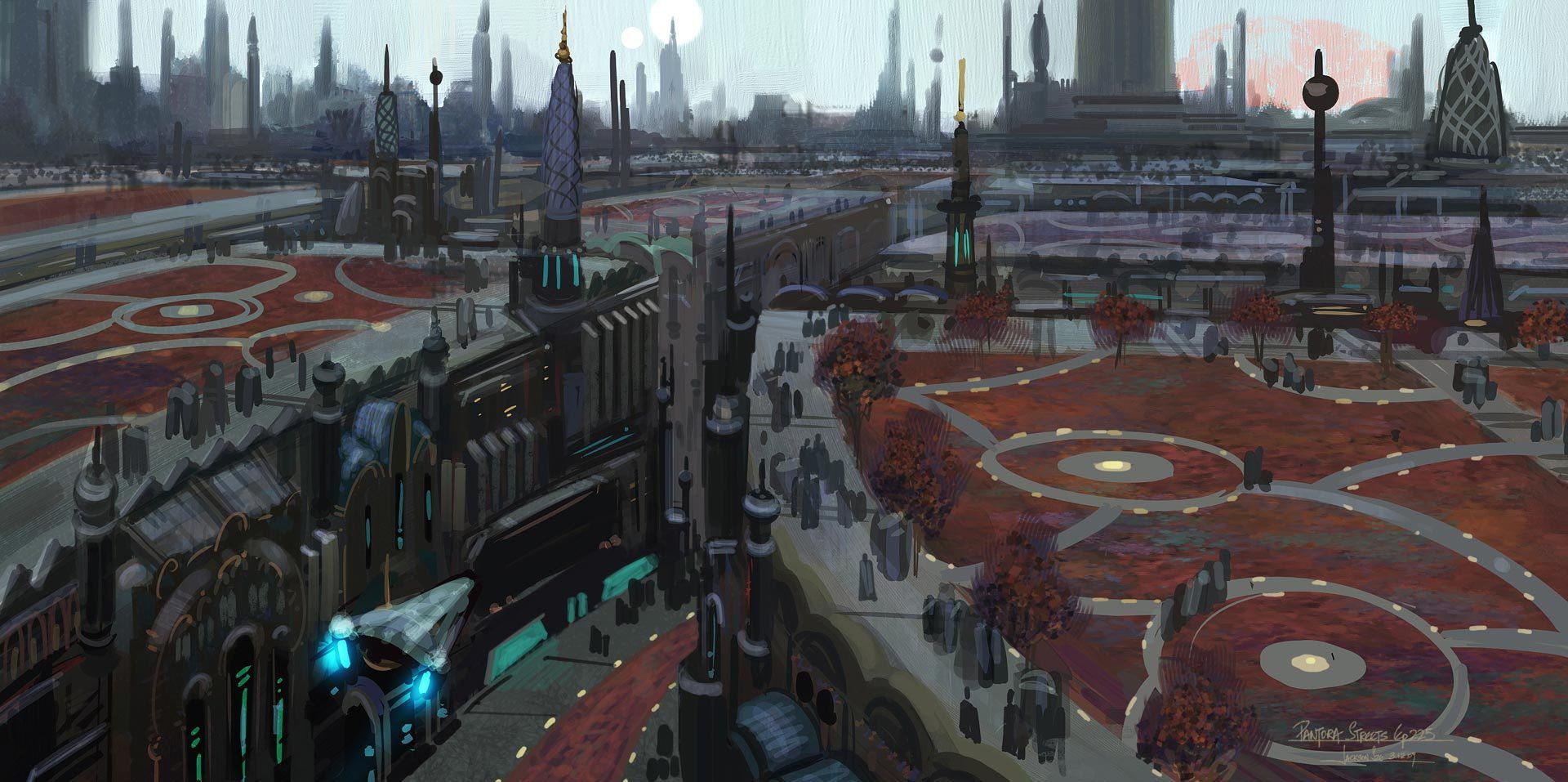
Concept art of the streets of Pantora by Jackson Sze.
[schema type=”book” url=”http://www.randomhousebooks.com/books/7868/” name=”Dark Disciple: Star Wars” description=”Based on unproduced scripts from the blockbuster TV show Star Wars: The Clone Wars! The only way to bring down the dark side’s most dangerous warrior may be for Jedi and Sith to join forces. In the war for control of the galaxy between the armies of the dark side and the Republic, former Jedi Master turned ruthless Sith Lord Count Dooku has grown ever more brutal in his tactics. Despite the powers of the Jedi and the military prowess of their clone army, the sheer number of fatalities is taking a terrible toll. And when Dooku orders the massacre of a flotilla of helpless refugees, the Jedi Council feels it has no choice but to take drastic action: targeting the man responsible for so many war atrocities, Count Dooku himself. But the ever-elusive Dooku is dangerous prey for even the most skilled hunter. So the Council makes the bold decision to bring both sides of the Force’s power to bear—pairing brash Jedi Knight Quinlan Vos with infamous one-time Sith acolyte Asajj Ventress. Though Jedi distrust for the cunning killer who once served at Dooku’s side still runs deep, Ventress’s hatred for her former master runs deeper. She’s more than willing to lend her copious talents as a bounty hunter—and assassin—to Vos’s quest. Together, Ventress and Vos are the best hope for eliminating Dooku—as long as the emerging feelings between them don’t compromise their mission. But Ventress is determined to have her retribution and at last let go of her dark Sith past. Balancing the complicated emotions she feels for Vos with the fury of her warrior’s spirit, she resolves to claim victory on all fronts—a vow that will be mercilessly tested by her deadly enemy . . . and her own doubt.” author=”Christie Golden” publisher=”Del Rey” pubdate=”2015-07-07″ isbn=”0345511530″ ebook=”yes” hardcover=”yes” ]
1st in the series not based on a novel (2nd if you count The Lost World) is slight but somehow more enjoyable for it. Punches its weight…
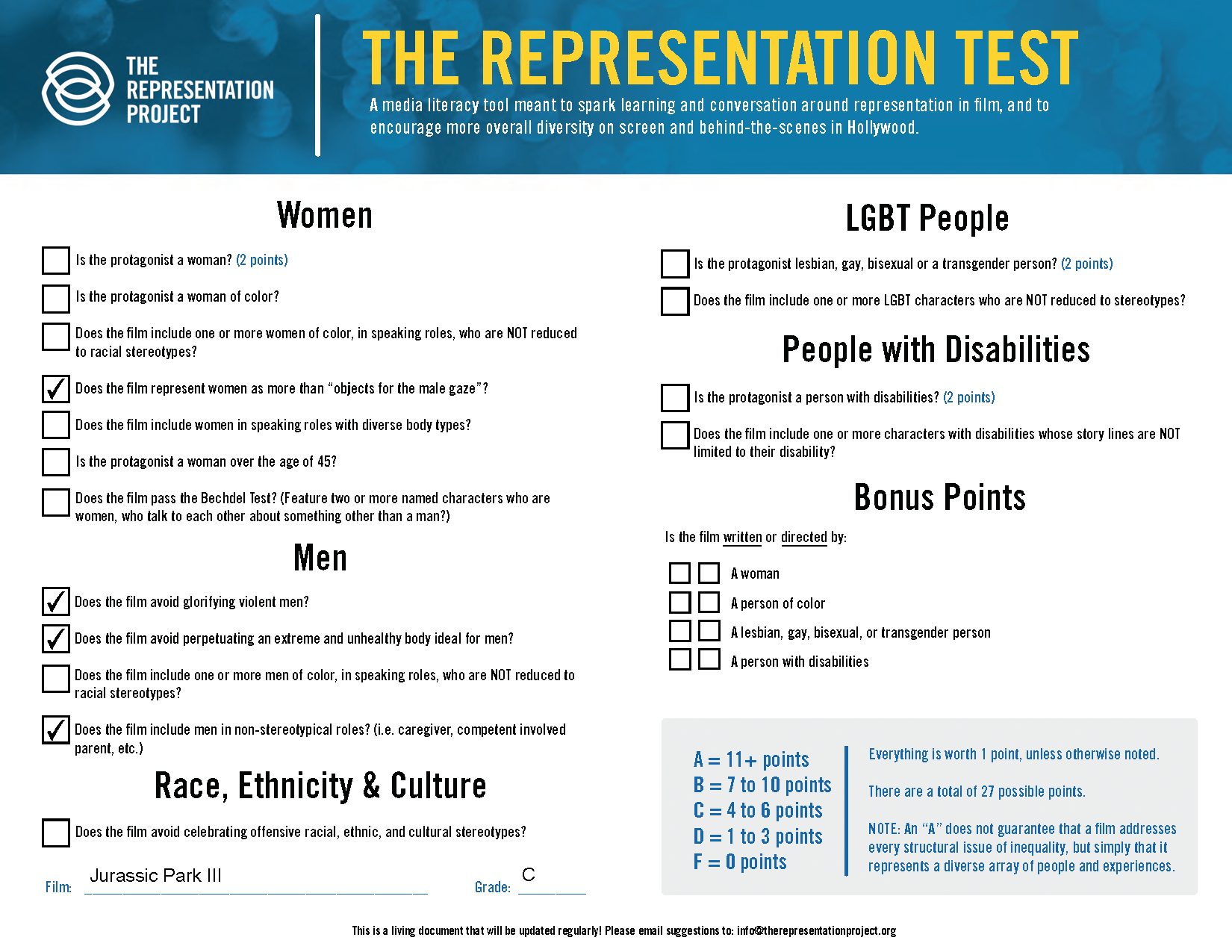
Spoiler-free Movie Review of Jurassic Park III:
It would be silly to suggest that a $93 million dollar dinosaur movie that is part of one of the highest-grossing franchises of all time could somehow be stealthy, but I really knew nothing of this film until it was in theaters.
You have to remember that in the years between the release of The Lost World: Jurassic Park (1997) and Jurassic Park III (2001), the internet was a very different place. Sure, there was a ton of information out there, but you didn’t trip over it like you do today – you needed to know what you were looking for and actively seek it out.
More importantly, though, the landscape of summer movies had changed since the last film. We had a new Star Wars trilogy, the surprise of The Matrix, the first good comic book movie in years (X-Men) and the promise of another (Spider-Man). Within the year, the first installments of The Lord of the Rings and Harry Potter were finally coming to theaters. Who needed dinosaurs?
It’s a Hollywood adage (attributed to Ben Burtt unless someone can come up with another source) that movies aren’t released, they escape. It certainly feels true in the case of Jurassic Park III, and not solely because of the under the radar nature in which it hit theaters in 2001. More than anything, it feels like a movie they made because everyone in Hollywood sees things in trilogies and so they finished this one because they had come this far and it seemed silly to stop now.
Jurassic Park III starts from a position of weakness, possessing an also-ran feel that’s hard to shake off. First picture not based on a novel, first picture not directed by Spielberg, first picture not scored by John Williams, first picture without Richard Attenborough or Jeff Goldblum. The impression that the film was an afterthought is completely untrue; the budget was larger than the previous films, director Joe Johnston had been interested in the picture all along, and the film made over $350 million worldwide – impressive compared to anything but the first two installments. But it feels true…
But why? I don’t think there’s any one thing to point to as a problem with Jurassic Park III – except possibly for that III – it just feels very much like the sequel that it is. The story is not bad, particularly, just not massively compelling.
The initial idea for The Lost World was a rescue mission, which was the only plausible reason for Ian Malcolm to willingly go to a dino-infested island. The rescue didn’t come across as clearly as a major plot point in the film as in the novel, so I guess they decided to tap into it for the plot of this picture. That’s a recurring theme, by the way – going back to the novels and using anything they didn’t get around to before.
In this case, the rescue involves the son of a presumably wealthy couple, the Kirbys, who shanghai Dr. Alan Grant and his assistant into the rescue mission on Isla Sorna (Site B and the location of most of The Lost World). Bringing Grant along as an unwilling conscript is a good concept, as the makeup of the character can remain consistent.
The Kirbys are in fact divorced and more importantly not good for the large sums they have promised their mercenaries and consultants. I don’t know which should have been the tip-off, that Tea Leoni would be married to a schlub like William H. Macy’s character, or that Macy would be paired with a TV actress. Either way, it’s news to Grant (Sam Neill) and Billy Brennan (Allesandro Nivola), who have been promised too much money to refuse in exchange for their services as guides for an aerial tour of the island. In fact, they are horrified to learn that the Kirbys intend to land on the island to search for their son Eric (Trevor Morgan), missing since a a parasailing excursion ventured too far to Isla Sorna, now a biological preserve if you remember from the end of the last film (if you were still awake and watching).
With the reluctant dinosaur experts in tow, the party does everything wrong and the mission goes south almost upon landing on the island. So inept is this plan that they didn’t even realize their dinosaur expert has never been on the island they are searching. The mercenaries are really more like hobbyists, led by the always entertaining Michael Jeter. Depending on your viewing habits, you may know him more from serious works like The Green Mile or The Fisher King or silly turns in Air Bud, Mouse Hunt and famously Mr. Noodle on Sesame Street, but in either case you’d never accept him as a hard-ass soldier of fortune.
It’s so great to have Sam Neill back as Alan Grant. Such a fine actor and it’s a really great part. I quite enjoyed Goldblum leading The Lost World: Jurassic Park as Ian Malcolm – he was excellent – but Alan Grant was sorely missed. Neill portrays the paleontologist with a mix of scholarly intellect, scientific determination, rugged bravery and boyish enthusiasm. Some of the best parts of the Jurassic series depict the curiosity and sense of wonder about these animals, often embodied as much by Grant as by younger characters. It’s something that Spielberg and Johnston both do extremely well, and it’s not to be overlooked. The pictures could very quickly be silly, overwhelmed by forehead-slapping “how could you be so stupid” moments to the point where the motivation behind continuing to make the films could come into question. But the filmmakers succeed in reminding the audience why this is all worth the ride, tapping into the human fascination with dinosaurs and love of a great adventure.
Of course the real stars of the picture are the dinosaurs, as it should be, and they’ve introduced a new big bad for this third time out, Spinosaurus. More than possibly any of the dinosaurs that have appeared in the series previously, Spinosaurus really looks nothing like my childhood study of dinos. Sure, a lot of the animals in these films move and act very different to our old perceptions of them, which is completely appropriate, as we’ve learned so much. (At least what we think we know has changed a lot, which some people think is the same thing.) Spino is very cool, but a bit lacking the brand recognition of T-Rex. The whole “Rex is the top of the food chain thing” was getting a bit long in the tooth (pun intended) and a new big bad seems to be a good solution, but since there’s no academic setup or exposition, it just seems to be sort of an arbitrary addition – the equivalent of “faster, more intense” direction. It just kind of appears to up the stakes and thusly feels like pandering. Besides, where the hell was this thing hiding on the island for the entirety of the last movie?
Sadly, while they shook up the Rex dynamic, the filmmakers continued their obsession with Velociraptors, the Wolverine of this franchise. Going by the Jurassic Park films, you are led to believe that Velociraptors were the most important and perfect animals on Earth and only their extinction kept them from becoming our rulers.
Easily the best stuff in Jurassic Park III was cribbed from the first novel; the twin set-pieces of the river raft sequence and the aviary. If you read the book, nothing was as sorely missed from the film Jurassic Park so much as the sequence in the aviary. Even a quick glimpse of Pteranodon as the final shot of The Lost World couldn’t sate my appetite for these animals. The entire film is worth it just to see this sequence.
And it’s not like a lot of your time is eaten up by this film, anyway. The filmmakers clearly heard the complaint about the overlong Lost World and took it seriously. While the picture repeats some of the pacing missteps of the last film, Jurassic Park III at least wasn’t leaving itself open for criticism about being too long, clocking in at 93 minutes. Over a half an hour shorter than Lost World – that’s like a 30% haircut. Which is appropriate, because the issue with Lost World wasn’t that it was too long in of itself, it’s that it was too long for a picture that spent four seconds on setup and dropped you on the island in the first 15 minutes; it was inconsistent and made the thing seem longer than it was.
I like Jurassic Park III; anyone who doesn’t like it, finding it needless and derivative is not off-base; there are legitimate issues with the film. It hews closely to the Matrix/Pirates of the Caribbean/Back to the Future template for unplanned trilogies (I think I’ll call the phenomenon the Rule of Unexpected Triplets: the second installment in an unplanned trilogy will be so long, over-busy & clunky that the third film will seem OK by comparison). I maintain that it pulls its weight, though, and at least it can’t rightly be blamed for the franchise’s long hiatus. If you want to learn more about that, a cursory search on the web will turn up more than you want to know about dino/human hybrids. ::shudder::
Incidentally, my favorite acting performance in this film? Bernie Zilinskas (http://www.imdb.com/name/nm1012545/), a school friend of mine from way back whom I had completely forgot had gone to Hollywood until he unexpectedly popped up in a brief speaking role in this picture. I nearly fell out of my seat at the AMC Braintree theater when a familiar looking guy stands up at Dr. Grant’s lecture to ask a question near the beginning of the film.
Oh yes, I did see Jurassic Park III in the theater, despite my earlier stated ignorance of the project. As I alluded to in my review of the original Jurassic Park novel, this topic and these films are something of a family affair. We all love them and share an enthusiasm that is unmitigated by the quality level of the production. Which came in handy with the subject of my next review, Jurassic World…
[schema type=”movie” url=”http://www.jurassicworld.com/” name=”Jurassic Park III” description=”Adventure runs wild when renowned paleontologist Dr. Alan Grant (Sam Neill) agrees to accompany a wealthy adventurer (William H. Macy) and his wife (Téa Leoni) on an aerial tour of Isla Sorna, InGen’s former breeding ground for prehistoric creatures. But when they’re terrifyingly stranded, Dr. Grant discovers that his hosts are not what they seem, and the island’s native inhabitants are smarter, faster, fiercer and more brutal than he ever imagined in this heart-stomping thriller.” director=”Joe Johnston” actor_1=”Sam Neill” ]
A decidedly odd couple with ulterior motives convince Dr. Alan Grant to go to Isla Sorna (the second InGen dinosaur lab.), resulting in an unexpected landing…and unexpected new inhabitants on the island.