To uncreatively borrow cooking motif, film equivalent of Chinese food; very good but you’ll be hungry again in an hour. Streep is Streep…
What’s more:
Julie & Julia plays out almost exactly as advertised. If the trailers looked interesting and funny to you, you’ll find the movie interesting and funny. If it doesn’t grab you, hey, you’re not going to miss anything by skipping it.
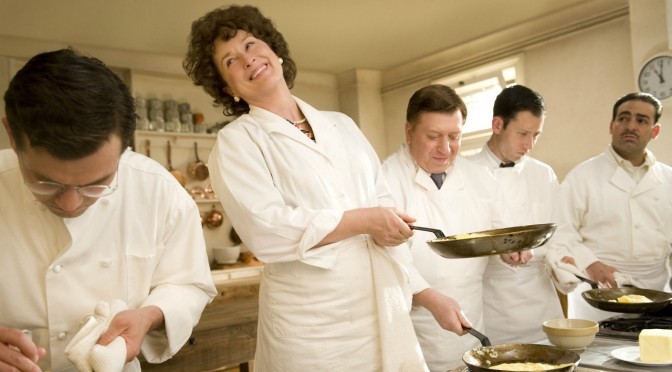
Countless words have been used in describing Meryl Streep’s talents, so I’m really not going to bother going on at length about her acting here; it’s fantastic. Better still is the interplay between her and Stanley Tucci. The relationship between Paul & Julia Child is a uniquely lovely and supporting partnership that is a delight to watch.
The main reason to see this movie isn’t the acting, though. It is the story. Two stories, really, as two women of entirely different time periods and lives strive to achieve something great. The stories are woven together by the always excellent Nora Ephron. The late Ephron both wrote and directed Julie & Julia, and it was her last film. It’s not her greatest work, but it is a nice capstone on a remarkable career. Bon appétit!
Julia Child’s story of her start in the cooking profession is intertwined with blogger Julie Powell’s 2002 challenge to cook all the recipes in Child’s first book.
Poster
Runtime
123
Tagline
Passion. Ambition. Butter. Do You Have What It Takes?
Terry Jones writes, directs & acts in one of the great non-Python comedies with Python sensibilities. Ensemble cast great; timeless classic.
Spoiler-free Movie Review of Erik the Viking:
It is the lot in life of former Monty Python members to have their works constantly compared to Python. This is not always a curse.
Terry Jones has produced some of the finest comedic work of his generation. (As well as some great non-fiction stuff; check out his BBC documentaries about the Crusades and medieval times.) Erik was his first non-Python directing job and his second non-Python screenplay (he also wrote the Jim Henson directed Labyrinth).
Erik the Viking follows along the same lines Jones explored in Holy Grail & Life of Brian, and it certainly is right in his wheelhouse, focusing on ancient myths and legends seen with his Welsh humor.
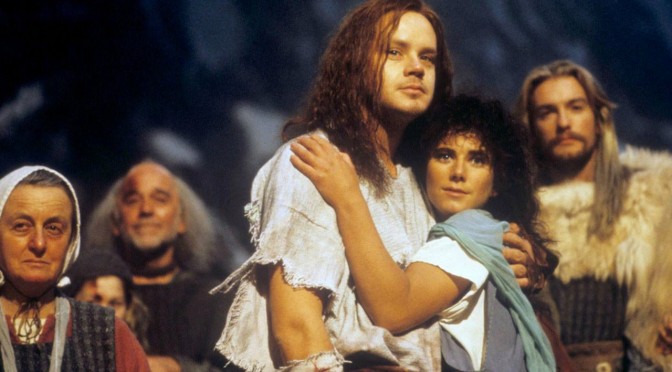
The titular hero, played by Tim Robbins (who was right in the midst of a fantastic string of comedies), is weary of the violence and cruelty of the Age of Ragnarök. He is filled with guilt over his accidental killing of a woman who had made him question the Viking rape, murder & pillage ways, and begins a quest to cross the Rainbow Bridge into Asgard and petition the gods to chase Fenrir the Wolf from the sky and release the sun. (I really didn’t need to explain the plot that fully, but I just love writing this stuff down. Fenrir! Asgard! Ragnarök!)
Accompanied by heroes like Thorfinn Skullsplitter, Ivar the Boneless, and Leif the Lucky, his quest is threatened by Loki and Halfdan the Black. (See what I mean? I just love this stuff!)
Some of the other character names:
Thorhild the Sarcastic
Ulf the Unmemorable
Thorkatla the Indiscreet
Unn-the-Thrown-At
If you’re getting the sense that this is all not taken very seriously, you’re spot on. Nor should it be. That’s not to say that there aren’t great cinematic scenes or that the story isn’t well-conceived with wonderful human moments, just that Jones knows his job well.
Tim Robbins has a standout performance as Erik. Sure, he’d soon go on to be a successful leading man in serious films, but remember that his early work was almost exclusively comedy and he is a fantastic comedic actor. Occasionally he remembers that and takes a comedic role and we are always better for it. Nicolas Cage & Tom Hulce were also approached about playing Erik, and either would have probably been great, but Robbins really makes it his role.
The acting of the ensemble cast is top shelf. John Cleese stepped in for Jack Lemmon (still can’t quite see that) and brings his usual John Cleese goodness. Mickey Rooney has a small role and Eartha Kitt (!) dazzles as Freya (“The Lady”). The rest of the cast is largely English character actors who are proof that stardom is often the least important component in good casting.
I got to know this movie through countless viewings on VHS. The film has an interesting release history; in theaters it was 107 minutes but Jones cut it down to 89 minutes for video because he thought it was too slow. Then he had his son edit it again for DVD and they tightened it to 75 minutes. Possibly the only time a director has willingly cut 30 minutes of his own footage.
Erik the Viking is second only to A Fish Called Wanda as the greatest post-Python comedies made by former Pythons. It should sit on your shelf right next to Life of Brian & Holy Grail.
Hitch’s 2nd best film is a master class in slowly building dramatic tension by letting the audience discover clues as the protagonist does.
What’s more:
I got the unexpected opportunity to see Rear Window on the big screen this week. While I’ve seen it a number of times, I had never seen it like this. No matter how great our at home systems get, there is nothing like seeing movies projected against a huge screen. Even if I one day get to build my ideal home theater, I can’t imagine that it will ever match the immersive experience that comes with entering a dark theater, turning off the outside world and being surrounded by the experience that the filmmaker intended.
Aside: Although I could do without the damn commercials. It’s a simple equation: tv is free (theoretically at least) so I have to sit through commercials – that’s my charge; I pay for movies so I don’t have to watch commercials. They’ve changed the implicit contract, something that makes me threaten to stop going to the theater every time.
Every movie gets better when it goes up on that screen on the wall, even if some movies aren’t going to be any good no matter what. When you’re seeing a classic film, something you originally saw on a tv screen, the experience is often transformative. Sometimes you notice new details that simply were lost with downsizing. Often there is a quality improvement as screenings frequently involve a restoration. But largely the grandeur and scope are simply the elements that are restored, just by virtue of commanding your scattered attention in an increasingly distracting world.
Rear Window really benefitted tremendously from a theatrical presentation. Many writers more insightful than myself have explored Hitchcock’s themes with this picture: putting the protagonist in the place of the audience and vice versa, the relationship between Jeff & Lisa being reflected in the other relationships visible through the window, etc. I won’t subject you to my own dog-eared analysis, other than the cynical observation that Hitchcock was too pragmatic of a filmmaker to waste time with all this literary nonsense – I think he just liked making crime pictures.
What is true is that watching the film theatrically really accentuated this idea of the film screen being the window pane. In all of the movie I can recall only a couple of instances of actors looking directly at the camera, and at those times it is clear that the camera is from Jeff’s POV. Watch the behavior of any of the visitors to Jeff’s apartment; they all approach the edge of the room, standing back from the enormous windows as if walking up to a wall-sized mural and trying to focus on an unreachable detail while still seeing the whole painting. The lighting is key; while never looking at you, you really feel the characters are stepping forward to better see through the screen that doubles as the window pane.
While the production is brilliantly confined like Jeff (Jimmy Stewart) to his apartment, and is staged as if it were a play, Rear Window truly is a film experience. Hitchcock tantalizes you with this panorama of interesting characters, but controls your view to the spectacle, as if someone else were in charge of moving your telescope for you. Jeff falls asleep, loses attention, fails to notice details – it’s a very human account of the story. He’s not an omniscient observer and so you cannot be.
The casting is truly inspired.
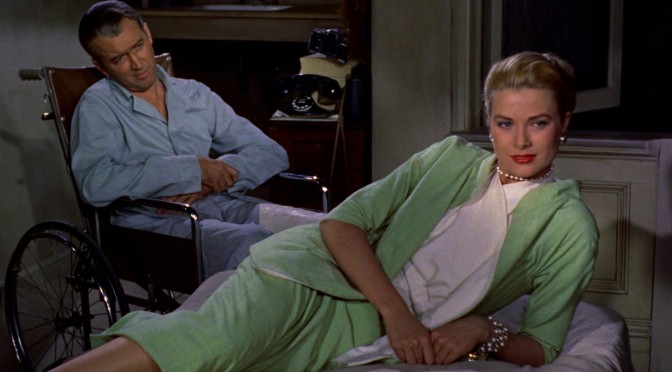
Jimmy Stewart in his 2nd of 4 Hitchcock movies provides his usual down-to-earth everyman who is so genial and Jimmy Stewarted that you don’t think he’s a creep for peeping at his neighbors all day. Which he is.
Grace Kelly. Ah, Grace Kelly. Her second and best Hitchcock film role gives her a little more edge than in Dial M for Murder. But mainly she shows inner strength as Stewart’s Girl Friday and wears Edith Head’s designed clothes as no one else before or since.
Thelma Ritter adds some comic relief, filling out the main cast.
Raymond Burr adds a bit of menace, even if he was cast mainly because he could easily be made up to look like producer David O. Selznick, whom Hitchcock disliked.
Based on the short story “It Had To Be Murder” by Cornell Woolrich, John Michael Hayes (pride of Worcester, MA) penned the screenplay, the first of four straight he did for Hitch.
The Franz Waxman score is wonderful as always, even if there really isn’t much of it. Hitch wanted all the sounds of the movie to be diegetic – the sounds of what you saw happening.
I believe Rear Window is second only to Vertigo in Hitch’s collected works. The story is grounded in reality, the tension is excellent, the dialogue wonderful and it has Grace Kelly.
Alright, that’s enough Grace Kelly pictures for you. One more? Ok. Here you are. And now you’re done…
And one more thing…
By the way, want to see something amazing? Filmmaker Jeff Desom mapped all of the shots outside the apartment window and composited them all into a panoramic time-lapse video. Shows the whole sequence of events all on one large plane. The original is about 20 minutes and is meant to be projected, but you can see a sample reel showing how it was done and the final product in a few minutes. Genius…http://www.jeffdesom.com/hitch/ (also at http://www.criticalcommons.org/Members/ccManager/clips/spatialized-timelapse-of-hitchcocks-rear-window)
Crichton adapts his novel into a screenplay, then directs this classic adventure story based on 1855 theft of gold for Crimean War soldiers.
Spoiler-free Movie Review of The Great Train Robbery:
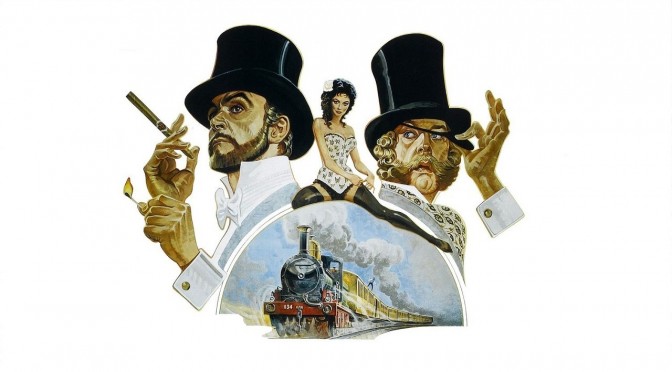
With the recent Crimean crisis, perhaps it is time to revisit The Great Train Robbery, Michael Crichton’s 1978 heist picture based on the 1855 theft of gold destined for English & French soldiers serving in the Crimean War.
A fantastic and exciting adventure, right from the start; Sean Connery’s voice-over exposition gives way to the energetic score by Jerry Goldsmith behind the title sequence and a fatal fistfight on board a moving train. You are instantly thrust into the time period and the tone of the film, and yet barely 4 minutes have passed. Michael Crichton wrote the screenplay and directed based on his own excellent novel.
The heist picture is a genre all by itself. I’m not sure exactly why so many people gravitate to these stories. I suppose like myself they are quite guiltless of any such crimes and would never seriously consider undertaking a confidence scam or robbery, yet are fascinated by those who turn their talents to these activities. There’s something wicked and thrilling about vicariously watching these illicit acts that we would not have the audacity to attempt.
So I must have read Crichton’s novel a dozen times. It’s a quick read, but like all of his works is meticulously researched. Maybe no modern writer was better at finding a searing narrative among a simple series of facts. I’m particularly fond of an audiobook version, which despite being needlessly abridged is narrated expertly by Michael Cumpsty.
With the author writing the screenplay and directing the movie the word adaptation barely applies – there’s no discernible difference between versions. One nice addition to the film is the role of Miss Miriam by Lesley-Anne Down; a minor associate in real life and in the novel, the expanded character works wonderfully as a device to tie together all of the steps of the job.
Connery & Sutherland are perfect in their turns as Edward Pierce and Robert Agar, respectively. They are simply charming and believable in their roles. One of the things that really sells the story is that Pierce has an undercurrent of danger about him. Connery plays him with an edge that makes it clear that while charm is his first weapon it is far from his only one.
Fair warning (and it’s not really a spoiler); about 15 minutes in there is a scene of a dog in a pit to attack rats. Some might find this upsetting. It’s brief, though.
One of the benefits of basing your movie on a real heist is that the plausibility of the crime doesn’t come into question. The plan is not needlessly complicated as in so many movies of this type. It is clever but practical, and the execution is filled with the sort of problems that crop up in a chaotic world.
In every respect, The Great Train Robbery is a classic adventure and a fantastic crime yarn.
[schema type=”movie” name=”The Great Train Robbery” description=”In Victorian England, a master criminal makes elaborate plans to steal a shipment of gold from a moving train.” director=”Michael Crichton” actor_1=”Sean Connery” actor_2=”Donald Sutherland” actor_3=”Lesley-Anne Down”]
It’s a gross-out stoner comedy – mileage may vary based on how much you like this sort of thing. I thought it was really funny. But gross…
What’s more:
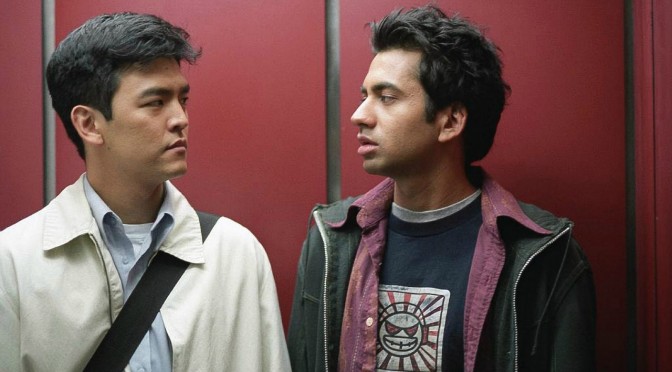
Nothing you haven’t seen before, Harold & Kumar Go To White Castle is still really damn funny and mostly works because:
John Cho & Kal Penn are really fun, likable young actors who you want to root for.
It’s a road comedy, a genre that lives and dies by how funny the wacky adventures are. These are pretty good.
Neil Patrick Harris plays an insane version of himself. This really kicked off the whole career revival for him.
Poster:
Trailer:
Bechdel Test:
Fail, although you could possibly argue that the two co-eds who engage in a game similar to Battleship qualify. I can’t get there.
The Representation Test Score: F (0 pts)
I think this may actually get 0 points, although I think you could argue for a D, as the question about racial stereotypes is a bit limiting. (“Does the film include one or more men of color, in speaking roles, who are NOT reduced to racial stereotypes?) Harold and Kumar certainly are exposed to many racial stereotypes, but I’m not sure I’d say that they are limited or reduced by them.