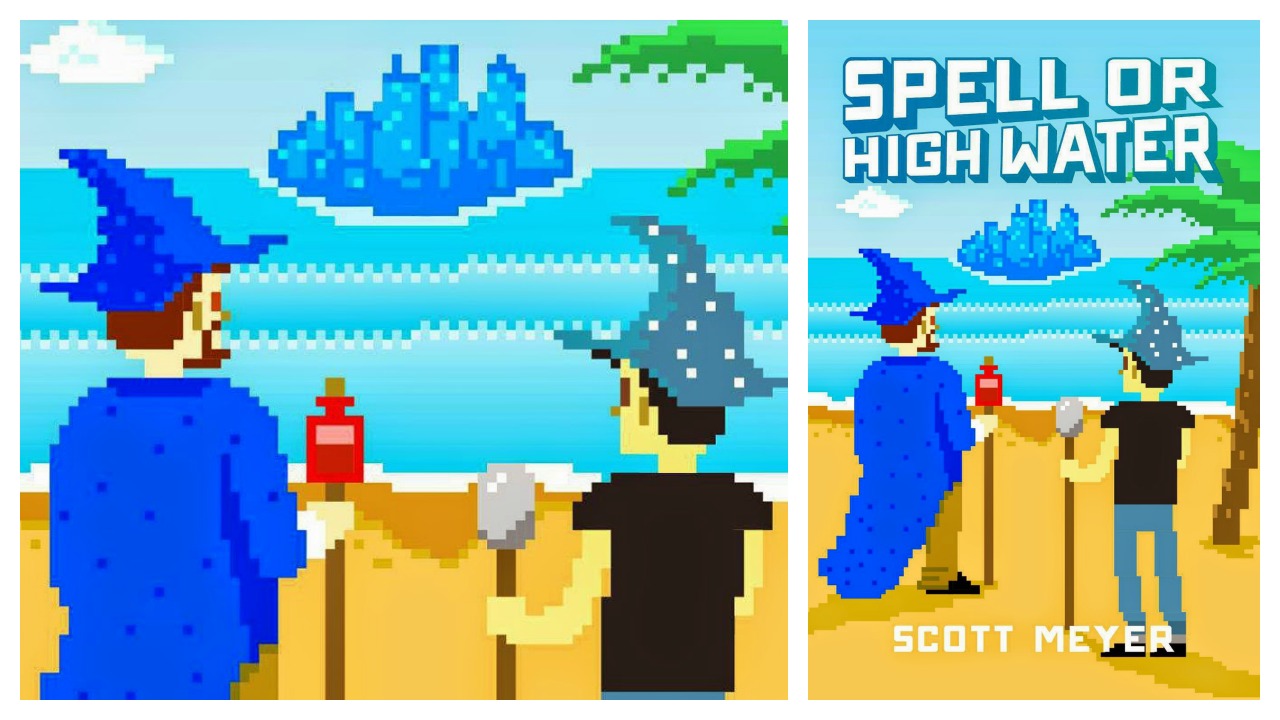
I read the first book in this series, Off to be the Wizard (Magic 2.0 #1) last summer and enjoyed it for the fun read it was. I didn’t dive right into the sequel as I planned to, because reasons. This may partly explain why it didn’t grab me immediately as the first novel did.
I think I was reading the Edgewood series by Karen McQuestion series at the same time, and while I quite enjoyed the first one, the sequels were really just more of the same. I think that’s why I haven’t reviewed those yet – I don’t really have anything positive or negative to add to the discussion and I’ve found that in the absence of anything positive that I want to discuss, my writing leans a little towards the critical side, and that’s not fair.
So I suppose I was feeling a little jaded about sequels at that point. But then, on my second approach to Spell or High Water, it stuck. I’m not sure exactly where the changeover occurred; for some time I was unenthusiastically plowing through familiar territory and in the next minute I found myself really enjoying the story.
In Spell or High Water, the characters of Off to be the Wizard take their act on the road, visiting Atlantis. Actually, it’s not really the lost city, rather a utopian construct created by new character Brit the Elder. See, her timeline split so that there are actually two versions of Brit occupying the same timeline – one who is proceeding through time semi-linearly and the other who has already experienced these events. I think it was around the introduction of this character that I put down the book for a while.
But once past that odd storyline, Spell or High Water settles into a good rhythm with the split plotlines of Martin, Gwen & Philip trying to stop Brit from being killed, and that of the formerly banished Jimmy trying to make his way back to the program. Jimmy’s scenes are actually quite funny, making this character much more enjoyable to follow than in the first book.
There’s a lot of great stuff with the man-servants of the female-run Atlantis and the seemingly pointless assassination attempts, but mainly author Scott Meyer focuses on what he does best: dialogue. This guy writes terribly funny stuff. The characters of Philip & Martin bicker like an old married couple and play well off of the third lead, Gwen, but really all of the characters get some fantastic lines. The entire complement of “wizards” are a riot, and there’s a whole lot more of them this time.
Ultimately, that is why, against all expectation, I preferred Spell or High Water to Off to be the Wizard. Both are a good time, but it was faith restoring to find a sequel that builds off of all of the good ideas from the original work while pushing forward with new ones. Recommended.
[schema type=”book” url=”http://basicinstructions.net/store/” name=”Spell or High Water – Magic 2.0 #2 (2014)” description=”The adventures of an American hacker in Medieval England continue as Martin Banks takes his next step on the journey toward mastering his reality-altering powers and fulfilling his destiny. A month has passed since Martin helped to defeat the evil programmer Jimmy, and things couldn’t be going better. Except for his love life, that is. Feeling distant and lost, Gwen has journeyed to Atlantis, a tolerant and benevolent kingdom governed by the Sorceresses, and a place known to be a safe haven to all female time-travelers. Thankfully, Martin and Philip are invited to a summit in Atlantis for all of the leaders of the time-traveler colonies, and now Martin thinks this will be a chance to try again with Gwen. Of course, this is Martin Banks we’re talking about, so murder, mystery, and high intrigue all get in the way of a guy who just wants one more shot to get the girl. The follow-up to the hilarious Off to Be the Wizard, Scott Meyer’s Spell or High Water proves that no matter what powers you have over time and space, you can’t control rotten luck.” author=”Scott Meyer” publisher=”47North” pubdate=”2014-06-17″ isbn=”1477823484″ ebook=”yes” paperback=”yes” ]
This film exists for 1 & only 1 reason: so Spielberg could have a King Kong moment with Rex on the mainland. Should have just remade Kong…
Spoiler-free Movie Review of The Lost World Jurassic Park:
Jurassic Park was a triumph in filmmaking, a great story and a dino-sized hit. This last fact is the reason Steven Spielberg insisted to making a sequel, even talking author Michael Crichton into writing another book. Which Spielberg then completely ignored…
The Lost World: Jurassic Park is possibly the all-time best example of the perils of going into pre-production without waiting for the source material.
Spielberg had dinosaurs on the brain after the smash hit that was Jurassic Park, and who can blame him? He wanted more, and guys like him don’t hear “no” a lot. Crichton knew there was no good reason for a second novel, but was swayed. One visualizes the director dressed in John Hammond’s all-white outfit, shaking his amber-tipped cane and insisting that “creation is an act of will”.
The novel The Lost World was published in September of 1995. The film adaptation escaped into theaters in May 1997. That’s barely 20 months; do you know how long it takes to make a big-budget FX picture? Hint: more than 20 months. So how do you compress all that pre-production, filming and post-production into that amount of time, not to mention the lengthy marketing timeline? Very poorly, actually…
No, I’m being glib. The real answer is that you don’t. You can’t. So you have to start pre-production before the novel is released. In actual fact, you probably start before the book is even written. Anyone spot a potential problem with that?
Jurassic Park was a great movie because it was a great story. Everything else, the FX, the music, the direction – that all just helped. Spielberg thought his movie succeeded because he knows how to make big summer blockbusters. And of course, he does. But you simply can’t take shortcuts like this, no matter how good you are.
Dismissing the offer of Joe Johnston to direct, the filmmaker proceeded with his vision for the film; he wanted to get a Tyrannosaurus Rex onto the mainland. That’s kind of it, actually. He really made this picture almost entirely because he wanted to get a dinosaur smashing stuff in San Diego. Makes me wonder if they let him film that sequence whether he might have let Johnston direct. If he wasn’t such a ball-hog and insistent on this one idea, there may have been a good film to be had. Instead, we got The Lost World.
All of the exposition I praised in Jurassic Park is missing in The Lost World; Goldblum is feverishly packing in as much dialogue in the first 10 minutes as possible as you can virtually see Spielberg ripping pages out of the novel and chucking them. Whenever a sequel goes back to the original source material and grabs everything they didn’t get around to the first time, it’s a sure sign that they’re short on material. Or in this case, that Spielberg is haphazardly grabbing anything that looks interesting as though he were a kid in a penny candy store.
The film would prove to be another massive success, but even Spielberg realized quickly that his monsterous production was all hat and no cattle. The film was so obviously barren of purpose, particularly after the critical success of Schindler’s List, that it would cause the man to reevaluate his career and he would spend the next few years and films trying to do something meaningful.
After opening with a scene from the first book, the entire premise of the film and justification for its existence are crammed into a very small amount of screen time. You could be excused for failing to grasp the plot of the picture because someone asked you to pass the popcorn – it’s that quick. If you were a little late to the theater, you’d have missed it entirely.
Not that it really matters. Much like its filmmaker, The Lost World assumes you don’t care about the why or the how, only that there’s another bunch of dinosaurs somewhere and it’s open season on humans. There’s a dinosaur escalation factor of enormous proportion – you see them early and often. The picture set new box office records at the time, so I guess the creators were right…
If this review hasn’t been negative enough, here are some other criticisms of The Lost World:
Combining the book characters of Doc Thorne and Eddie Carr into one character, played well by Richard Schiff, isn’t really a problem – except that it makes no logical sense, since they then need to introduce another member to the party. So they create activist/photographer Nick Van Owen (Vaughned into existence by Vince Vaughn). This is to support the film’s invented subplot that the team is there to document the animals in order to go public with their existence and create support for leaving the animals alone, unsupervised, on an island that they’ve provably escaped from already. And some of them can fly.
The acting…wait, no, I’m sorry, I can’t let this go. Instead of a simple plot that was already written, some combination of Spielberg, screenwriter David Koepp and the producers has stepped off the path, making changes for no particular reason, and now they have to start making up crap to get them back. This is pretty much a good summary of the problems with this film.
Product placement – this film is the first time my friend Paul brought my attention to the increasingly sinister prevalence in product placement in film. Up until then it had really escaped my notice and I sort of shrugged it off, but time has proven him more than right…
Back to the acting, or rather the casting: the main “bad guy”, InGen CEO Peter Ludlow (played with crisp English coldness by Arliss Howard) is such a stereotypical “rich jerk in a suit” it’s ridiculous. But that’s not the biggest problem. They also cast Harvey Jason as Ajay Sidhu, the longtime Indian hunting partner of Pete Postlethwaite’s African big-game hunter Roland Tembo. What’s wrong with that? Well, apart from the fact that Howard isn’t from England, Jason isn’t from India and Postlethwaite isn’t from Africa – they are all short, bald white men in a frequently dark setting. The fact that Tembo doesn’t wear glasses is the only reason I could distinguish him from the other two, who both wear thin-framed glasses. This may seem a minor point, but when a dozen or more people are running away from a dinosaur at night in the jungle, it’s more than a little difficult to tell who anyone is, particularly since they didn’t bother to give Jason’s character anything to do. Jason’s only real speaking scenes were left on the cutting room floor. At one point Tembo mentions something to Ludlow about Ajay, even using his name, and I thought “Who the hell is Ajay?”
Vince Vaughn. Just because Vince Vaughn…
The dinosaur expert that is clearly meant to be Dr. Robert Bakker. That’s not even inside baseball – it’s just dumb.
The kid. Granted, the two precocious kids in the novel have been exchanged for one precocious kid in the film, which should be addition by subtraction. And for the most part, the character of Kelly (Vanessa Lee Chester), the child of one of the former Mrs. Malcolm’s is fine and credible. But there’s a cutesy gymnastics thing going on that nearly made me walk out of the theater. It’s “I don’t like sand” bad…
And that sort of crappy humor makes up almost the entirety of the San Diego portion of the film. It really is tacked on. I’d go as far as to suggest that if the film ended with the humans safely leaving the island, The Lost World, despite all of the negatives, would be considered a pretty good film. But the superfluous fourth act that is the Kong homage is so dreadful and pads an already overlong runtime.
I actually remember when the film ended that I had to run out of the theater to use the head, having finished my dino-sized drink, not realizing the picture was going to be so long. I begged my friends not to compare notes on the movie until I got back, because I wanted the first shot at it; I wanted to rant about what the hell I just saw and didn’t want to miss a second of criticizing it…
Yikes, pal, you must really hate The Lost World, huh? Not at all – what makes you say that?
Look, we’re always hardest on the films that we expect greatness from. I really thought this was going to be an amazing film and it wasn’t. Not even close. But do I hate it? Not even remotely. Why?
Jeff Goldblum is once again great as Ian Malcolm, nearly everyone’s favorite character from Jurassic Park. I’d actually argue that people respond more to Goldblum’s portrayal of Malcolm than the character himself. I don’t think Malcolm is the hero of The Lost World film because he was the hero of the novel, I’d say that he is the hero of The Lost World novel because Goldblum made the character the star of Jurassic Park.
(However, the flipside of this is that Richard Attenborough’s portrayal of John Hammond, described by Crichton as a dark Walt Disney, is so kindly and paternal that not only couldn’t they kill him off in the first picture, they’ve turned him into a philanthropist/environmentalist/naturalist/humanitarian grandfather presence in this one. So it cuts both ways…)
Julianne Moore may have done this one strictly as a paycheck film (she’s admitted as much), but she’s too good of an actress not to stand out in anything she appears in. Dr. Sarah Harding is a good character, a unique character, and it’s just Moore’s bad luck to have so much screen time with Vince Vaughn. (Although, the character is forced to do some very out of character things, like carrying around bloody clothes and not cleaning her campsite, so maybe she earned this one…)
Postlethwaite is a tremendous talent and makes Roland more interesting than any two other characters combined.
The action set-pieces; there are some really good ones here. The sequence with the trailer being attacked by the parent Rexes is at least as good as anything in the first film. It’s a seriously long scene that just keeps upping the ante, Indiana Jones style…
The look of the picture is great; frequent Spielberg collaborator DP Janusz Kamiński has shot a few clunkers, but they always look good. Actually, the locations aren’t quite as interesting, as they opted for California instead of Hawaii or New Zealand.
The score by John Williams isn’t as iconic as Jurassic Park, but then, that’s a tough act to follow. There are still some great moments, along with the familiar cues.
While it’s brief, I really like the scenes of the abandoned facility; reminds me of the interesting parts of the novel.
Despite the rim-shot nature of a lot of the lines, there is some good humor and dialogue. “It’s so important to your future that you not finish that sentence.”
No matter how many problems The Lost World: Jurassic Park has, I can’t totally pan it. It still has good effects and John Williams and lots of dinosaurs. It coulda, shoulda been a better film, but then I suppose it could have been worse…
[schema type=”movie” url=”http://www.jurassicworld.com/” name=”The Lost World: Jurassic Park” description=”Director Steven Spielberg takes us back to the scene of Jurassic Park in The Lost World, the blockbuster sequel with even more dinosaurs, more action and more breathtaking visual effects than its record-breaking predecessor. The Lost World remains among the most successful films of all time and features an all-star cast including Jeff Goldblum, Julianne Morre and Pete Postlethwaite. It has been four years since the disaster at Jurassic Park and two groups are in a race against time that will determine the fate of the remote island’s prehistoric inhabitants.” director=”Steven Spielberg” actor_1=”Jeff Goldblum” ]
Michael Crichton never wrote a sequel to any of his novels until Steven Spielberg talked him into doing so following Jurassic Park. He never wrote another sequel after The Lost World, either. Make of that what you will…
That may sound like the buildup to a very negative review, but the truth is I mostly like The Lost World. The book, that is. The movie is crap, but we’ll get to that with the next review…
Sure, the biggest problem with the novel is that there is no pressing need for it to exist; it’s a blatant cash-in and marks probably the only opportunistic move of Crichton’s career. But The Lost World is not at all a bad tale for all of that. The main reason is that Crichton actually comes up with a creative and interesting premise.
Despite the ridiculous tagline of both the novel and the film, “Something has survived”, The Lost World is not simply a variation on a theme – a sequel being created out of the ashes of the first story that callously and simplistically tosses aside the logic of the original. Mostly…
It certainly starts that way, not only retconning Ian Malcolm back to life but rehashing the “strange animals appearing in South America” opening of the first book. Other than the obvious logical leap that Malcolm wasn’t actually killed in Jurassic Park, the structure is fairly tight.
Malcolm was an interesting character in the first book, but he has actually undergone obvious changes and growth as a result of his experience on Isla Nublar six years earlier. So Crichton introduces a new arrogant and irritating genius, Richard Levine, who possesses none of the likability or charm of Malcolm, making his parts of the novel joyless. That the character didn’t make the film adaptation is absolutely no surprise.
The conceit is simple but clever: Jurassic Park was a tourist attraction, not a serious manufacturing plant. No enterprise of this scale could possibly have presented as well as the park on Isla Nublar did (you know, before people started getting eaten). Levine and Malcolm postulate that the actual cloning and growing of the animals must have taken place at a different location. It’s certainly a better concept than I would have expected; that’s a solid, reasonable assumption, and so the existence of another South American island full of dinosaurs isn’t (totally) as ludicrous as it sounds when I repeat it. In the film, the raison d’être is mentioned in passing ten minutes into the picture in possibly the all-time worst and most rushed exposition scene of all time. But in the novel, the explanation doesn’t take place until a quarter of the way through the book, and it’s the best scene in the whole thing.
Other than that, it’s pretty straightforward. There are different wrinkles this time, newer characters and newer perils, but it’s more or less the same adventure from the first story. Malcolm even gets severely injured and delivers scholarly dissertations while doped up on morphine – again.
Other than Levine, the new characters are pretty good. Characterization isn’t Crichton’s long suit, but it’s nice to see a strong female character in Dr. Sarah Harding. Actually, the dynamic isn’t radically different from Jurassic Park – a male & female scientist as the leads, two precocious kids, a sacrificial outdoorsman and a few other characters to pad the body count.
The Lost World novel shares a somewhat unsatisfactory ending with the original Jurassic Park. There are some great set-pieces in the book, but the story doesn’t end much differently than it began, just with fewer people.
I suppose the only reason I can’t wholeheartedly recommend The Lost World is the futility of the thing. Crichton does a good job making you understand why Malcolm would willingly go back into the T-Rex’s Den, so to speak, but he’s the only person with a respectable reason. The only other character who seems to have plausible motivation is the “villain”. #WeGotDodgson
Despite the above criticisms, I rather enjoy The Lost World. It has dinosaurs, for goodness sake…
I probably sat down and read the novel once or twice, but I’ve listened to the abridged audiobook version read by Anthony Heald something on the order of 100 times. These stories are very revisitable…
[schema type=”book” url=”http://www.crichton-official.com/books-lostworld-history.html” name=”The Lost World” description=”Six years after the death of John Hammond and the mysterious destruction of his Jurassic Park island of Isla Nubla, mathematician Ian Malcolm discovers a second island off Costa Rica, where Hammond created his genetically bred dinosaurs. He travels there with a scientific research team including paleobiologist Richard Levine, Sarah Harding, and two stowaway kids, Kelly and Arby, both 11 years old. Once on the island, they find themselves on the run for their lives from some of the killer dinosaurs with whom Ian has already crossed paths, along with some new killers. The group not only has to contend with the dinosaurs, but with murderous rival scientist Lewis Dodgson and his cronies, who are out to steal the dinosaur eggs for themselves, as well. ” author=”Michael Crichton” publisher=”Alfred A. Knopf” pubdate=”1995-09-17″ isbn=”“Something has survived.” Misleading tagline for the mixed bag that is Michael Crichton’s Jurassic Park sequel novel, The Lost World (1995). Review…” ebook=”yes” paperback=”yes” hardcover=”yes” ]
Probably Michael Crichton’s most popular novel, Jurassic Park actually earns the praise, as it is a clever and entertaining read; among his best.
The author really had a gift for examining complex issues and crafting captivating tales around them. A more cynical author would see these topical issues as simply fodder for a setting; an excuse to retell the same story with a new twist and count on people interested in the current topic area as a built-in audience. In Crichton’s stories, however, the big idea is not only absolutely crucial to the story, it’s frequently the raison d’être.
So it is with Jurassic Park, in which the author examines ethical issues surrounding scientism, the impact of commercialization and profitability into the sciences, cloning, natural selection, corporate espionage and patronage. Plus it has dinosaurs!
After all, while it’s a well-researched, whip-smart study, first and foremost it’s a great story – a classic adventure in the mold of Jules Verne, Arthur Conan Doyle or Robert Louis Stevenson.
The novel actually had a long gestation period, having been started as early as 1983, while Crichton struggled to get the right story/feel. This is sort of amusing in retrospect, as he really shouldn’t have needed to look far for inspiration – he’d already written and directed a film about a high-tech amusement park turned deadly (Westworld).
If you’ve only seen the film and not read the source novel, I can highly recommend Jurassic Park. You’ll absolutely gain appreciation for the story and get more out of the picture. The film is largely faithful to the book, at least in the ways that matter – tone, intent, conclusions. But the novel understandably has much more meat on the bone, and the scientific processes and the logic behind decisions and motivations is much clearer, making what may initially seem a far-fetched tale much more credible.
The best reason to read the novel may be the following passage, which is condensed into possibly the best scene in the film, but really bears repeating in full:
“Most kinds of power require a substantial sacrifice by whoever wants the power. There is an apprenticeship, a discipline lasting many years. Whatever kind of power you want. President of the company. Black belt in karate. Spiritual guru. Whatever it is you seek, you have to put in the time, the practice, the effort. You must give up a lot to get it. It has to be very important to you. And once you have attained it, it’s your power. It can’t be given away: it resides in you. It is literally the result of your discipline.
Now what is interesting about this process is that, by the time someone has acquired the ability to kill with his bare hands, he has also matured to the point where he won’t use it unwisely. So that kind of power has a built-in control. The discipline of getting the power changes you so that you won’t abuse it.
But scientific power is like inherited wealth: attained without discipline. You read what others have done, and you take the next step. You can do it very young. You can make progress very fast.
There is no discipline lasting many decades. There is no mastery: old scientists are ignored. There is no humility before nature. There is only a get-rich-quick, make-a-name-for-yourself-fast philosophy.
Cheat, lie, falsify–it doesn’t matter. Not to you, or to your colleagues. No one will criticize you. No one has any standards. They all trying to do the same thing: to do something big, and do it fast.
And because you can stand on the shoulders of giants, you can accomplish something quickly. Yon don’t even-know exactly what you have done, but already you have reported it; patented it, and sold it. And the buyer will have even less discipline than you. The buyer simply purchases the power, like any commodity. The buyer doesn’t even conceive that any discipline might be necessary.
I’ll make it simple. A karate master does not kill people with his bare hands. He does not lose his temper and kill his wife. The person who kills is the person who has no discipline no restraint, and who has purchased his power in the form of a Saturday night special. And that is the kind of power that science fosters, and permits. And that is why you think that to build a place like this is simple.”
For the 25th anniversary of the publication of the novel, and to tie into the release of the new film Jurassic World, Brilliance Audio has released a new unabridged audiobook narrated by Scott Brick. I’ve only just started it, but Brick is a great reader and I am enjoying it very much. I’m particularly enjoying just being able to listen to the story again. We bought my dad the Random House Audiobooks version from the early 1990’s and we all listened to it a million times. This version was only released in abridged version and on audio cassette and was ably read by John Heard. Despite the short run-time of only three hours, I quite enjoyed it. While I vastly prefer unabridged audiobooks, there’s often something nice about the abridged versions – they allow you to listen to a complete (if gutted) story during the time it takes to work on a project. Which is invariably what I was doing when listening. To this day, to hear this and a few other audiobooks is to mentally reach for a screwdriver or begin sorting files…
Jurassic Park was a great read when it was published and remains a great read now. The topic was ahead of its time and inspired many to explore STEM, creating an uptick in people pursuing paleontology, chaos theory and genetics. Or at least we all found them fascinating and took a greater interest, and hey, that’s something…
[schema type=”book” name=”Jurassic Park” description=”A billionaire has created a technique to clone dinosaurs. From the DNA that his crack team of scientists extract, he is able to grow the dinosaurs in his laboratories and lock them away on an island behind electric fences, creating a sort of theme park. He asks a group of scientists from several different fields to come and view the park, but something goes terribly wrong when a worker on the island turns traitor and shuts down the power.
__
An astonishing technique for recovering and cloning dinosaur DNA has been discovered. Creatures once extinct now roam Jurassic Park, soon-to-be opened as a theme park. Until something goes wrong…and science proves a dangerous toy….” author=”Michael Crichton” publisher=”Knopf” pubdate=”1990-11-07″ isbn=”0394588169″ ebook=”yes” paperback=”yes” hardcover=”yes” ]
Near perfect example of an event movie; Spielberg isn’t the only one capable of delivering one of these, but it sometimes feels that way…
Spoiler-free Movie Review of Jurassic Park:
It would be difficult to overstate how huge this film was in the summer of 1993. Jurassic Park nicely illustrates the definition of event movie. When the film was released in the summer of 1993 it was the first time I remember standing in a massive line for a movie since Return of the Jedi. It was the first time since Batman that people insisted on going to a good theater with a big screen to see the picture.
The book is splendid and more rewarding certainly, but the film stands on its own legs quite well and even adds some touches that improve the story, particularly the characterizations of Hammond and the grandkids. For all of his considerable talents with “big ideas” plots and storytelling, character development was never Michael Crichton’s long suit. When your stories are this good, that’s not as much of a deal-killer as it normally would be…
I think I was the only person in my family who didn’t read the novel before seeing Jurassic Park. The book came out in November of 1990, at which point I was a senior in high school and likely focused on my own crap. Besides, my dad and my sister are the scientists in the family; they actually read the books that these things are based on (and which I only try to read). I’m more like my mother – I want a good story. I tried several times to get through James Gleick’s Chaos and all of the Jack Horner, Robert Bakker and Steven Jay Gould books in order to better understand the science involved, but the lack of narrative in which to frame the concepts involved always loses my interest. One of the reasons I like Crichton’s writing so much, I suppose; he had a true gift for researching dry medical, scientific or business concepts and then weaving a tale from them.
The idea for the book was so ridiculously attractive, it’s small wonder that Crichton was able to demand a huge chunk of change and points before the novel even saw release. Steven Spielberg had the inside track, since he was already developing the tv series ER with Crichton, and it’s probably for the best that he got the rights. There’s something about “dinosaur theme park” that makes you involuntarily think Spielberg. But the other teams involved included Tim Burton, Joe Dante and Richard Donner, all of whom would have been capable of great things.
The novel really is excellent. Usual Crichton blend of detailed subject matter infused with thriller-type storyline. One thing the book conveys so much better than a film is capable of is the business concepts behind this venture. Both in Jurassic Park and in the sequel novel The Lost World, the story provides a credibility to the whole dinosaur experiment. What seems like a summer-movie conceit in the films is actually more than plausible as laid out in the books. This isn’t “hey what if we had these alien robots that could turn into cars” thrill-seeking; these are serious issues scientists, venture capitalists and ethicists are dealing with right now. Far from being science fiction, Jurassic Park possesses the Jules Vernian trait of being more like premature science fact.
David Koepp reworked Crichton’s adapted screenplay into something fit for the screen, even if it did drop some of the depth in translation. The dialogue is hugely quotable, smart and funny, and the film showcases a masterful delivery of exposition; Spielberg is somewhat known for this, but I don’t think he gets enough credit. His pictures deal in big concepts to a very broad audience with a populist approach, yet a whole lot of information gets imparted in a quickly paced and usually relatively brief amount of time. At 127 minutes, Jurassic Park is a fast-moving tale that never outstays it’s welcome.
Good actors, though not given a ton to work with. First acting appearance by Richard Attenborough in years. Jeff Goldblum as Ian Malcolm, the rock star, chaotician – it’s a great film role, but the characterization makes a lot more sense if you’ve read the book. The lunch scene in the first act is the best in the film – really captures spirit of the book’s lessons and the thrust of the ethical dilemma facing scientists. And again, great delivery of exposition.
I don’t want to focus too much on the visuals, for while they are of course the main draw, it’s a mistake to think of this solely as an FX picture. The film is absolutely a master class of filmmaking legends showing their stuff. There’s a good mix of CG, miniatures and full-size animatronic models. The sound design is breathtaking, quite literally, and it’s delivered perfectly since Spielberg invested in the creation of the film sound standard DTS for the picture. The credits for Jurassic Park read like a VFX Hall of Fame roster: Dennis Muren, Stan Winston, Phil Tippett and Michael Lantieri; Gary Summers, Gary Rydstrom, Shawn Murphy, Ron Judkins and Richard Hymns. And of course who could forget the score from maestro John Williams…
Jurassic Park truly is an amazing picture. Spielberg is just so good at building suspense; movie is so suspenseful that you don’t even realize that there’s only about 20 minutes of actual dinosaur footage in the whole thing. From the fantastic opening on, you really know you are in good hands. Spielberg is really flexing his muscles here with the adventure/suspense ratio. They make great decisions, like forgoing music in the T-Rex set-piece scene; that’s a gutsy move only made by experienced filmmakers who have honed their craft to an art form.
The film could really have stopped after the 1st scene with the dinosaurs twenty minutes in, such is the power of that reveal. Even though CG has developed so much in the past few decades, these effects still stand up amazingly well, communicating the sense of awe at being alongside these creatures. That is the real triumph of Jurassic Park – not the visuals themselves but the masterful way in which the FX enable the storytelling.
[schema type=”movie” url=”http://www.jurassicworld.com/” name=”Jurassic Park” description=”During a preview tour, a theme park suffers a major power breakdown that allows its cloned dinosaur exhibits to run amok.” director=”Steven Spielberg” producer=”Kathleen Kennedy” actor_1=”Sam Neill” ]