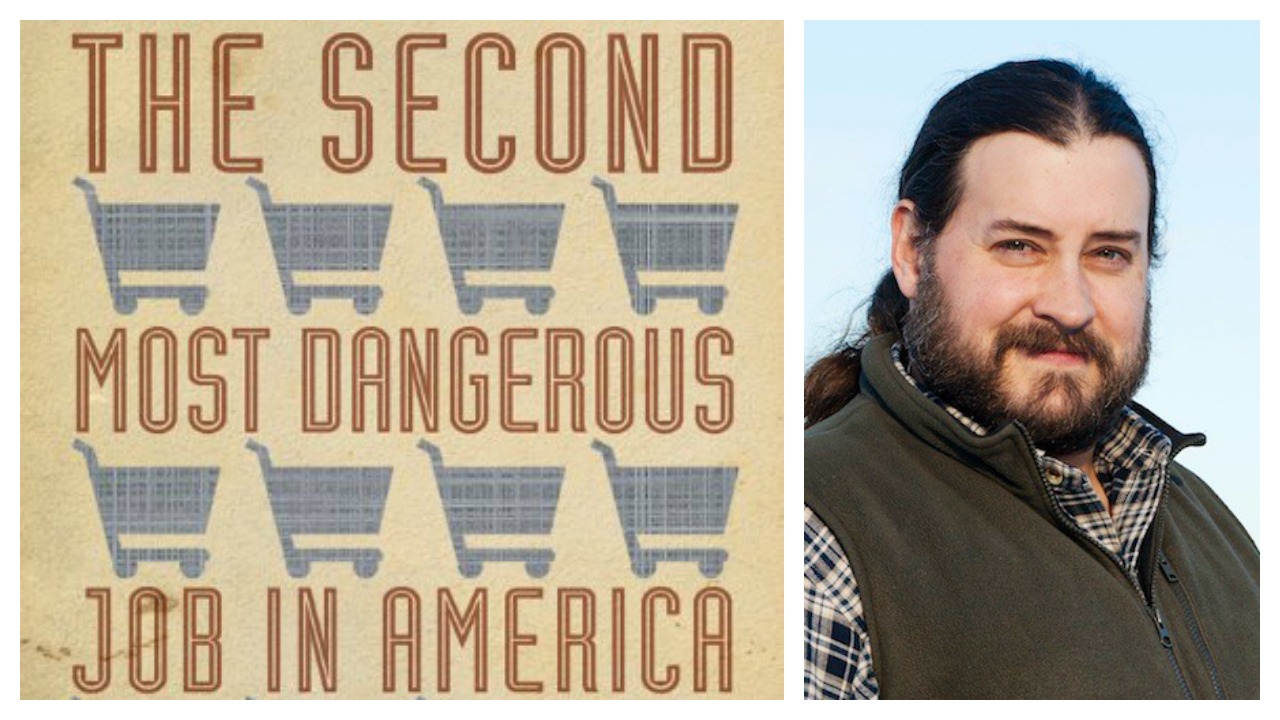
This e-book short (57 pages) from author Steve Himmer reads like some hybrid of novel and memoir, so clear and realistic are the experiences related by the protagonist. Set up in 50 short chapters that each more or less detail an individual encounter, the book is like a bunch of anecdotes told by a friend.
The Second Most Dangerous Job in America is what one assumes is a semi-autobiographical account of the odd and dispiriting experiences of an undergrad staffing the local 24-hour convenience store, working the counter in the middle of the night/morning. The unnamed main character is on summer break from college, and his chronicle of the depressing mundanity of the task will no doubt be uncomfortably familiar to anyone who’s spent time in a job they didn’t care to do or take seriously. Because, to the credit of the author, he isn’t being insulting to the work as a career choice; these are merely the way these experiences present themselves to someone punching the clock unengagingly. While he paints sometimes unflattering portraits of the night creatures that wander through this fluorescent oasis, there’s no mean-spiritedness at play here. The book is simply an account of the sort of things that can happen in the middle of the night in a small college town that has discharged all of the students for a few months.
Confused drunks, manky hookers, indie rockers and other refugees from a Tom Waits album pass through the sliding doors, depositing wisdom, loose change and random expletive-filled proclamations before vacating the store, leaving the young man alone once more. It’s really story of solitude, very much in keeping with the author’s first novel, The Bee-Loud Glade: A Novel.
The sheer banality of the repetitive interactions and quiet hours are implicit, made obvious from the weariness of the character rather than the reader having to experience first hand. The Second Most Dangerous Job in America is a marvel of efficiency; the author is able to utilize the reader’s familiarity of the the carbon copy convenience store setting and cut straight to quick musings interspersed with exchanges with the eccentric clientele.
The book is a quick read – the first time I read it I tore through it on one train ride. It’s fun to revisit, as well. There’s a familiarity to the writing not unlike the moment you step through the doors and the bell dings and you realize that no matter where you are or how long it’s been, the convenience store is always the same, forever…
[schema type=”book” url=”http://stevehimmer.com/” name=”The Second Most Dangerous Job In America” description=”The Second Most Dangerous Job In America chronicles a young man’s long, dark nights of the soul working graveyard shift in a convenience store, featuring minor celebrities, bargain brand cigarettes, and cup after cup of bad coffee. It’s a microcosmic meditation on work, self, and ambition set against a comic backdrop of mid-1990s fatalism. About the Author Steve Himmer is the author of the novels The Bee-Loud Glade, Fram, and Scratch (coming 2016). His short stories, essays, and reviews have appeared in The Millions, Ploughshares online, Post Road, Los Angeles Review, Hobart, and other anthologies and journals. He edits the webjournal Necessary Fiction teaches at Emerson College in Boston, Massachusetts.” author=”Steve Himmer” publisher=”Atticus Books” pubdate=”2012-01-13″ isbn=”984040528″ ebook=”yes” ]
Gutsy character study by Kristen Wiig, who gives her most nuanced performance yet. Story doesn’t quite fill its run-time, but not a problem.
Spoiler-free Movie Review of Welcome to Me:
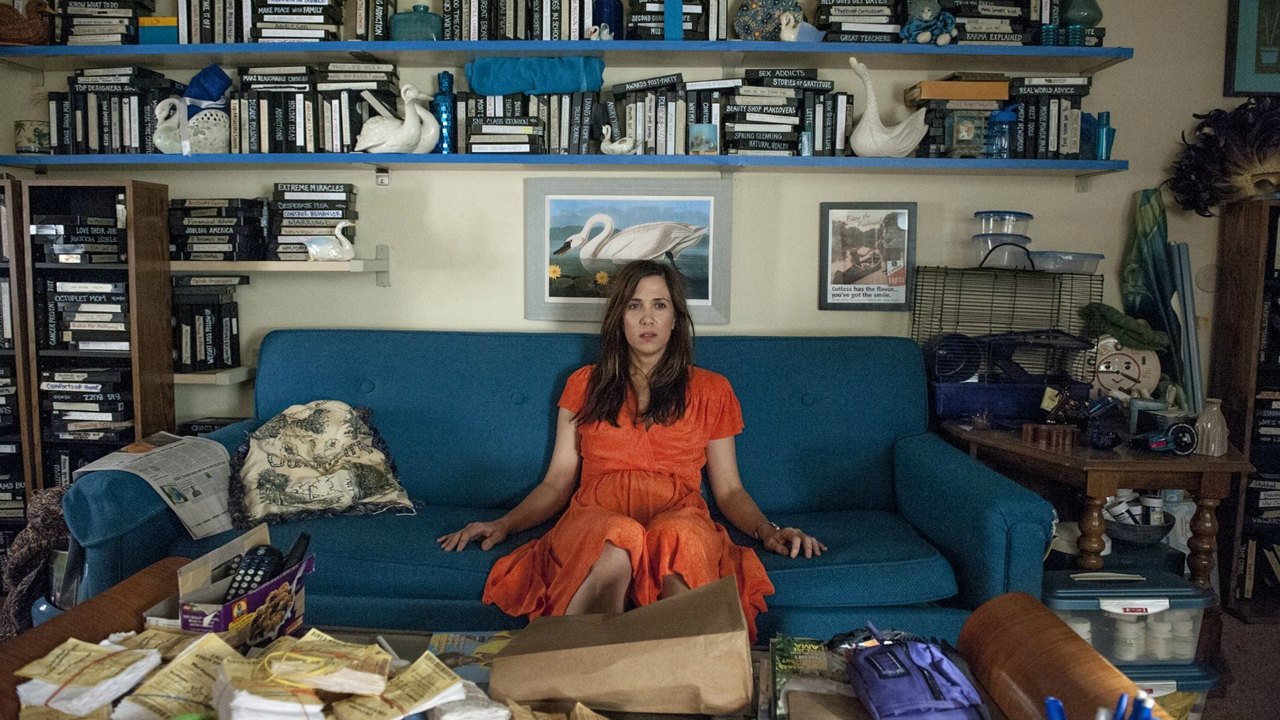
Kristen Wiig is clearly someone we’re going to have to watch very closely over the next few years. She’s always been a comic superheroine, but she has been taking on increasingly gutsy roles and just keeps upping her game.
Much as the title suggests, Welcome to Me is essentially a one-woman show, in which Wiig brings to life the complicated character Alice Klieg. Alice suffers from borderline personality disorder, a condition worsened when she stops taking her medication after winning the lottery. Alice has for years been obsessed with Oprah Winfrey, and her new found riches allow her to indulge her desire to host her own Oprah-style TV show.
This unlikely tale isn’t really that far-fetched and the subject of fame-seeking narcissists is far from virgin territory. What makes Welcome to Me unique is the low wattage of fame’s klieg lights. (The character’s name is almost certainly a nerdy screenwriting pun.) In correctly picking all of the lottery numbers, Alice has won a tremendous amount of money, $86 million, yet only courts fame after a chance opportunity to come up on stage during the filming of a low-budget infomercial. Her money can commandeer the entire struggling infomercial production company, whose principals cannot afford to veto any of her outlandish demands.
Welcome to Me distinguishes itself from other tales of lottery winners with its frank portrayal of a member of the noveau riche who isn’t being exploited by anyone. Wiig’s take on Klieg is wholly original, as is the character. Klieg isn’t seduced by the money, or letting it change her; she’s making her wealth work for her and create the opportunity to be exactly what she wants to be. It’s the people around her who have to toe the line of enabling Alice and exploiting her.
The supporting staff is marvelous, led by Rich (James Marsden) & Gabe Ruskin (Wes Bentley) as the brotherly team that own the company that becomes the launching pad for Alice’s two-hour show about herself – “Welcome to Me”. The show staff includes sympathetic director Dawn Hurley, typically well-played by Joan Cusack, and a blink-and-you’ll-miss-her Jennifer Jason Leigh as a disapproving set designer. Tim Robbins also has a great part as Alice’s therapist, Dr. Moffat. Alan Tudyk even drops by for a small but fun part.
The finest supporting part, though, is that of Alice’s best friend Gina, brought to life by the excellent Linda Cardellini. Gina isn’t swayed or jealous by her friend’s new fortune or fame; she’s eternally vigilant of her friend’s safety and best interests in what must be a very difficult friendship. Gina is a uniquely consistent character.
Because the only real trouble with Welcome to Me is that it somewhat puts you in the role of Gina, feeling protective of Alice. The movie is very entertaining and funny, but while Alice is a remarkably self-assured character in many ways, she is a troubled person, struggling with a serious disorder, and it’s not always clear if the picture is laughing with her. There’s an unsettling feeling at times that the outlandish and bizarre situations are coming at the expense of the protagonist and that we are perhaps being encouraged to laugh at the “weird” person.
It is this last uncomfortable feeling that keeps Welcome to Me from becoming something more than the amusing black comedy that it is. The writing from Eliot Laurence is smart, the direction from Shira Piven solid, but I can’t wholeheartedly recommend the film. Welcome to Me is entirely worth a watch, particularly for Kristen Wiig’s performance, but the weak third act and the sensation of unease keep it from being truly great.
Note:Welcome to Me was screened as a festival selection in the fall of 2014, before hitting extremely limited release on May 1, 2015. It is the first theatrical film to be released to library patrons via the Hoopla service at the same time as theaters. This may leave you with the impression that the studio is cutting bait. Sadly, I believe this to be exactly the case…
[schema type=”movie” url=”http://www.welcometomemovie.com/” name=”Welcome to Me” description=”A woman with borderline personality disorder (Kristen Wiig) wins the Mega-Millions and—much to the dismay of her parents, therapist, gay ex-husband and local TV station—uses the winnings to fund her lifelong dream of becoming the next Oprah.
“Alice is going to be on TV whether you like it or not.”” director=”Shira Piven” actor_1=”Kristen Wiig” ]
I don’t know what movie all those other reviewers were watching, but the one I saw was a smart, good-hearted, gorgeous family-friendly film.
Spoiler-free Movie Review of Tomorrowland:
You almost got me. I’m susceptible to buzz and hype at least as much as the next guy, and the poor reviews almost convinced me not to go see Tomorrowland. Despite all of the previews looking great, despite the guiding hand of Brad Bird, despite the intriguing premise, I nearly skipped it. Just because everyone seemed to hate it. Shame on me. I should know better.
Co-produced and co-written by Damon Lindelhof and director Brad Bird (based on a story by Lindelhof, Bird and long-time EW film critic Jeff Jensen), Tomorrowland is a science-fiction film that dares to be an original story. That may be the most revolutionary thing about it in 2015. It isn’t a sequel or a reboot (though it does have a minor tie-in/brand recognition with the Disney theme parks).
More than anything, it shares a sensibility with the dreams and ideals of Walt Disney himself. In this way it echoes the excellent and underrated 2007 CG-animated Disney film, Meet the Robinsons, and its borrowed from Walt motto “keep moving forward”.
Tomorrowland celebrates dreamers and curiosity and will probably be ridiculed for its earnestness and naivete. Oh well. There’s nothing wrong with trying hard to do something unique and inspirational. If your work comes off as cloying and saccharine, well, maybe you have a little work to do on your screenwriting. But if it simply is criticized by the jaded for well-meaning sincerity, I think you have to take that in stride.
One of the reasons I enjoyed the picture so much may be that I’d avoided learning too much about it ahead of time. The couple of teasers I saw were enough to pique my interest, but I didn’t even see the trailers that gave away too much. I didn’t even know Hugh Laurie was in the film. When compiling the assets for this review, I found trailers that included shots of practically all the twists of the picture, including one uninterrupted chase scene that was one of the films highlights. Stop giving away so much in trailers, people!
In the acting department, George Clooney is great at world-weary, so it comes across perfectly here, even if he’s a little less convincing as a former idealist. Despite the star-friendly billing, Britt Robertson as dreamer/doer Casey Newton is the real lead of the film, and she’s quite good. Most of the scenes are stolen, however, by tween actor Raffey Cassidy, who is marvelous as the mysterious Athena. Hugh Laurie is his usual wonderfully cranky self. Oh, and Keegan-Michael Key popped up, which always makes me happy!
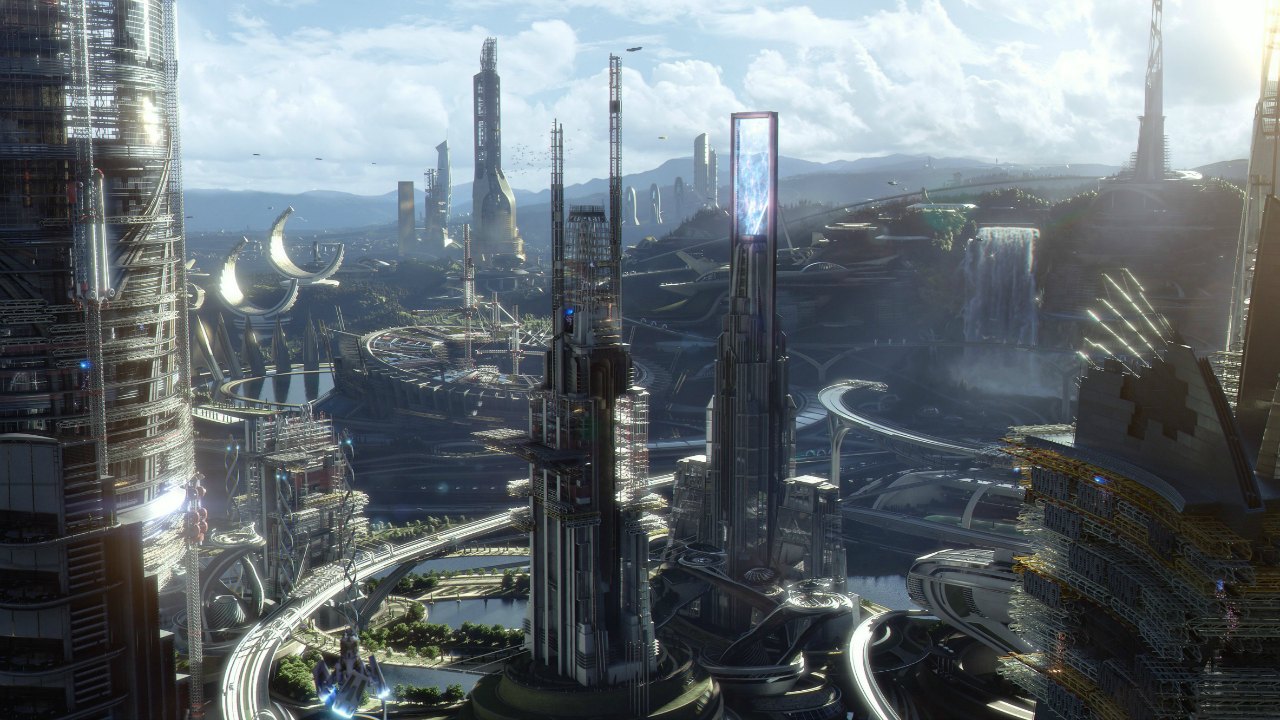
The look of the film is wonderful; both the production design (Scott Chambliss) and the cinematography (Claudio Miranda). The effects are great, even if the whole picture somewhat screams CGI. Not always a bad thing, plus I really like the futuristic designs. It’s 2015, so of course the color timing is ridiculously excessive, but everyone is guilty of that now. The music by Michael Giacchino is also lovely – the theme was in my head for the rest of the day.
Mostly, though, the story just plays. It is well-written and enjoyable, it doesn’t pander or needlessly scare kids. It is a solid PG, which is noteworthy in of itself. The film was made to watch with the whole family and to be enjoyed by all ages. Often that sounds like a curse on the lines of “may you live in interesting times”, but despite the knee-jerk reaction you may have, the phrase family-friendly is not actually supposed to equal low-quality film-making.
Tomorrowland is an excellent film. My family and I loved it without qualification. Take your kids and go see it. And if you don’t have kids, you were one once, right? Tomorrowland is an old-school adventure film in the spirit of the 1980’s. Or the 1970’s. Or any age in which kids looked to the sky and dreamed…
Update June 22, 2015:
You know, when I wrote my review of Tomorrowland, I was so focused on refuting the negative press on it that I think I may have come off as a little defensive. More importantly, I spent so much time on why it wasn’t bad, I’m not sure I adequately pointed out why it was so good. The biggest thing I missed on (somewhat ironically, considering the pro-female message I hope to impart with my little ramblings) was what a female positive film it is. I freely admit I took it for granted before reading a very well-written post by Reel Girl Margot Magowan. It was a lightbulb moment for me. The stars of the picture are two wonderfully strong, complex and detailed females who are allowed to be fully realized characters with all of the traits of complete human experience. How did I not draw attention to this point? I guess the positivity of the film got to me and I momentarily let myself believe that we live in a world where I shouldn’t have to note the atypical characterization; for once I just assumed that prominently featuring one half of the human race in a positive light shouldn’t need to be regarded as a novelty or even praiseworthy, but expected. Alas, I’m pining for Tomorrowland, too…
[schema type=”movie” url=”http://movies.disney.com/tomorrowland/” name=”Tomorrowland” description=”Bound by a shared destiny, a teen bursting with scientific curiosity and a former boy-genius inventor embark on a mission to unearth the secrets of a place somewhere in time and space that exists in their collective memory.” director=”Brad Bird” actor_1=”George Clooney” ]
Bound by a shared destiny, a teen bursting with scientific curiosity and a former boy-genius inventor embark on a mission to unearth the secrets of a place somewhere in time and space that exists in their collective memory.
Original filmmaker Miller returns to his most famous (human) character with intense, unrelenting, disturbing & completely nuts thrill ride.
Spoiler-free Movie Review of Mad Max: Fury Road:
Everyone is absolutely loving the new Mad Max film, Mad Max: Fury Road. They are right to do so. It’s a great picture.
I had serious misgivings when the project was announced. I’m weary of our reboot & rewrite first mentality to modern filmmaking. The original Mad Max trilogy was fairly brilliant. What’s more, while the pictures were great, it’s not as though they were anchored by some brilliant story that needed to be brought to a new generation. They succeeded in spite of, and possibly due to, some of the most minimalist writing of all time. These were highly successful films that deserved every bit of praise directed at them – they punched their weight and did so quite well.
A few things changed my view on the reboot, though:
Finding out that the creative team for the original pictures were behind Fury Road. This was pretty much the only reason I needed. My oft-stated aversion to reboots is nearly always absent when the reason for a new picture is the desire of the original filmmakers to revisit their own work. I completely understand and relate to a director wanting to improve upon a vision they weren’t fully able to realize earlier in their career.
While Mel Gibson was born to play Max Rockatansky with that wild-eyed crazy that worked a lot better before you realized he was playing to type, I do like me some Tom Hardy. The guy is extremely adaptable and talented.
Ultimately, though, my decision was made for me by the great buzz, most particularly from my friend Benn Robbins. Benn writes the occasional review for Forces of Geek although I’m trying to recruit him for the New Hong Kong Cavaliers. We often clash on our opinions, but in the best way possible, with total respect for each others well thought-out arguments.
I’ve never seen anyone go so totally fanboy over a picture. Saw the movie like four nights in a row. The first week. Actually before the first week. The film’s actual release date was May 15th. I saw it the morning of the 16th and homeboy had already seen it four or five times. (Must be nice having press access…) So if someone I respected was that crazy for the movie, I had to give it a real shot.
So this happened…
Somewhere between a reboot and a sequel, Fury Road features the same main character, Max Rockatansky, the same car, (1973 Ford Falcon XB GT Interceptor) and really nothing else concrete that nails this down as a sequel. But it really could be Mad Max 4. Other than the fact that he keeps having flashbacks to a little girl that presumably is meant to be his daughter, there isn’t anything in Fury Road that directly contradicts anything that’s come before. [Max’s child in the first film, Sprog (?), was male.]
Co-writer/director Miller labels the film a “revisit” as the films have no clear chronology. Perhaps it’s as some have postulated, that the Max stories are each narratives, given at different times by different people and consistency is mixed up in legends passed on by mouth. If so that’s rather clever; even if it isn’t, it’s a great idea and I’m going to accept it and leave it at that.
No matter how you classify it, Fury Road is definitely a standalone film (even if sequels are coming), requiring no prior history with the character or films. It completely retains the same feel and spirit of the original trilogy, while still having room stylistically to be updated. The production design is truly excellent.
I’m not going to spend too long on the story, as they really aren’t the main draw with these films, but following Max’s emotional arc is one of those things that muddy the water on whether this a sequel or not. He seems as distanced and broken at the outset of this picture as he is in The Road Warrior, but also comes to terms with his humanity quicker, which possibly argues that the events of Beyond Thunderdome did happen. You can argue it either way. The point is that the story is a good one.
As with all of the films, Fury Road takes place in post-apocalyptic Australia (actually, the only allusion to the films taking place after a nuclear war is in Thunderdome), where resources are scarce and life brutal. Everything depends on gasoline and water and everyone spends the entirety of their existence focused on survival. The main baddie of the film, Immortan Joe (interestingly played by the main villain, Toecutter, of the original Mad Max, Hugh Keays-Bryne) is head of his own little slice of Wasteland paradise. He has an army of scrawny, bald, white-painted War Boys, a stockpile of water and plants, a fleet of hopped up vehicles and a harem of women for breeding.
Thus is formed the main crux of the story; Joe’s top lieutenant makes off with his property (the pregnant women), and we spend 120 minutes chasing them. Max? He’s dragged along, actually chained to a car as a living blood bag after he is captured and his car taken from him…for the third consecutive movie…(this plot point could use a little work.)
So let’s get to the koala in the room – the secret feminist agenda of Mad Max: Fury Road. Seriously? Are we even having this discussion? Grow up, people…
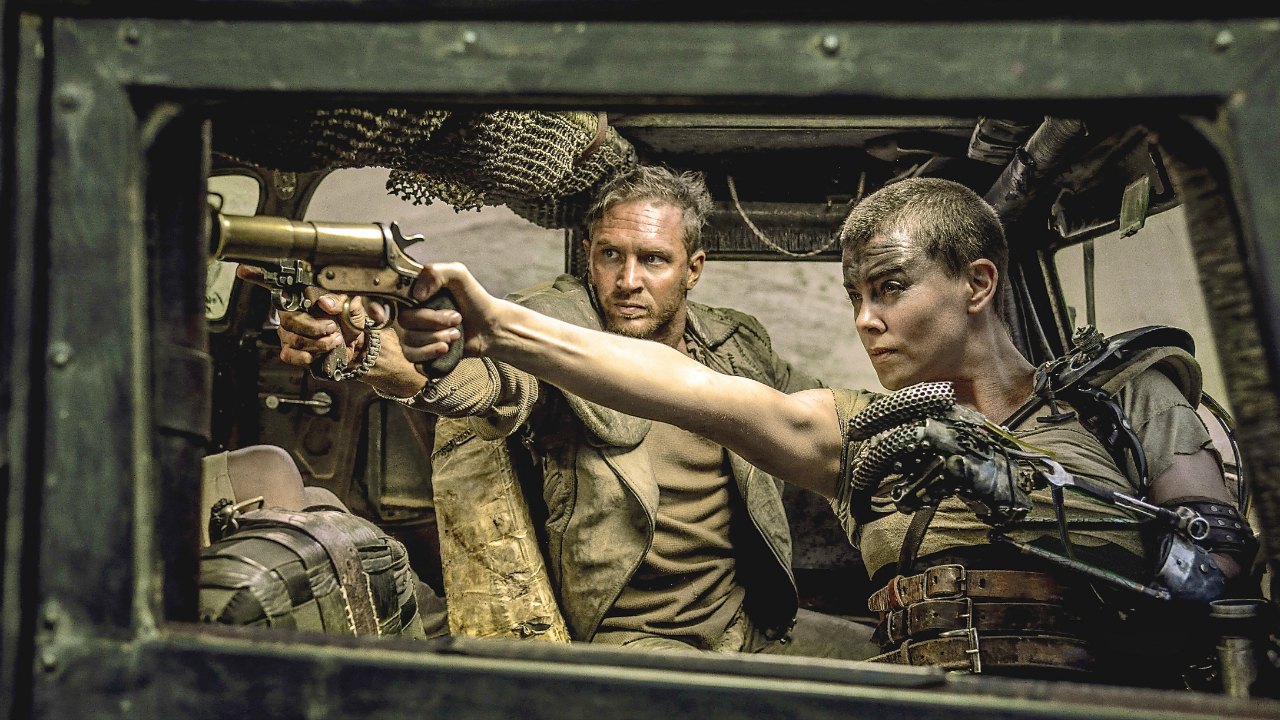
Yes, Fury Road features a seriously strong female character in the form of Imperator Furiosa (Charlize Theron) who is so integral to the story that she is arguably the main protagonist of the film. Countless articles that I’m not reading have been published about: a) how Fury Road is a secret feminist film, and/or b) how upset fanboys are about it.
Maybe I’m missing something (and if so I’m thrilled to be missing it), but I haven’t heard anyone grousing about the supposed feminist agenda of the film. I haven’t heard anyone complaining that Furiosa is a more important character than Max. Hell, I haven’t heard anyone complaining about anything – this movie is getting ridiculously good feedback.
I’d like to think this is much ado about nothing; that lazy journalists are presuming that because Miller has injected his action movie with decent representation from one half of the human race that troglodyte man-children everywhere must be enraged. Maybe some are, I don’t know. But it really seems to me as though people are trying to manufacture a controversy here. I can’t seriously imagine that there are fanboys who are anything but thrilled about Furiosa and the whole film.
Were the fanboys supposedly up in arms over Sigourney Weaver’s Ripley in the Alien films? Because every man I have EVER spoken with about Alien absolutely loves the character.
I personally love the character of Furiosa. I don’t consider her to be the main character of the film particularly, although I certainly understand the argument and don’t object. These types of movies have a history of the lead being almost secondary to the more colorful supporting characters, though; they’re “man without a name” stories for a reason. The last film, Thunderdome, isn’t really even about Max. It’s about the kids. That’s even how the story came to be. Doesn’t mean he isn’t the protagonist…
There are actually a number of strong women in Fury Road and I’m still not shutting myself in my cave in a tantrum. I don’t think other males are either. Let’s all look forward to a day when we don’t have to even talk about this stuff because representation isn’t so novel.
Besides, you certainly need some strong women in this film to counteract the over-familiar brutality to women that is always on display in these pictures. The Mad Max films aren’t misogynistic – there’s brutality enough for everyone in these pictures – but Fury Road actually shows women being bred and milked like chattel, so maybe a second coat of ass-kicking females was the correct choice here…
I’ve never seen a movie quite like Mad Max: Fury Road because they’ve never made one quite like it. The film is so over the top – it’s completely insane. I’ve never seen a movie so completely unrelenting. It’s total intensity for a solid two hours. That’s hard to do. Up until now I would have said it was impossible…
Despite the complete over-stimulating experience this sounds like – and is – I never stopped enjoying myself. Two hours is a long time, but not at this pace.
I saw the picture in 3D, which I usually consider a mixed bag. With the exception of one really pandering shot, the 3D completely enhanced the experience with this movie and never felt tacked on or gimmicky.
The look of the film is truly unique – a neat trick when making the fourth film in a series. It honestly looks very different from the other pictures, while still maintaining the same feel. Production Designer Colin Gibson has really come up with something special.
The set design is inspired – equal parts beautiful and hideous. Cinematographer John Seale came out of retirement to do this picture, and it’s amazing. Every other dystopian future picture looks like someone grabbed the color tone dial off your old TV, yanked it to the grays, broke it off and used the stump of it to scratch the camera lens. But Fury Road is vibrant, full of color. And the filming of so complicated a showcase of action scenes is remarkable.
A lot has been made of the use of so many practical effects in this picture. Reportedly 80% of the effects are in-camera or in some other way not digital. First off, nonsense. I’m not calling shenanigans, but there’s no reason to exaggerate, The overwhelming feel of the film is realistic; the effects are visceral because you’re looking at real steel road monsters crashing and burning. You don’t have to be embarrassed to admit that there’s still plenty of good old fashioned CG in here. The effects and action sequences are jaw-dropping not because they are practical, but because they are daring, inspired and well-executed. Doesn’t matter how you get there…
Mad Max: Fury Road is a fantastic action picture and great summer movie. Is it as amazing as everyone is saying? Yeah, pretty much. It’s not Earth-shattering or anything, but it does what it does very well. Go see it. And since the laws of probability suggest that you’ll see my friend there, say hi for me…
[schema type=”movie” url=”http://www.madmaxmovie.com” name=”Mad Max: Fury Road” description=”In a stark desert landscape where humanity is broken, two rebels just might be able to restore order: Max, a man of action and of few words, and Furiosa, a woman of action who is looking to make it back to her childhood homeland.” director=”George Miller” actor_1=”Tom Hardy” ]
In a stark desert landscape where humanity is broken, two rebels just might be able to restore order: Max, a man of action and of few words, and Furiosa, a woman of action who is looking to make it back to her childhood homeland.
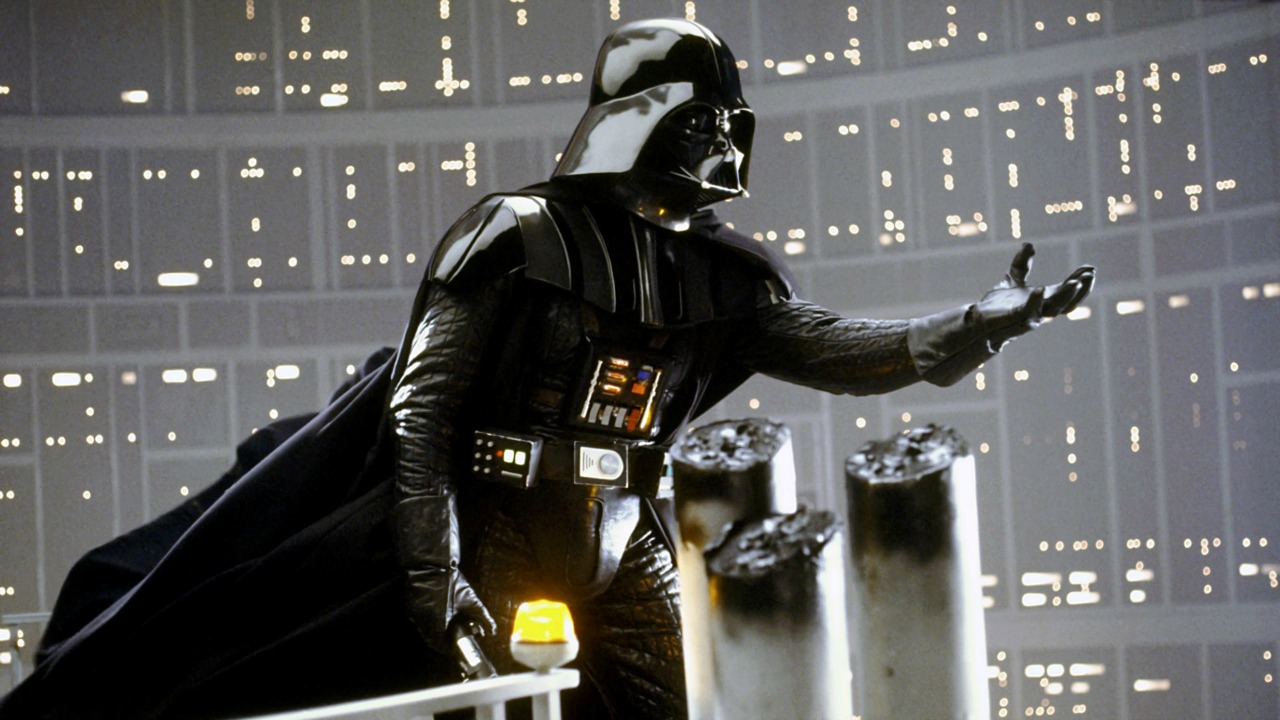
The best film sequel of all time? Easily. The best SW film? Probably. One of the greatest films of all time? Absolutely. Risky at time? Yes.
Spoiler-free Movie Review of Star Wars: Episode V – The Empire Strikes Back (1980):
With a new Star Wars film coming out later in 2015, I’m going to be writing in-depth pieces on each film, so I think I’ll leave more discussion of The Empire Strikes Back for later. For now, enjoy the 35th anniversary of Episode V and watch it for the zillionth time. A New Hope will always be my favorite Star Wars film, but it’s pretty hard to argue that Empire isn’t a better film in nearly every way.
[schema type=”movie” url=”http://www.starwars.com/films/star-wars-episode-v-the-empire-strikes-back” name=”Star Wars: Episode V – The Empire Strikes Back” description=”After the rebels have been brutally overpowered by the Empire on their newly established base, Luke Skywalker takes advanced Jedi training with Master Yoda, while his friends are pursued by Darth Vader as part of his plan to capture Luke.” director=”Irvin Kershner” producer=”Gary Kurtz” actor_1=”Mark Hamill” ]
After the rebels have been brutally overpowered by the Empire on their newly established base, Luke Skywalker takes advanced Jedi training with Master Yoda, while his friends are pursued by Darth Vader as part of his plan to capture Luke.